Sign in

Covid-19: The state of R in India

The effective R number takes into account factors relating to how the virus jumps from person to person (for instance, the basic infectivity if the virus, the probability of an actual infection during contact, and the duration of contagiousness.)

Published on: Apr 14, 2021, 08:32:56 IST
By ,
Share
Share via
  • facebook
  • twitter
  • linkedin
  • whatsapp
Copy link
  • copy link

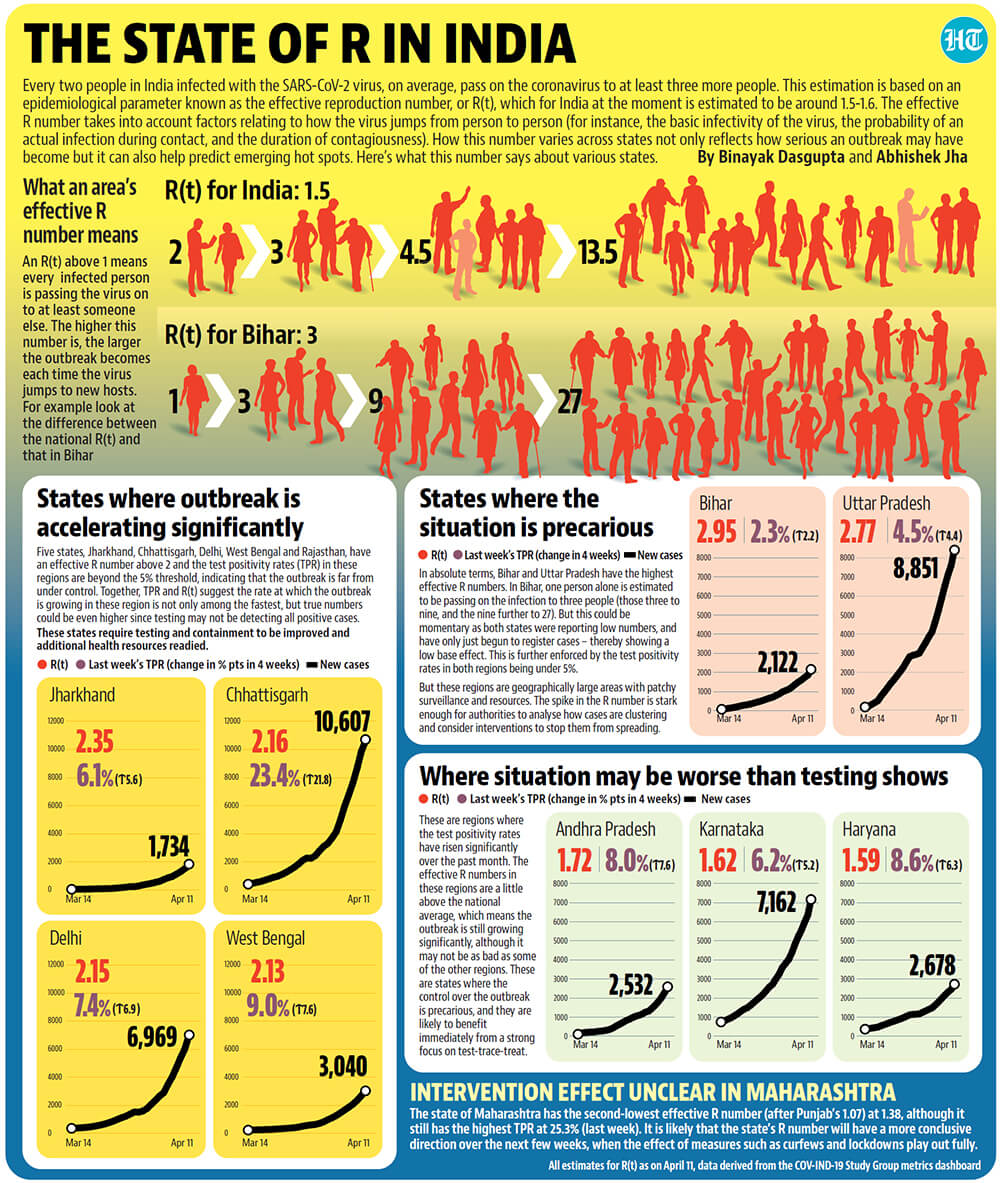
Every two people in India infected with the SARS-CoV-2 virus, on average, pass on the coronavirus (Covid-19) to at least three more people. This estimation is based on an epidemiological parameter known as the effective reproduction number, or R(t), which for India at the moment is estimated to be around 1.5-1.6.

A health worker collects a swab sample for coronavirus test, at Nizamuddin Railway Station, in New Delhi, India. (Amal KS/HT Photo)

The effective R number takes into account factors relating to how the virus jumps from person to person (for instance, the basic infectivity of the virus, the probability of an actual infection during contact, and the duration of contagiousness.) How this number varies across states not only reflects how serious an outbreak may have become but it can also help predict emerging hot spots.
  • Binayak Dasgupta
    ABOUT THE AUTHOR
    Binayak Dasgupta

    Binayak Dasgupta is a senior editor at Hindustan Times, New Delhi, where he has worked since 2013. He heads the paper's Page 1 team and is part of the editorial leadership overseeing daily news operations. He has previously led the national news desk. His work sits at the intersection of specialist depth and emerging public consequence — stories where complexity and nuance are in themselves the journalistic challenge. He shapes Hindustan Times's coverage and editorial positions on technology and artificial intelligence, information security, environment, health and science — steering these subjects from the commissioning of reporting to editing and the framing of the paper’s institutional view. His work spans analysis, commentary and reportage, and in the past, he has led the paper's coverage of Covid-19 pandemic science. His interviews and hosted sessions include Nobel laureates, technology leaders, economists and climate justice scholars. In recent months, Binayak has overseen coverage of the Air India Flight 171 crash and its investigation, India's energy exposure during the West Asia conflict, the trade dispute with the US, Delhi's air quality emergency and the evolving conversations around AI, including the IndiaAI Summit.Read More

  • Abhishek Jha
    ABOUT THE AUTHOR
    Abhishek Jha

    Abhishek Jha is Assistant Editor-Data at Hindustan Times. He uses statistical programming to generate newsworthy insights from large datasets. He is part of the team that produces Number Theory, a daily data story feature of the paper’s print edition. Since March 2024, he has been writing Weather Bee, a weekly column for the Hindustan Times website. He is a chemical engineer by training, who specialises in stories related to weather, climate, and the environment. Jha has been at HT since 2018, where he offers data-driven perspective and analysis on politics, environment, weather, climate, economy and society. His work includes data coverage of elections in India and abroad, including the 2019 and 2024 Lok Sabha elections; the disasters and extreme weather resulting from changing climate, such as floods, droughts, heat waves, cold waves, and dwindling snow cap in the Himalayas; the factors that drive poor air quality in northern India; the changing patterns of land use; the Covid-19 pandemic and its impact on labour market conditions; the changing pattern of consumer spending seen in the new consumer spending surveys; and social norms seen in the surveys such as the National Family Health Survey.Read More