
 E-Paper



Declassified White House tapes: Criticism over Richard Nixon’s racist, sexist remarks
Richard M Nixon, the late president who left the White House in disgrace, used racist and sexist language to vent his frustration with India over the 1971 War, especially Indian women, possibly triggered by his well-known antipathy towards then Prime Minister Indira Gandhi, according to recently declassified White House tapes.

 Prefer HTon Google


Richard M Nixon, the late president who left the White House in disgrace, used racist and sexist language to vent his frustration with India over the 1971 War, especially Indian women, possibly triggered by his well-known antipathy towards then Prime Minister Indira Gandhi, according to recently declassified White House tapes.
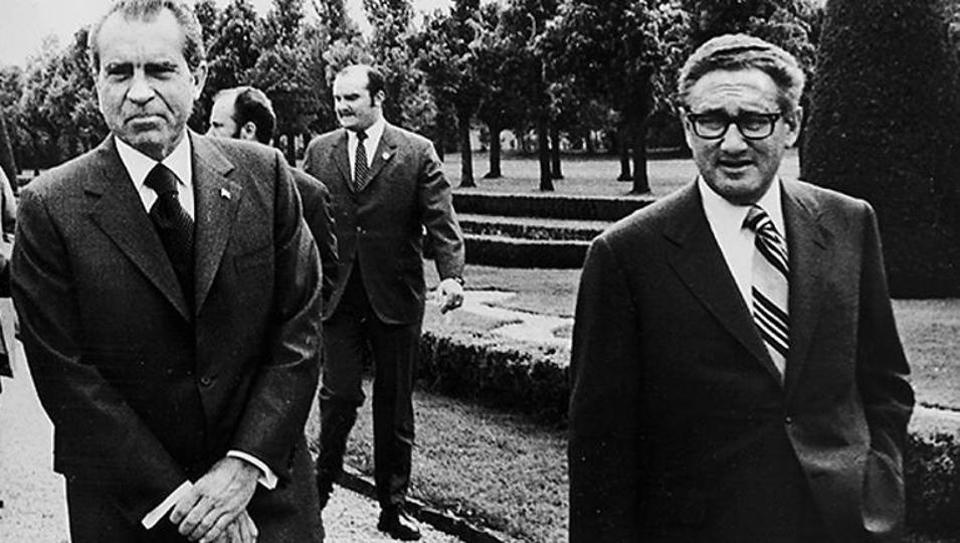
The comments have come under severe criticism from the Indian community in the US, and bodies representing them have described the statements as “appalling” but in line with Nixon’s “bigoted views”.
“Undoubtedly the most unattractive women in the world are the Indian women,” Nixon said in June 1971, adding, for emphasis, “Undoubtedly.”
He continued: “The most senseless, nothing, these people. I mean, people say, what about the Black Africans? Well, you can see something, the vitality there, I mean they have a little animal-like charm, but God, those Indians, ack, pathetic. Uch.”
The tapes show that Nixon told his National Security Adviser Henry Kissinger: “To me, they turn me off. How the hell do they turn other people on, Henry? Tell me.”
These remarks are from a fresh lot of declassified White House recordings obtained by Gary Bass, writer of “The Blood Telegram”, the seminal book about the independence of Bangladesh, and they were reported by him first for The New York Times on Thursday.
Indira Gandhi had met Nixon ahead of the 1971 war that broke out in December with India liberating Bangladesh — then East Pakistan — from Pakistan. The United States had sided with Pakistan in that war and Nixon had sent the Sixth Fleet to intimidate India.
Nixon’s antipathy for Gandhi and Indians has been reported before. He had used foul language to describe the late PM in an earlier lot of recordings declassified in 2005. He had also used insulting language for Indians, calling them “a slippery, treacherous people”.
In the recently declassified tapes, Nixon used explicitly racist and sexist comments. “They turn me off, he said for Indians. “They are repulsive and it’s just easy to be tough with them.”
On November 12, 1971, in another conversation the president said, “I don’t know how they reproduce.”
The shockingly insulting language used by the then US president for Indians is in character for Nixon.
“I was appalled when I learned about the prejudice against Indians and people of other nationalities exhibited by a former American president and his national security adviser,” said Sanjeev Joshipura, the executive director of Indiaspora, a group that works with the Indian diaspora. “We already knew about Nixon’s and Kissinger’s bigoted views, but the visceral nature of these comments does not behove American government leaders, and is extremely offensive to so many around the world! Moreover, it is disgustingly unprofessional to conduct foreign policy and global diplomacy hinging upon the base instincts of humankind.”
“Thankfully,” he added, “the tone and trajectory of US-India relations today is the polar opposite of the attitudes expressed by Nixon and Kissinger.”
There was no immediate reaction from Indian officials to the new tapes.


