E-Paper



Cycle of blockades continue while Manipuris suffer
Manipur is witnessing a protracted blockade of its two lifelines – NH2 and NH37 – but its residents, though inconvenienced, are not exactly surprised.


Manipur is witnessing a protracted blockade of its two lifelines – NH2 and NH37 – but its residents, though inconvenienced, are not exactly surprised.
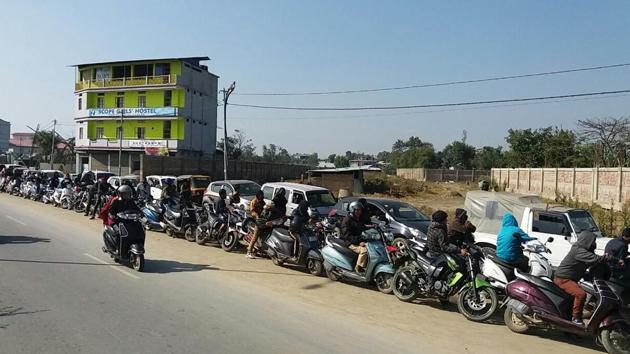
The recent history of this landlocked state tucked in the country’s northeast is lined with blockades enforced by different outfits pressing for divergent objectives. The current blockade, by members of the United Naga Council (UNC), of the two national highways that bring in essential goods from other states to Imphal would enter its 59th day on Friday.
The blockade’s toll has been huge: prices have skyrocketed as shelves in stores across the state mostly remain empty. The authorities are attempting to ease the crisis by bringing in trucks carrying essential items to the city under armed escorts, but supplies still remain at best patchy.
Yet, the UNC – the enforcers of the blockade — are far from being apologetic.
“Blockade is the most effective option to make the state government listen to our demands as all national highways to Imphal Valley pass through Naga-dominated areas,” UNC general secretary Milan Shimray told HT.
The Imphal Valley, which is home to the majority Meitei community, is surrounded by hill districts where Nagas, Kukis and other tribes reside.
In the absence of railway network, all essentials reach Imphal via the two highways. And blocking them is the easiest way for Naga and Kuki groups to put pressure on the state government or the Centre to address their demands.
Manipur-based activists say the state’s geography largely dictates the desire to impose blockades. They disrupt life and focuses attention on issues of a region thousands of miles away from New Delhi.
The view has gained further currency in the backdrop of Irom Sharmila’s 16-year hunger strike. Her valiant struggle failed in its principal aim: the repeal of the Armed Forces (Special Powers) Act, which gives extrajudicial powers to the security forces during counter-insurgency operations.
The blockades, at times, have taken somewhat bizarre dimensions.
In 2011, the Sadar Hills Districthood Demand Committee (SHDDC), an organisation of Kukis — the state’s third major ethnic community — enforced a blockade demanding the creation of a new Sadar Hills district.
The UNC, opposed to the demand, responded with a tit-for-tat blockade. The UNC blockade stretched for 122 days.
The myriad groups in Manipur have a long list of grievances and consequently, many of them have put their faith on blockades to seek redressal.
In 2005, the state witnessed a total 60 days of highway blockades. It was followed by 97 days the next year, 77 in 2007 and 53 days in 2010.
For records sake, the current blockade by the UNC is in protest against the creation of seven new districts that it says benefits the non-Naga communities.
On Wednesday, the UNC held a consultative meet at Senapati district and decided to continue the blockade till the state government rolls back the decision to create new districts.
“Our indefinite blockade will continue. And if the state government and the Centre doesn’t address our demands, we will intensify our protest in coming days,” the UNC’s Milan Shimray said.
As in the past, the current blockade is also resulting in more bad blood.
Frustrated by the scarcity of goods, some unorganised Meitei groups in Imphal Valley carried out counter-blockades, preventing movement of vehicles heading to the hill districts. Nearly 20 vehicles were torched by those opposed to UNC blockade.
“They (UNC) are holding an entire state to ransom. This time people got fed up,” said Elangbam Johnson, president of United Committee of Manipur, a civil society organisation comprising mostly Meiteis from Imphal Valley.
Non-Nagas are suspicious of UNC intent. Its blockade started close to Ningol Chakouba, the most prominent festival of Meiteis when married daughters come to their parents’ homes to have specially prepared meals.
It also coincided with Kut, the biggest annual festival of the Kukis, which marks an end to the harvest season.