E-Paper



Climate crisis may be spurring rapid intensification of cyclones: Experts
World Meteorological Organization (WMO) said on Friday that Mocha will lead to a humanitarian crisis.

 Prefer HTon Google


Very Severe Cyclone, Mocha has rapidly intensified from the status of a cyclone on May 11 midnight over central and adjoining southeast Bay of Bengal (wind speed of around 65 kmph) to a severe cyclone at 5.30pm on May 11 (winds of 93 kmph) to a very severe cyclone at 5.30 am on May 12 (winds of 120 to 138 kmph), following a recent trend that has seen rapid intensification of cyclones on account of climate crisis.
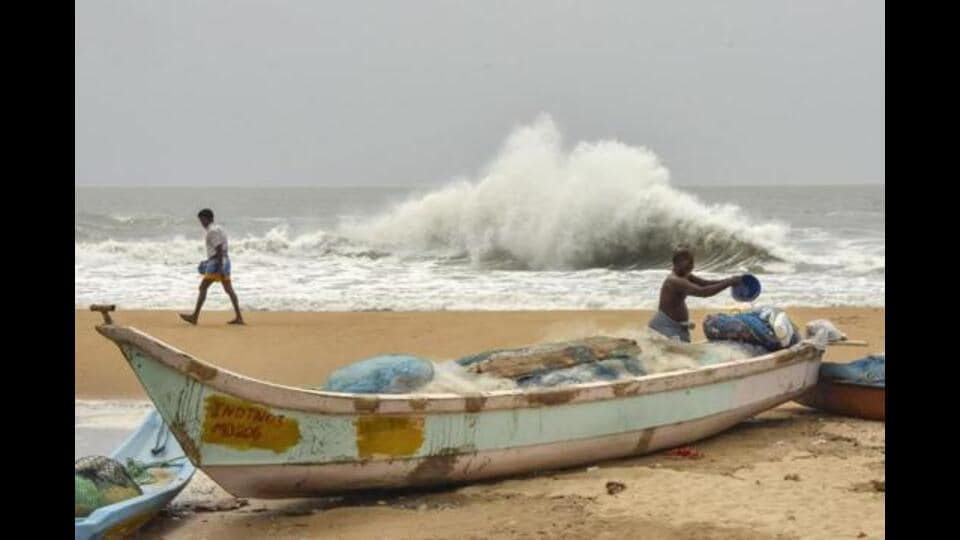
India Meteorological Department (IMD) has now forecast that Mocha will intensify further to an Extremely Severe Cyclone with wind speed of 160 to 170 kmph gusting to 185 kmph on Friday night and further winds of 180 to 190 kmph gusting to 210 kmph on Saturday.
“Cyclone Mocha intensified from 65 km/hr on 11 May to 120 km/hr on 12 May. This perfectly falls into the category of rapid intensification. If the cyclone wind speeds increase by 55 km/hr in 24 hours, we can term that as rapid intensification. In recent years, we see more of these cases, where cyclones are intensifying quite rapidly due to warm ocean conditions. Warm ocean waters provide continuous supply of heat and moisture, the energy source for cyclones to intensify. Forecast models find it difficult to simulate it,” explained Roxy Mathew Koll, climate scientist at Indian Institute of Tropical Meteorology.
World Meteorological Organization (WMO) said on Friday that Mocha will lead to a humanitarian crisis.
There will be major impacts both ahead and after landfall for potentially hundreds of thousands of the world’s most vulnerable people, WMO said.
Cox’s Bazaar is home to nearly one million Rohingya refugees - the world’s largest camp. The state of Rakhine in neighbouring Myanmar has about six million people in need of humanitarian assistance. This cyclone’s impact area both in Cox’s Bazaar and Rakhine is low-lying and highly prone to flooding, WMO added.
Super Cyclone Amphan in 2020, intensified rapidly from a cyclonic storm to a super cyclone with a wind speed of 220 to 230 km per hour in less than 48 hours. Amphan, which made landfall in the Sunderbans near the India-Bangladesh border is estimated to be the costliest tropical cyclone on record in the North Indian Ocean with economic losses amounting to about $14 billion, according to the WMO. The cyclone caused large-scale evacuation of residents of coastal areas in India and Bangladesh where 129 lives were lost in the cyclone.
Extremely Severe Cyclone, Tauktae which formed over Arabian Sea and impacted Gujarat in May 2021; extremely severe cyclone, Fani which impacted Odisha in 2019; Freddy, over the south Indian Ocean , one of the longest-lasting tropical cyclone on record which sustained for 33 days and impacted the Mozambique coast twice -- all are among recent cyclones that underwent rapid intensification.
Mocha increased its intensity by two categories (Severe and Very Severe Cyclone) or an increase in wind speed by 30 knots during a period of 24 hours which is termed as “rapid intensification,” and signifies power of the Cyclone, IMD officials said on Friday.
Conducive atmospheric and oceanic factors such as very high sea surface temperatures and low wind shear in some areas helped Mocha intensify rapidly. IMD cyclone experts expect it to intensify even further which could be devastating for the vulnerable delta regions of southeast Bangladesh and north Myanmar. IMD is the nodal agency issuing advisories on Mocha both to Bangladesh and Myanmar.
“Intensification of a cyclone depends on both ocean and atmospheric impact. There are warm and cold regions over the ocean. Warm regions pump huge moisture into the system so it gets support from the ocean to intensify. As far as atmospheric impact is concerned, when the Cyclone is far from the shear zone, or goes to a low shear zone, it has freedom to intensify. The internal structure of the cyclone if vertically aligned will try to intensify quickly. Mocha is expected to reach wind speed of 85 to 95 knots which is really the boundary with Extremely Severe Cyclonic Storm. We are now forecasting that it will become an ESCS category cyclone before becoming a very severe cyclone ahead of landfall. When a Very Severe Cyclone makes landfall there is extremely heavy rain for several hours so it’s only natural that delta regions and other low-lying areas will be flooded,” said Ananda Kumar Das, the man incharge of IMD’s cyclone monitoring division .
“We predicted the rapid intensification of Mocha. When the wind speed increases by 30 knots in 24 hours, it is rapid intensification. We are seeing this pattern in the case of Mocha and we are alerting Myanmar and Bangladesh governments ...,” said M Mohapatra, director general, IMD.
“In the last four decades, the sea surface temperature has increased by 1.4 degree Celsius in the Arabian Sea and 0.8 degree Celsius in the Bay of Bengal. Along with the sea surface temperature, ocean subsurface temperature too is rising rapidly in the north Indian ocean in last four decades. High ocean surface, subsurface temperature provides large amounts of moisture supply to the cyclone which leads to more intense, rapid intensification of cyclones. If we compare with Northwest Pacific, there the rapid intensification rate is only 22%, in Indian Ocean it is 38%,” said Vineet Kumar Singh, researcher, Typhoon Research Center, Jeju National University, South Korea.