
 E-Paper



Dakota, Biju Patnaik... and a homecoming
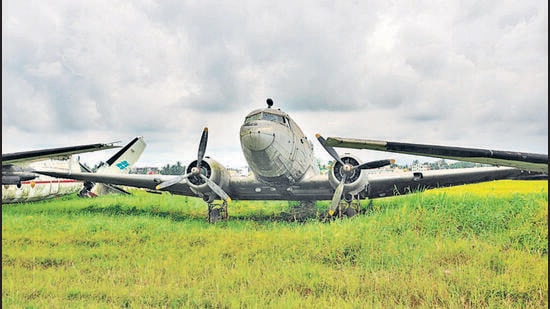
In what is perhaps the origin story of Patnaik’s political legend, on July 21, 1947, Patnaik and his wife, fellow aviator Gyanwati Patnaik, flew a fixed-wing propeller-driven aircraft – the Dakota (DC-3) VT-AUI, owned by his own company Kalinga Airlines – into a makeshift airstrip in Jakarta amid threats by Dutch that the aircraft would be shot down if it entered Indonesian airspace


In July 1947, 32-year-old Biju Patnaik, then a Congress MLA in the provincial pre-Independence Orissa assembly and a pilot with Royal Indian Air Force, received a phone call. At the other end of the line was Jawaharlal Nehru, who in a month would become the first Prime Minister of independent India, but was at the time putting the final touches to the transfer of power from the British.
Nehru had an extraordinary request. He asked Patnaik, who had in the past been involved in rescue operations in Rangoon, to evacuate Indonesian prime minister Sutan Sjahrir and vice president Mohammad Hatta from Jakarta, where they were under house arrest by Dutch and British forces.
In what is perhaps the origin story of Patnaik’s political legend, on July 21, 1947, Patnaik and his wife, fellow aviator Gyanwati Patnaik, flew a fixed-wing propeller-driven aircraft – the Dakota (DC-3) VT-AUI, owned by his own company Kalinga Airlines – into a makeshift airstrip in Jakarta amid threats by Dutch that the aircraft would be shot down if it entered Indonesian airspace. “Resurgent India does not recognise Dutch colonial sovereignty over the Indonesian people. If my aircraft is shot down, every Dutch plane flying across the Indian skies will be shot down in retaliation,” Patnaik said at the time. In a daring mission, Patnaik and his wife successfully flew the two leaders to Singapore on July 22, and then back to Delhi on July 24, where Sjahrir was met by Nehru.
Now, 75 years after that mission and 25 years after Biju Patnaik’s death, the Odisha government, led by his son Naveen, is set to bring that same Dakota (DC-3) VT-AUI aircraft back to Bhubaneswar from the Netaji Subhas international airport in Kolkata, where it has been sitting for the past seven decades. It will be commemorated and parked at the aptly named Biju Patnaik International Airport.
The mission
On August 17, 1945, Indonesia first declared freedom from the Dutch after two centuries of colonisation, with Achmed Sukarno becoming the first president of the country, and prime minister Sutan Sjahrir forming its first independent government. Historian V Suryanarayan, in his book, Together in Struggle: India and Indonesia 1945-1949, wrote that the Dutch attempted to recolonise the country after the exit of Japanese forces that temporarily occupied Indonesia during World War II.
“Indonesians rejoiced, but the Dutch still claimed sovereignty over Indonesia, and on October 1, 1945, the Dutch government announced that it would not negotiate with Sukarno over Indonesia’s independence and the next day Dutch government deployed its troops. Over next few months, the Indonesian People’s Army declared war against occupying British and Dutch troops. On July 21, 1947, Dutch forces started a police action imprisoning several leaders in Java and Kalimantan. They retook Jakarta pushing the Indonesian leaders like prime minister Sutan Sjahrir and vice-president Mohammad Hatta to the Yogyakarta region of central Java,” wrote Suryanarayan.
He added that despite still being under foreign rule, led by Nehru, India convened the Asian Relations Conference at Sapru House on New Delhi’s Barakhamba Road between March 23 and April 2, 1947, that Sjahrir attended, where he spoke of the need to endorse both the Indian and Indonesian freedom struggles.
Anil Dhir, a Bhubaneswar-based historian who has written a book on Biju Patnaik, said once Nehru found out that Sjahrir and Hatta had been in house arrest for over a fortnight, he called Patnaik and asked him to fly one of his Dakotas to rescue them. Patnaik and his 26-year-old wife Gyanwati Patnaik, who also had a commercial pilots licence, decided to fly together. “Both of them had earlier flown together before. In 1941, Biju Patnaik had evacuated British families in Yangon, and had also undertaken risky operations across the Himalayas to help Chinese revolutionaries in Chiang Kai Shek’s China. Nehru was convinced that Biju Patnaik was the man who could fly out the besieged Indonesian leaders,” said Dhir.
The 32-year-old pilot and his wife, who had given birth to their first son, Prem Patnaik, just 14 days earlier, landed on an improvised airstrip on July 21, and flew out the two Indonesian leaders the same night. “He courageously ventured into Dutch-occupied airspace and despite warning by the Dutch that he would be shot down, he flew Sjharir and Hatta to Singapore on July 22 and New Delhi on July 24,” said Dhir.
Patnaik’s daring mission helped focus global attention on Indonesia’s fight for freedom, and on December 27, 1949, the Dutch signed the Hague Agreement which formalised their freedom. A grateful Indonesia decorated Biju Patnaik with its highest civilian honour Bhumiputra in 1950.
The aircraft’s journey to Odisha
The Dakota aircraft that Patnaik used remained in operation for the next few years as one of the 18 Kalinga Airlines aircraft that operated out of Kolkata airport. When the company merged with Indian Airlines in 1953, the aircraft went out of commission, and was housed in a forgotten corner of the airport.
The matter was raised by Dhir, who wrote multiple letters to the Odisha government before 2017. “Following my letters, the state government in 2017 wrote to the Airports Authority of India (AAI) urging it to shift the plane to Bhubaneswar. AAI offered all assistance and support to the state government in procuring the aircraft, but it got stuck in red tape. Things started moving again when the state government wrote to AAI in January 2020, saying that it (the aircraft) should be displayed near Biju Patnaik’s statue outside Bhubaneswar airport. Then Covid struck and the process was stalled again,” said Dhir.
Principal secretary of the Odisha commerce and transport department, Usha Padhee, said a tender was floated last year to select a firm to disassemble, transport, reassemble, and restore the Dakota aircraft. The Bhubaneswar-based Aerospace Research & Development Centre was then chosen for the job at a cost of ₹75 lakh.
Debasish Mohanty, a senior enginer at the company that is currently dismantling the aircraft at Kolkata airport, said that the process is being led by a four-member team. “The aircraft is very old and we want to ensure that it does not suffer any damage. It will be transported by road,” he said.
He said that the aircraft, which weighs 8 tonnes, is likely to leave Kolkata by January 16. “The West Bengal Police will provide an escort from the Kolkata Airport exit gate to the state border from where Odisha Police will accompany it up to the Biju Patnaik international Airport.”
At the airport, there are preparations being made for its arrival, with 1.1 acres of land being granted by the AAI for it to be parked next to a statue of Biju Patnaik. “The Public Works department will do landscaping, plan and design the display exhibit of the Dakota Aircraft outside Terminal 1 of the airport,” she said.
Political significance
From 1947 till his death in 1997, Patnaik’s star in Odisha would only rise; he became chief minister from the Congress in 1961, and then in 1995 from the now defunct Janata Dal. After his demise in 1997, his younger son Naveen Patnaik formed the Biju Janata Dal, which has been in power in the state since 2000. “The story of his rescue (of the Indonesians) only bolstered his reputation among Odia people who looked up to him as a hero,” said Satya Prakash Dash, former professor of political science in Sambalpur University.
Cut to 2022, experts believe that with a resurgent Bharatiya Janata Party (BJP) hoping to topple the BJD, and an assembly election in a year and a half, the return of the Dakota has an element of political theatre. “In 2024, the BJD under Naveen Patnaik would be facing anti-incumbency after 24 years of rule. While Naveen Patnaik is building his own image, reminding the people of the state about the exploits of his father is a smart move,” said political analyst Rabi Das.
BJD leader Prasanna Acharya said the return of the Dakota plane is a long-overdue step. “People will be able to see the symbol of Bijubabu’s bravery. He was a hero and deserves to be celebrated.”
The BJP, however, has questioned the timing of the move. “While we are all proud of Biju babu, the whole timing is suspect, just ahead of the 2024 elections,” said BJP spokesperson Sajjan Sharma.
In Bhubaneswar, meanwhile, there is frenetic activity to prepare for a homecoming – of an aircraft that is a symbol of not just Indonesian freedom but also of Odia pride and politics.



