
 E-Paper



Defence minister Rajnath Singh boards INS Vikrant, meets Indian Navy troops in Goa
INS Vikrant, India’s 4th aircraft carrier, was built over 13 years at a cost of ₹20,000 crore. It is 262 metres long, 76% indigenous, and has 15 decks.


Defence minister Rajnath Singh met with Indian Navy personnel aboard INS Vikrant on Friday during his visit to Goa, amid heightened tensions with Pakistan.
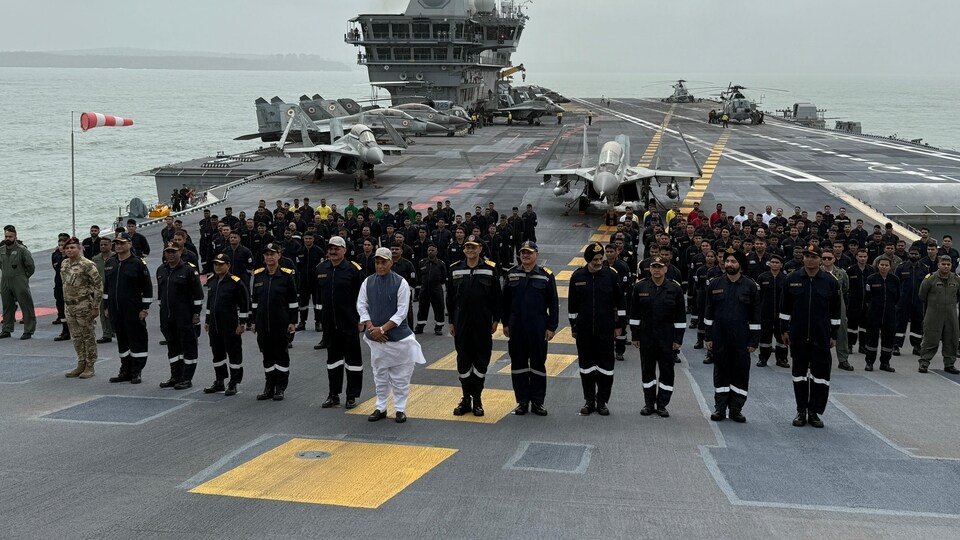
INS Vikrant is the fourth aircraft carrier operated by the Indian Navy, following the first British-origin INS Vikrant (1961–1997), INS Viraat (1987–2016), and the Russian-origin INS Vikramaditya (2013–present). The carrier is named after India’s first aircraft carrier.
Commissioned into service two years ago by Prime Minister Narendra Modi, INS Vikrant was built over 13 years at a cost of ₹20,000 crore. The 45,000-tonne vessel boasts 76% indigenous content, is 262 metres long, and includes 15 decks and 2,300 compartments.
It can carry up to 30 aircraft, accommodates a crew of 1,600, and has a range of 7,500 nautical miles, according to a previous report by Hindustan Times.
On Thursday, Rajnath Singh lauded two Indian Navy officers for overcoming significant physical and mental challenges during their journey aboard INSV Tarini, which began on October 2, 2024.
Two women officers, Lt Commander Dilna K and Lt Commander Roopa A, successfully completed a double-handed circumnavigation of the globe, anchoring at Goa’s Mormugao Port on Thursday. The feat took just over eight months.
“Yes, we made it,” said the two officers as their yacht, INSV Tarini, reached the port for the flag-in ceremony, which was attended by Rajnath Singh.
Throughout their journey, the duo covered 25,400 nautical miles (around 50,000 km), crossing four continents, three oceans, and three Great Capes, while facing extreme weather conditions.
'We could have done more': Rajnath Singh warns Pakistan
Rajnath Singh on Thursday said that India demonstrated a powerful yet restrained response to Pakistan’s provocations during Operation Sindoor, adding that while Indian forces were capable of inflicting greater damage, the government chose to showcase discipline and strategic coordination to the world.
Addressing the inaugural plenary of the Confederation of Indian Industry (CII) summit in the capital, Singh said the dual goals of national security and self-reliance, praising the role of the Make in India initiative in bolstering India's defence readiness.
“You saw how we first destroyed the terrorist hideouts and then the enemy's military bases and airbases,” Singh said. “‘Karne ko hum kuch aur bhi kar sakte the’ (We could have done even more), but we presented a great example of coordination of power and restraint to the world.”
Tensions between India and Pakistan escalated after India launched Operation Sindoor, aimed at neutralising terror camps in Pakistan following a terror attack in Pahalgam, Jammu and Kashmir.
The two nuclear-armed neighbours agreed to a ceasefire on May 10, after exchanging attacks on May 7, 8, 9, and 10.
According to a ministry of information & broadcasting press release, Operation Sindoor was a focused offensive to dismantle terror infrastructure along the Line of Control and deeper inside Pakistani territory. As part of the retaliatory action, India also struck Pakistani military installations during the four-day confrontation.
In response, Pakistan carried out drone and UCAV (unmanned combat aerial vehicle) strikes targeting Indian airbases and logistical hubs. However, these attempts were successfully thwarted by India’s multi-layered air defence system.


