E-Paper



Delhi AQI climbs to season high of 391; still no GRAP stage 3 curbs
Last December, the Supreme Court set a threshold of 350 for stricter pollution control rules to be invoked under GRAP, with Stage 4 to be invoked at 400

 Prefer HTon Google


New Delhi: Air quality in the national capital deteriorated further on Sunday morning, with the AQI climbing to 391 at 8 am — the highest this season officially and just short of entering the ‘severe’ category.
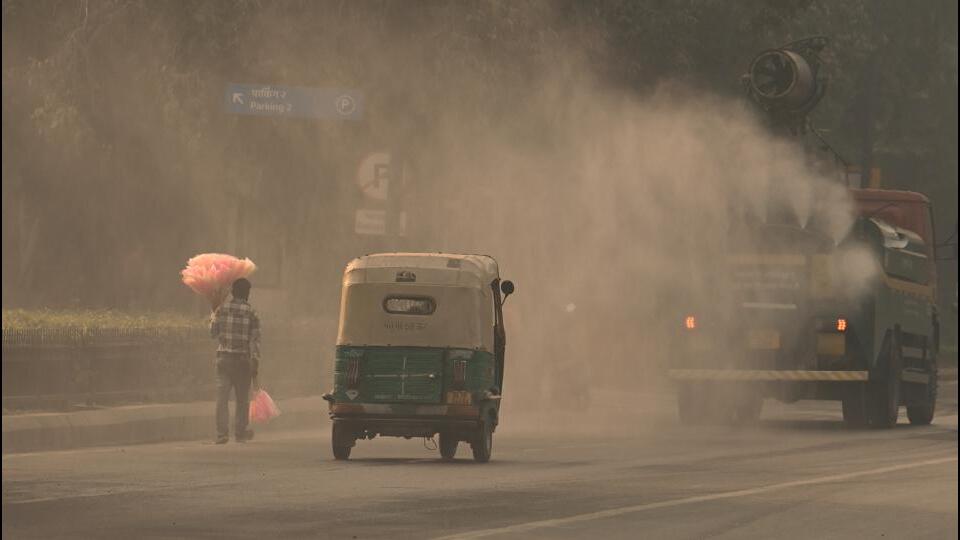
The capital has not officially recorded a ‘severe’ air day so far this year. The last such reading was on December 23, 2024, when the AQI was recorded at 406.
Though Sunday’s AQI has eclipsed this season’s peak of 388 at 10 am on November 2, the Commission for Air Quality Management (CAQM) has not invoked Stage 3 measures of the Graded Response Action Plan (GRAP).
Last December, the Supreme Court set a threshold of 350 for stricter pollution control rules to be invoked under GRAP, with Stage 4 to be invoked at 400.
The original threshold of 400 for Stage 3 of GRAP is set to be breached too.
Meanwhile, Delhi Chief Minister Rekha Gupta on Saturday advised residents to opt for carpooling, use public transport more frequently, and encouraged private institutions to give preference to work-from-home arrangements in view of the pollution.
The Delhi Pollution Control Committee (DPCC), meanwhile, held a press conference and denied allegations of faulty data and potential manipulation at stations, as it cited an improvement in AQI in the first week of November compared to 2024.
Data from the Central Pollution Control Board (CPCB)’s Sameer app showed that at 8 am, 23 out of the 39 active air quality monitoring stations were in the ‘severe’ category. The worst impacted was Rohini (435), followed by Wazirpur (434). Interestingly, even amid smog, the Netaji Subhas University of Technology (NSUT) Dwarka station showed a reading of only 200.
An AQI of 51 to 100 is classified as “satisfactory”, 101 to 200 as “moderate”, 201 to 300 as “poor”, 301 to 400 as “very poor”, and above 400 as “severe”, as per the CPCB.
GRAP’s Stage 3 brings with it a ban on private BS-3 petrol and BS-4 diesel four-wheelers in Delhi, Gurugram, Faridabad, Ghaziabad, and Gautam Buddh Nagar; blanket curbs on private construction and demolitions; and restrictions on the use of stone crushers, mining and associated activities. Further restrictions include a prohibition on non-essential diesel-operated BS-4 medium goods vehicles (MGVs), and a ban on BS-4 and lower diesel-operated light commercial vehicles registered outside Delhi, except for those carrying essential goods or providing essential services.
Schools up to Class 5 in Delhi and its neighbouring districts will also have to mandatorily shift to “hybrid” lessons, while Stage 3 also asks the Delhi and NCR state governments to stagger timings for public offices and municipal bodies in Delhi, Gurugram, Faridabad, Ghaziabad and Gautam Buddh Nagar.
Delhi, meanwhile, recorded a minimum temperature of 11.6°C on Sunday, which was three degrees below normal. This was marginally higher than Saturday’s season low of 11°C.
The impact of cold northwesterly winds is set to continue, with stubble smoke intrusion expected. The Decision Support System (DSS) has forecast a daily contribution of over 32% to Delhi’s PM2.5 levels on Sunday.