
 E-Paper



Delhi falls back into the ‘very poor’ AQI abyss, spotlight on reasons beyond farm fires
Delhi's overall AQI was at 340 at 9 am on Tuesday, Dec 2; worse than the previous day; Chandni Chowk and Vivek Vihar were in the ‘severe’ category

 Prefer HTon Google


Delhi’s pollution peaked again — firmly in the ‘very poor’ bracket on the Air Quality Index (AQI), on Tuesday, December 2 — with the last two days marking a swift return to the smog spell.
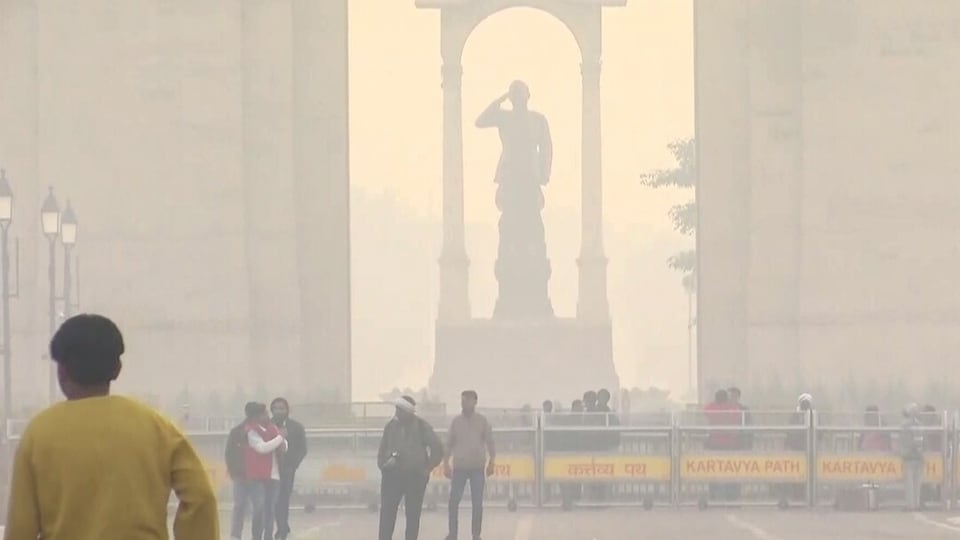
Delhi's AQI stood at 340 on Tuesday morning, up from 301 recorded at the 9 am the previous day, according to the Central Pollution Control Board's (CPCB) data. This renewed deterioration followed a brief respite experienced on Sunday, when the AQI improved, relatively, to 279 — though still 'poor'.
What is Delhi's AQI today?
- Delhi's overall AQI was at 340 at 9 am, up from Monday's 301 at the same time.
- Of the 39 stations where AQI is measured, at least two — Chandni Chowk and Vivek Vihar — were much worse than the national capital's average, in the ‘severe’ category with readings above 400, according to data from the CPCB's Sameer app.
- AQI up to 50 and 100 is ‘good’ or 'satisfactory', then 101-200 is 'moderate', while 201-300 takes it to 'poor', 301-400 'very poor', and 401-500 'severe' and worse.
- The month of November saw an average AQI of 357, in the ‘very poor’ range, and included at least three ‘severe’ days, 24 ‘very poor’ days, and three ‘poor’ days. No days were categorised as ‘good,’ ‘satisfactory,’ or ‘moderate’.
SC wants report beyond blaming farm fires
This sharp decline in air quality coincides with intense judicial scrutiny.
On Sunday, December 1, the Supreme Court, while hearing a long-running case on air pollution, questioned the persistent focus on paddy stubble burning as a primary cause of toxic air in Delhi and the National Capital Region.
The bench of Chief Justice Surya Kant and Justice Joymalya Bagchi stressed that the narrative around farm residue burning must not become "a political issue or an issue of ego”, and emphasized that the causes of pollution are multiple.
Chief Justice Kant specifically remarked: "Stubble burning was there during the Covid [pandemic of 2020-21], but why could the people still see clear blue sky?”
The court pressed the central government for immediate action on factors outside of farm-residue fires. A directive was issued, demanding a comprehensive report within a week, detailing the effective measures taken to prevent causes other than stubble burning. The bench also sought details regarding the expertise and background of the members serving on the Commission for Air Quality Management (CAQM). The matter was scheduled for December 10 next.
What are the factors beyond stubble burning?
The court's comments spotlighted the role of non-seasonal, localised pollutants in Delhi's toxic air. For instance, according to the Decision Support System of the Indian Institute of Tropical Meteorology, transport emissions accounted for 20 per cent of Delhi’s pollution on Monday, with a projected contribution of 19.8 per cent on Tuesday.
Additional Solicitor General Aishwarya Bhati, appearing for the central government, confirmed that vehicular emissions and industrial dust remain major pollutants, referring to IIT studies from 2016 and 2023. Justice Bagchi also identified construction activity as a critical contributor.
The government also informed Parliament that incidents of farm fires in Punjab and Haryana were down about 90 per cent during the 2025 paddy harvesting season compared to 2022. Environment minister Bhupender Yadav acknowledged that stubble burning is an “episodic event”, with local and regional factors driving the pollution.
Further aggravating the air quality is the tightening of winter conditions. The minimum temperature dropped to 5.7 degrees Celsius on Monday, which is 4.6 notches below the season’s normal.
As forf measures, the Commission for Air Quality Management (CAQM) revoked GRAP Stage 3 restrictions on Wednesday, November 26. The Graded Response Action Plan (GRAP) currently enforced across Delhi-NCR is Stage 2 (for ‘very poor’ air quality), along with Stage 1.


