E-Paper



Delhi flood puts Hathnikund barrage in eye of storm
AAP on Friday accused the BJP-ruled Haryana government of releasing all water from Hathinikund to Delhi, and not diverting the excess water to Uttar Pradesh

 Prefer HTon Google


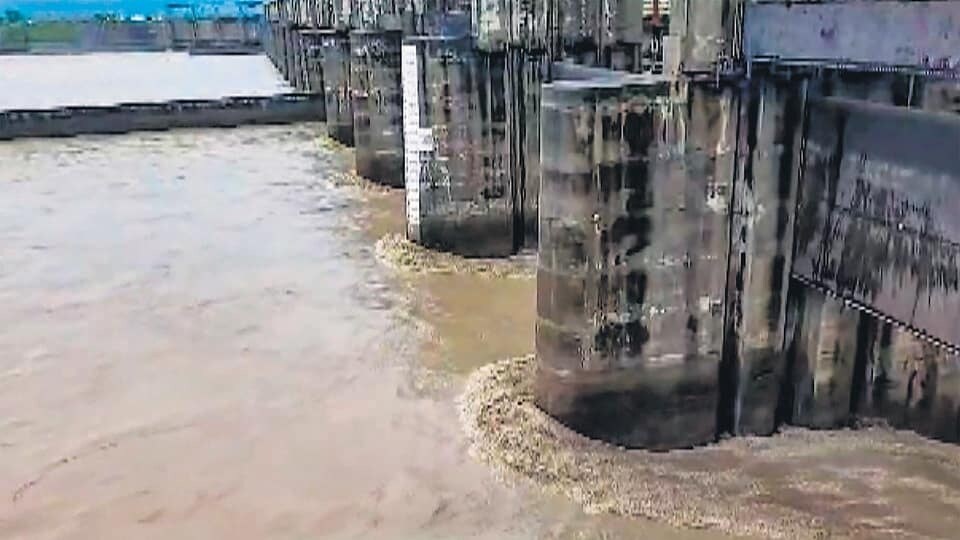
The Delhi flood has brought into sharp focus the Hathnikund barrage, upstream on the Haryana-UP border, through which the flow of water of the Yamuna is regulated, with the Aam Aadmi Party on Friday alleging it was being deliberately mismanaged to inundate the Capital.
Also read: ‘I, too, can say a lot of things but…’: Delhi L-G in front of Arvind Kejriwal over Delhi flood
How the barrage works, therefore, is important to understand.
Water regulation through Hathinikund barrage (it is not a dam, and does not have a reservoir or overflow channel) is regulated by the Upper Yamuna River Board, which has representatives of all riparian stakeholders of the river -- Himachal Pradesh, Haryana, Delhi, Uttar Pradesh, and Rajasthan – ensuring that every state gets the share of the water agreed upon on May 12, 1994.
The agreement was signed under the aegis of the then Water Resources ministry, now Jal Shakti ministry, to resolve a long-pending Yamuna water dispute between different states, and to ensure that the states get adequate water for drinking and irrigation.
A key part of the agreement was to build the Hathinikund barrage, which started in 1996, and was completed in 1998, to replace the Tajewala barrage, 3km downstream, and set up the Upper Yamuna River Board to regulate all water storage and barrages on the Yamuna till Okhla in south Delhi, in consultation with the floodplain states.
The Hathinikund barrage (HKB) regulates the flow and distributes share of water from the main stream of the Yamuna, Western Yamuna Canal (WYC) in Haryana and Eastern Yamuna Canal (EYC) in Uttar Pradesh, as per the agreement. Delhi is supposed to get 0.580 billion cubic meter of water every year from Yamuna through Hathinikund.
The barrage in the Tajewala village of Yamunanagar district, from where the Yamuna enters the plains, 172km from its point of origin in Yamunotri in Uttarakhand, ensures a minimum flow of 10 cumec (cubic meter per second) water in the main Yamuna. One cumec is equal to 35.5 cusecs (cubic feet per second).
“The barrage does not stop flow of the water on river Yamuna, it just regulates water flow as per the agreement and water sharing guidelines of the Central Water Commission. The barrage is managed by Haryana government as per the guidelines,” said a Jal Shakti ministry official.
The AAP, which rules Delhi, on Friday accused the Bharatiya Janata Party (BJP)-ruled Haryana government of releasing all water from Hathinikund to Delhi, and not diverting the excess water to Uttar Pradesh. The party said that had the excess water been diverted to Uttar Pradesh, Delhi would not have got flooded.
“Since July 10, the Haryana government has been releasing water in one direction, whereas it could have been distributed evenly in all three states. The Delhi flood is an organised plan. The BJP has purposely pushed the national capital into this situation and made people suffer because of political reasons,” said senior AAP leader and Rajya Sabha MP Sanjay Singh.
There is one key condition in the guidelines that monitor the release of water, Haryana irrigation officials said. Sandeep Kumar, executive engineer of Haryana Irrigation and Water Resources Department, said the CWC water sharing-formula is adopted when the flow of water comes down below 100,000 (1 lakh) cusecs. As per the formula, in that scenario, 15,000 cusecs is discharged into western canal and 2,000 cusecs into eastern canal and remaining flows into main Yamuna.
“If the flow of water exceeds 1 lakh cusecs, there will be no flow into the western and eastern canals and the entire water is to be discharged into the main Yamuna as two canals cannot withhold the high flow of water,” he said. This is because the higher intensity of water, measured through cusec flow, can damage the man-made canals, he added.
As the water flow at Hathinikund got reduced to 58,495 cusecs at 3pm on Friday, 10,510 cusecs was discharged into western canal, which provides drinking water to northern parts of Delhi, and there was no release of water into the eastern canal. “The UP has not demanded water as there is a breach in the eastern canal in UP and the water will be discharged when the UP government raises demand,” an official said.
When contacted, a spokesperson for AAP said: “So the Centre’s planning was always that whenever there is a natural calamity in Yamuna, the Delhi side would be overwhelmed. Even if the western and eastern Yamuna canals were made for irrigation, in the event of such a calamity why can’t it be opened? And if this all was really true, how come water started being released into both the western and eastern canals today after AAP strongly raised this issue? Did the CWC guidelines change so suddenly?”
Also read: Of late, Yamuna rises less often but levels turn more dangerous
Devender Singh, advisor (Irrigation) to Haryana chief minister, Manohar Lal Khattar, said the Hathinikund is a barrage, which regulates water flow and is not a dam, in which water can be stored. “The water discharged into the Yamuna river, for the protection of the barrage, is the water which is constantly coming from Himachal Pradesh and Uttarakhand these days due to excessive rains,” he said in a statement.
Delhi BJP chief Virendra Sachdeva dismissed AAP’s allegations. “Political leaders do not decide when and how much water will be released from any barrage or dam, but technical officers take such a call,” he said