
 E-Paper



Delhi lab starts ‘drive-through’ Covid-19 test
The central government has so far allowed about three dozen private lab chains to detect Covid-19 cases, a move experts say is important to ramp up testing to flatten the curve of the disease.


Fill out an online form, drive to the designated collection centre, display your identity proof, roll down your car window, tilt your head back to allow the collection of swab samples from your throat and nose, and leave – a person suspected to have the coronavirus disease (Covid-19) can now undergo testing in these simple steps at a private lab’s drive-through centre in west Delhi.
The central government has so far allowed about three dozen private lab chains to detect Covid-19 cases, a move experts say is important to ramp up testing to flatten the curve of the disease. The Indian Council of Medical Research (ICMR), however, allows only symptomatic people with travel history, health care workers, people with severe respiratory illnesses, and people in direct contact with confirmed cases, to be tested. Those approaching the private facilities need a doctor’s prescription under these guidelines to qualify for testing.
Click here for the complete coverage of the Covid-19 pandemic
On Monday, the Punjabi Bagh branch of Dr Dangs Lab -- one of the eight private labs approved in the city -- organised a dummy run of its drive-through facility. Interviews and interactions with suspected cases were not possible in view of privacy and safety concerns.
The process of drive-through testing begins at home, where a symptomatic person can use the lab’s website to fill out an online form with personal details, preferred date of sample collection, details of the doctor recommending the test, and clinical symptoms. The person also needs to submit the registration number, make and colour of the car they intend to use.
Once the appointment is booked and online payment made, the lab makes a confirmation call and sends an e-mail with the details of the process.
The facility is set up along a 100-foot stretch of the street outside the lab located in Punjabi Bagh’s West Central Market. The entry and exit points are controlled by iron chains manned by security guards. Multiple signs are fixed along this stretch to guide the suspected patients through the process.
When the car arrived at the centre for the dummy run on Monday, a guard tallied the driver’s identity and registration plate with the form submitted online. The car’s parking lights had to be switched on – these instructions are e-mailed after the booking. While the guard lowered the iron chain to let the car through, a sanitation worker in a coverall sprayed the path with disinfectant. No words were exchanged.
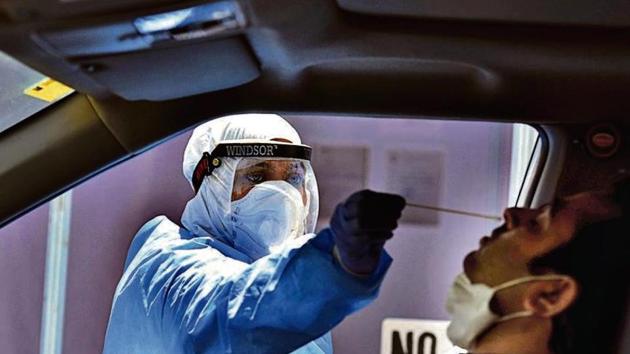
The car drove into a 15ft × 6ft rectangular painted patch, while a technician – wearing personal protective equipment (PPE) – approached the driver with a placard that instructed him to lower the window, tilt his head back, and allow the collection of swab samples from his throat and nose.
The technician tore out a swab from a packet, collected a sample from the nose for about five seconds, and placed the swab in a cylindrical container. The process was repeated with the throat.
The dummy patient rolled up the car’s window, as the guard lowered the iron chain to allow him to drive away. The sample collection process took less than five minutes.
Another technician then wrapped the samples with cotton gauze, placed them in a larger cylindrical plastic container, which was stored in a thermocol box padded with ice packs. This process took another five minutes.
Not more than two people are allowed to occupy a car at the time of testing. If the car driver is not the patient, he or she must sit on the right side of the rear seat to facilitate the collection of swab samples. Patients receive their results through email and phone within 36 hours. The cost of the test is ~4,500.
To be sure, since the collection centre ran a mock collection process, an actual test was not performed for the purpose of this news report.
Arjun Dang, chief executive officer of Dr Dangs Lab, said that the drive-through facility was looking at serving 25-35 patients per day, with 20 minutes assigned to each patient. “It will operate from 8.30am to 4.30pm, but we may increase the timing if the demand increases,” he said, adding that about a dozen people had registered for the tests since appointments opened late Sunday afternoon.
Zoya Brar, CEO and founder, CORE Diagnostics, a private lab that has ICMR approval, said: “I appreciate that Dr Dangs has replicated what has been done in South Korea and other places to expand testing. On our end, we are focused on providing home collection since that is the lowest exposure for the patient to the outside world. We do this by default for all cases.”
While one other private lab chain said they were assessing the process to begin a similar testing procedure, another lab did not comment on the matter. A third lab said it had no immediate plans of starting a drive-through testing facility.
Public health experts say that wide and aggressive testing along with social distancing is the only way to control the outbreak of the new disease. A massive testing effort, largely by drive-through centres, has been touted as a major reason why South Korea has been able to slow the spread of the highly contagious disease, which has killed at least 71,000 people worldwide.
At one point in March, South Korea had the second largest outbreak after China, but the country has since managed to flatten the curve of the infections. After an initial delay, the US has also begun wide drive-through testing to control the pathogen that has infected over 330,000 people in the country.


