E-Paper



IGI airport waterlogged, passengers drag luggage through: Monsoon fury chokes Delhi ahead of BRICS
The Brics Summit will be held on September 12 and 13, with delegations from 11 countries expected to fly into the Capital beginning next week.

 Prefer HTon Google


Eight days before the Capital hosts world leaders for the Brics Summit, a sudden downpour on Friday afternoon left parts of the Indira Gandhi International Airport (IGIA) waterlogged, forcing passengers to wade through ankle-deep water at terminal forecourts and approach roads, while flight operations were disrupted and several planes diverted.
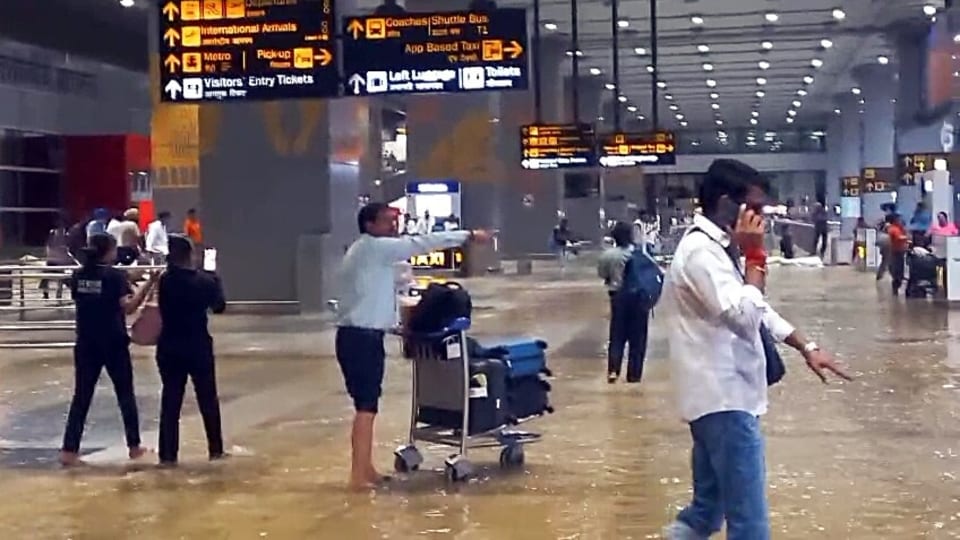
Passengers at the airport were seen rolling up their trousers and dragging luggage through accumulated water to reach the terminal. At some places, vehicles moved slowly through the waterlogged approach roads. The water accumulation was reported around Terminals 2 and 3, with airport officials later clearing the water.
The airport operator, Delhi International Airport Ltd (DIAL), said heavy rainfall resulted in water accumulation. “The accumulated water was cleared within some time,” DIAL said.
Questions on basic airport provisions rise ahead of BRICS summit
Friday’s spectacle raises the question of whether an operator that has rebuilt one terminal, is planning a new pier at another and is finalising a blueprint to carry 140 million passengers a year has given the same attention to basic measures, such as being able to withstand the annual monsoon rains.
The Brics Summit will be held on September 12 and 13, with delegations from 11 countries expected to fly into the Capital beginning next week.
IGIA has been under near-continuous construction for close to a decade. Terminal 1 was rebuilt under the Phase 3A expansion, announced in 2019 at ₹9,800 crore, which took the terminal from 55,740 sqm to 206,950 sqm and folded all Terminal 2 flights into it when it resumed full operations on April, 2025. The airport is the only one in the country able to handle more than 100 million passengers a year, and DIAL is finalising a master plan for 2026-2036 that would raise that to 140 million, add a new pier at Terminal 3 and build an elevated air train linking the three terminals.
A passenger, Mansi Sharma, said that she had been waiting for nearly half an hour for the water level to recede before she could make her way towards the arrival gates. “I’ve never seen anything like this; there is so much water,” she said.
Another passenger, Prabhash K, said he had witnessed a similar situation at the airport around two years ago.
Rain has exposed the built environment at the airport before. On June 28, 2024, a portion of the canopy over Terminal 1’s old departure forecourt collapsed, killing a taxi driver who was crushed in his car by a fallen iron beam and injuring at least four others. Departures from the terminal were suspended.
DIAL officials did not respond to requests from HT on the specific gaps that caused water to accumulate on Friday, especially at a time when the city is preparing for a host of VIP arrivals.
Friday’s downpour also affected flight operations. At least 11 flights were diverted between 3.30pm and 7pm, with five flights diverted to Jaipur, four to Lucknow and one each to Ahmedabad and Chandigarh, according to an airport official. More than 400 flights were delayed at Delhi airport on Friday, according to flight-tracking data.
At the airport, an airport worker, Govinda Pandey, said he had not seen water accumulate like this during his three years at the airport and suggested that a blocked sewer could possibly be responsible.
Strong winds, heavy rain bash Delhi
The weather system brought strong winds along with the rain. Squally winds of up to around 76 kmph were reported at the airport area during the afternoon, further affecting conditions around the terminal.
Palam, the weather station closest to the airport complex, recorded the city’s heaviest rainfall on Friday. Between 8.30am and 8.30pm, Palam recorded 74.8mm, followed by Narayana at 56mm, Janakpuri at 53mm and Lodhi Road at 34.6mm. Safdarjung, Delhi’s representative weather station, recorded 35.2mm during the same period. Pusa recorded 30mm and Jharoda Kalan 29mm.
Also Read I Beach view, Venice and a GDP dig: Opposition takes swipe at Centre over waterlogging at Delhi airport
Waterlogging also returned to several stretches across the Capital, where a host of other agencies too have been racing to prepare the city for next weekend’s summit. Flooded roads were seen in Mahipalpur, Connaught Place and around Subroto Park, with vehicles moving through waterlogged stretches. In Mahipalpur, children played in knee-deep accumulated rainwater, while in Connaught Place vehicles struggled through submerged roads. Near Subroto Park, water was seen cascading onto vehicles from a flyover.
“Delhi calls itself the National Capital, yet this is what residents are forced to navigate after rain. Complaints are made, photos are shared, authorities are tagged but still no action. How long will ‘zero accountability’ be the system?” said Rashmi Nanda, a resident of Malviya Nagar.
The rain also brought back familiar problems. A tree fell near Geetanjali Red Light on the road from Malviya Nagar Metro Station towards PTS, completely blocking the carriageway. Delhi Traffic Police advised commuters to avoid the stretch and use MB Road as an alternative while personnel worked to remove the tree. Another fallen tree obstructed the loop road from Akshardham towards ITO for an hour.
IMD weighs in
Meteorologists attributed the spell to the monsoon trough. “A well-built, low-pressure area was present over southwest Uttar Pradesh, and the trough was moving towards the same region, while moving through Haryana, Punjab, and Delhi. On Saturday, as the trough moves further north, Delhi may see even heavier rain,” said Mahesh Palawat, vice-president of Skymet Weather.
Palawat said dry westerly winds were likely to begin affecting Delhi from Sunday, with only light rain possible thereafter.
The IMD had earlier escalated its warning for Delhi to a red alert amid forecasts of intense rain, thunderstorms and gusty winds. By Friday evening, a yellow alert was in place for Saturday, with the weather department forecasting spells of light to moderate rain accompanied by thunderstorms or lightning at many places.
Also Read I IMD red alert in Delhi for heavy rain; severe waterlogging at IGI Airport
Gurugram police also issued an advisory asking people to use alternative routes as waterlogging around Shiv Murti in Delhi near the Gurugram border led to increased traffic pressure.
The one respite for commuters was that Friday was a public holiday for Janmashtami, which kept traffic volumes lower than a regular working day. Despite waterlogging at several locations, many major roads remained comparatively clear, limiting the extent of traffic disruption that might otherwise have followed the downpour.