
 E-Paper



Delhi sees hottest Republic Day in 8 years, temperatures to rise further | Why is city so warm in Jan?
The warmest Republic Day in Delhi before this one was in 2017 when the city had recorded a maximum temperature of 26.1 degrees Celsius.

 Prefer HTon Google


It was the warmest Republic Day for Delhi in eight years on Sunday, January 26, with the maximum temperature settling at 23.7 degrees Celsius, two notches above normal as per the India Meteorological Department (IMD), which has forecast that mercury is expected to rise further in the city.
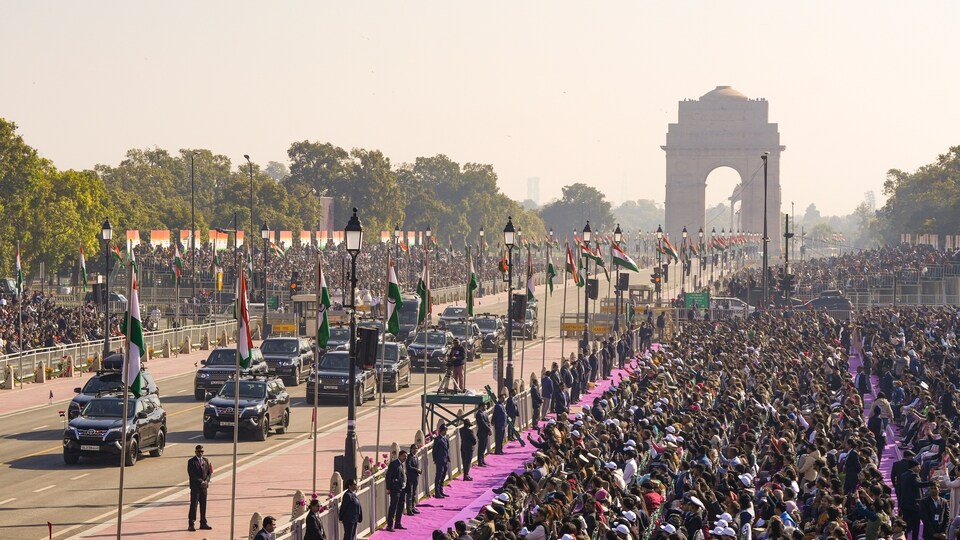
The warmest Republic Day in Delhi before this one was in 2017 when the city had recorded a maximum temperature of 26.1 degrees Celsius, as per figures mentioned in a news agency PTI report.
The clear skies made the Republic Day Parade fly-past a breathtaking sight, which is not usual as foggy conditions reduce visibility at this time of the year generally.
However, Delhi's minimum temperature on Sunday was 7.2 degrees Celsius, a notch below normal and a slight drop from 8.6 degrees Celsius on Saturday and 9.8 degrees Celsius on Friday.
Why is Delhi so warm in January?
Over the years, Delhi's temperature on January 26 has fluctuated significantly. While the long-period average (LPA) maximum for the day since 1991 is 22.1 degrees Celsius, recent years have been cooler with the mercury settling at 20.6 degrees Celsius in 2024, 17.3 degrees Celsius in 2023 and 16.4 degrees Celsius in 2022.
The IMD has cited dry northwesterly winds and clear skies as the reasons for consistent above-normal maximum temperatures in Delhi.
Also Read | Republic Day Parade: Tableaux, contingents, fly-past shine at Kartavya Path - Visuals
"Despite a recent western disturbance bringing some rain and snow to parts of northwest India, the maximum temperature in Delhi has remained relatively unaffected due to bright daytime sunshine," PTI quoted as saying vice president of private weather monitoring agency Skymet, Mahesh Palawat.
Temperatures to rise further in Delhi
A fresh western disturbance is expected to impact the region starting January 28, leading to a further rise in both maximum and minimum temperatures, Palawat said.
He said the disturbance will shift wind patterns, reduce wind speeds and bring cloud cover, which will "trap heat at night and cause night temperatures to rise".
According to the IMD, the minimum temperature could increase to 9-11 degrees Celsius by the weekend while the maximum will hover between 24-26 degrees Celsius.
Meanwhile, Delhi's Air Quality Index (AQI) entered the 'poor' (216) category on Sunday from 'moderate' (174) on Saturday. At around 5 am on Monday, the overall AQI of Delhi stood at 240, according to Centre's Sameer app.
An AQI between 0 and 50 is categorised as 'good', 51 to 100 as 'satisfactory', 101 to 200 as 'moderate', 201 to 300 as 'poor', 301 to 400 as 'very poor', and 401 to 500 as 'severe'.
According to the Early Warning System (EWS) for Delhi, AQI levels are likely to remain in the 'poor' category on January 27 and 28, and worsen to 'very poor' by January 29.


