
 E-Paper



Delhiwale: Mansion of a dozen labourers
Delhiwale: Exploring the living arrangements of a group of labourers in the Walled City


It looks like a museum. Nothing like this old-fashioned balcony exists anywhere else in the immediate vicinity.
What is it like to actually live in this building?
It turns out that this elegant Walled City mansion is a rent-free home to a dozen labourers. They work for a construction material supplier who sits in the shop below, here in Mohalla Qabristan neighbourhood. The building belongs to him.
“It’s at least 100 years old, but our family moved to a bigger house, nearby, a long time ago,” he says.
The entry is dramatic. The steep unlit staircase abruptly opens into a tiny, cluttered courtyard. It doesn’t feel like the same building—that from the outside looks so grand.
This morning, the courtyard smells of amla (gooseberry) hair oil and Lifebuoy soap. One corner is piled up with ladders and ballis (wooden poles), probably the work equipments of the dwellers. The only room on this floor has its door partially open. Three men are asleep, loudly snoring.
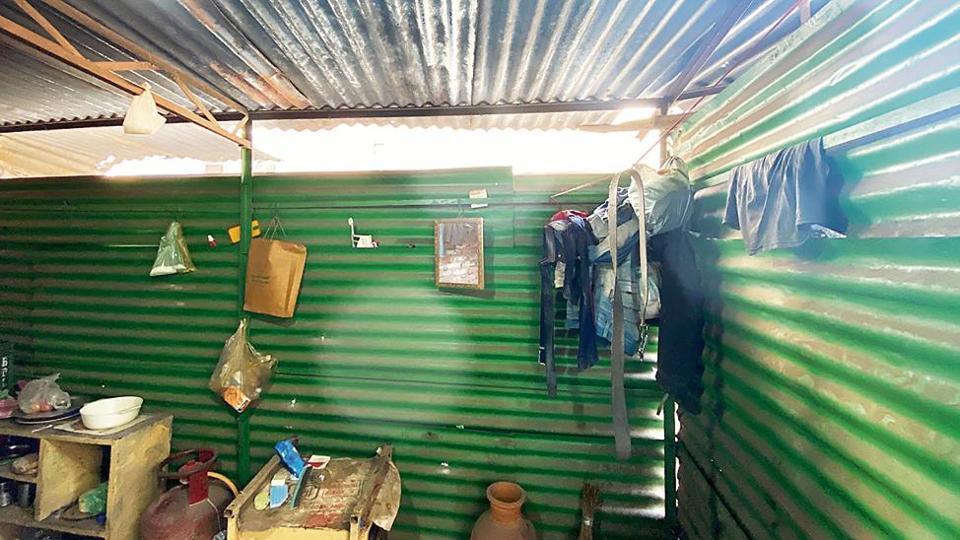
The landing above is accessed by a makeshift metallic staircase. Two tin-roofed sheds comprise the living quarters of another set of labourers. In one, Zafar is making meat curry for lunch, while Annu is having his breakfast—aloo subzi and roti. There’s no window, and street sounds have grown fainter, as if coming from very far. The room looks bare, yet it has all the basic household essentials, including a gas cylinder. A broom is plonked beside a tall earthen pot. A metal trunk is plopped up on what appears to be the remains of a dressing mirror—“we picked it from a kabadi walla (waste picker),” says Zafar. Clothes are hung from a metal chord. A hand-held mirror on the wall is reflecting the aforementioned trunk, making it look like a painter’s framed ‘still life’.
By this time some of the residents have already left for work, Zafar says. On clambering down back to the street, the house no longer looks like a museum, but very contemporary, pulsating with the presence of the people living in it.


