
 E-Paper



India: Rich nations must do more on green goals
Piyush Goyal said the Rome Declaration, adopted at the end of summit after five days of negotiations, acknowledges that the developed world has not done enough in terms of meeting its commitments and will have to be more forthcoming with finance and technology


Developed countries will have to do more to achieve net zero carbon emissions and to provide low cost finance and technologies to developing nations for climate transition, commerce minister Piyush Goyal said at the conclusion of the G20 Summit on Sunday.
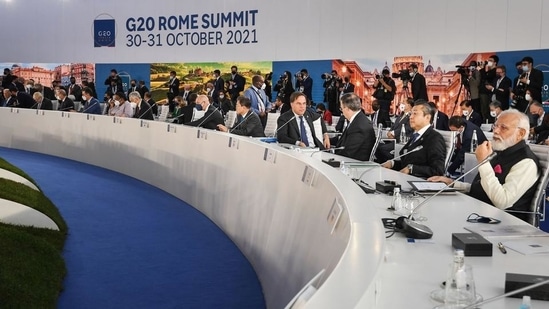
The Rome Declaration, adopted at the end of summit after five days of negotiations, acknowledges that the developed world has not done enough in terms of meeting its commitments and will have to be more forthcoming with finance and technology, Goyal told a media briefing in Rome.
The grouping of the world’s 20 largest economies further agreed that Covid-19 immunisation is a “global public good” and that Covid-19 vaccines deemed safe and efficacious by the World Health Organization (WHO) will be mutually accepted, said Goyal, who is India’s G20 sherpa or representative of the head of government for negotiations at the summit.
Also Read| ‘Global sea levels rose by a factor of two within 10 years’: WMO
“We have got into the text the language which confirms that the developed world has acknowledged that they have not done enough in terms of meeting their commitments, and that they will have to be more forthcoming in providing finance, technologies and the enablers to make the transition to a clean energy world in the future,” he said.
With the G20 agreeing on achieving net zero by or around the mid-century, Goyal said a firm date was not identified as technologies needed to “transition in a big way to clean energy and innovation” do not currently exist.
“We have discussed and decided [on] global net zero. So, all the countries put together will be net zero, which means the developed countries, which have already enjoyed the fruits of low cost energy for several years, will have to go in for net zero much faster and possibly even go in for net negative, so that they can release policy space and some carbon space for the developing countries to pursue their development agenda,” he said.
More work will have to be done on technological solutions and innovations to absorb clean energy and maintain grid stability. “We will have to look at more technology and innovation playing an important role before we can identify a year,” he said.
Goyal said while responding to a question on India’s capital needs to transition to clean energy that this would be determined by factors such as switching from coal to nuclear power. India will need large amounts of capital to set up more nuclear plants to replace current demand and to meet future demands for development imperatives, and it will also have to become a member of the Nuclear Suppliers Group to get raw materials, he said.
The G20 pushed the developed world to deliver on its commitment to provide $100 billion a year from now till 2025 so that greater levels of capital are available for developing countries.
Net zero emissions refers to achieving a balance between a country’s greenhouse gas emissions produced and emissions removed from the atmosphere through natural means or by using carbon capture technology. India is the third largest emitter of greenhouse gases after China and the US but has pushed back against calls by the developed world to work for net zero.
Goyal said the G20 Summit, with a theme of “people, planet and prosperity”, has delivered a strong message of recovery from the pandemic in terms of the economy, health, employment, education, tourism and climate action. The Rome Declaration also gives a very strong message under the health section, through an agreement that Covid-19 immunisation is a global public good and Covid-19 vaccines declared safe and efficacious by WHO will be mutually accepted, he added.
The G20 states agreed to help to optimise the processes and procedures of WHO for approving vaccines, and to strengthen the UN’s health body so that it can approve jabs faster.
Also Read| Need to regulate housing footprint to limit the severity of climate crisis
The G20 states also agreed to extend the Debt Service Suspension Initiative so that vulnerable and low income countries are not burdened with debt repayment amid the Covid-19 crisis.
There was also focus on protecting the livelihood of small and marginal farmers, while energy and climate action was at the centre-stage of discussions. Goyal said India made a concerted push for safeguarding the interests of the developing world.
The developed countries in the G20 also identified sustainable and responsible production and consumption, and the provision of finance and technology as critical enablers for achieving the climate goals set by the Paris Accord, he said.
Prime Minister Narendra Modi’s call for sustainable lifestyles found resonance in the Rome Declaration, which encouraged developed countries to reduce their luxurious and energy intensive lifestyles, Goyal said. There was also focus on gender-based violence and increasing women’s participation in workforce.


