E-Paper



Discontent brewing since Oct escalated on Monday
Though it wasn’t the first time violence has erupted along the 164km boundary between both northeastern states, Monday’s incident was the bloodiest till date.


Monday’s violent clash along the Assam-Mizoram border that claimed seven lives, including those of six policemen, and left 41 others injured on the Assam side was the culmination of simmering discontent between the two states since October 2020, when skirmishes left several injured on both sides and resulted in a blockade of NH-306, the lifeline to Mizoram, for 12 days.
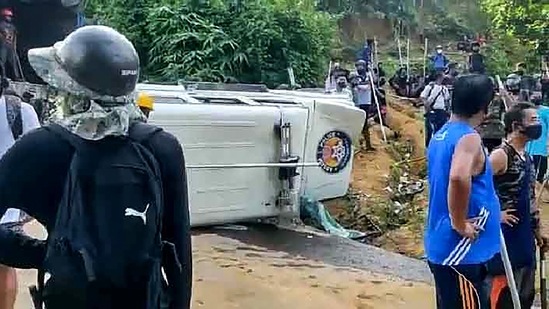
Though it wasn’t the first time violence has erupted along the 164km boundary between both northeastern states, Monday’s incident was the bloodiest till date. The border dispute between both states is nearly five decades long and started after Mizoram, which was earlier a part of Assam, was declared a Union territory in 1972 and gained statehood in 1987. While Assam claims Mizoram has encroached its “constitutional boundary”, the latter maintains the area belongs to it.
Three districts of Assam, Cachar, Hailakandi, and Karimganj, share borders with three districts of Mizoram, Kolasib, Mamit, and Aizawl. The main bone of contention is a 509 square mile stretch of the inner line reserve forest on the interstate boundary that Mizoram claims as its own. The origin of the dispute lies in two different notifications issued during the British era.
Mizoram wants delineation of the border based on a 1875 notification framed under Bengal Eastern Frontier Regulation of 1873 that sought to demarcate the Lushai Hills (the earlier name of Mizoram) from the plains of Cachar (in Assam) and also introduced the inner line permit regime (ILP) that regulates entry of outsiders to the area, now Mizoram, even today. Assam follows a 1933 notification through which delimitation of the earlier boundary between Lushai Hills and the former princely state of Manipur was modified.
As expected, there have been allegations and counter allegations on what ignited Monday’s clashes.
Mizoram’s home minister Lalchamliana issued a statement in the evening accusing Assam police personnel of entering the state and indulging in violence. The statement added that Mizoram police retaliated after tear-gas canisters and grenades were hurled by Assam’s security forces.
Late at night, Assam responded by issuing a statement that blamed Mizoram of breaching existing agreements and status quo on the border and accusing police of the neighbouring state of firing on its security forces and civilians using light machine guns (LMGs).
Earlier in the day, Mizoram chief minister Zoramthanga and his Assam counterpart Himanta Biswa Sarma indulged in a blame game on Twitter. It ended with intervention of union home minister Amit Shah, after which the two CMs talked over phone, agreed to maintain status quo and work for peace.
Besides Mizoram, Assam has border disputes with Meghalaya, Nagaland and Arunachal Pradesh. Assam shares an 804km-long boundary with Arunachal Pradesh. Though there was no dispute initially, over the years allegations of residents of one state encroaching land on the other have led to disputes and violence. A suit has been pending in Supreme Court since 1989 on the issue. Earlier this month, Arunachal Pradesh CM Pema Khandu had expressed hope of solving border dispute with Assam out of court.
Nagaland and Assam share a 434 km boundary and a dispute that’s going on for over five decades. Both states have refused to accept recommendations of two commissions set up by Centre to solve the issue and a suit is pending in Supreme Court on the issue since 1988. There have been several violent clashes on the issue. Over 100 people have been killed, most of them on the Assam side, in attacks by armed men from Nagaland in separate incidents in 1979, 1985 and 2014.
The Assam-Meghalaya border dispute is at least four decades old and there is contention between both states at 12 points along the 733km boundary they share. Several rounds of talks have failed to solve the issue. Last week, the CMs of Assam and Meghalaya met and agreed to use a pragmatic approach to sort their boundary problems.
The long-standing border disputes were expected to change with change in power equations in the region over the past five years. Since 2016, when a BJP-led coalition first formed government in Assam, the Congress has been virtually wiped out from the region.The BJP is heading governments in Arunachal Pradesh, Manipur and Tripura and is part of the ruling coalition in Meghalaya and Nagaland. In Mizoram, Mizo National Front (MNF), which is a constituent of North East Democratic Alliance (NEDA), a BJP-led front of anti-Congress parties in the region formed in 2016, is in power.
Monday’s incident came two days after Amit Shah interacted with CMs of all eight northeastern states in Shillong where the pending interstate border disputes were also deliberated upon. The Union home minister urged all states to resolve their issues before the 2024 general election. Significantly, during the 4th NEDA conclave held in Guwahati in September 2019, Shah urged all chief ministers of the region to address all border disputes in a timebound manner before India celebrates 75 years of Independence in 2022.