
 E-Paper



Divisions in Congress on J-K
Leaders of Congress did not put up a united front on the government’s move to revoke Article 370.

 Prefer HTon Google


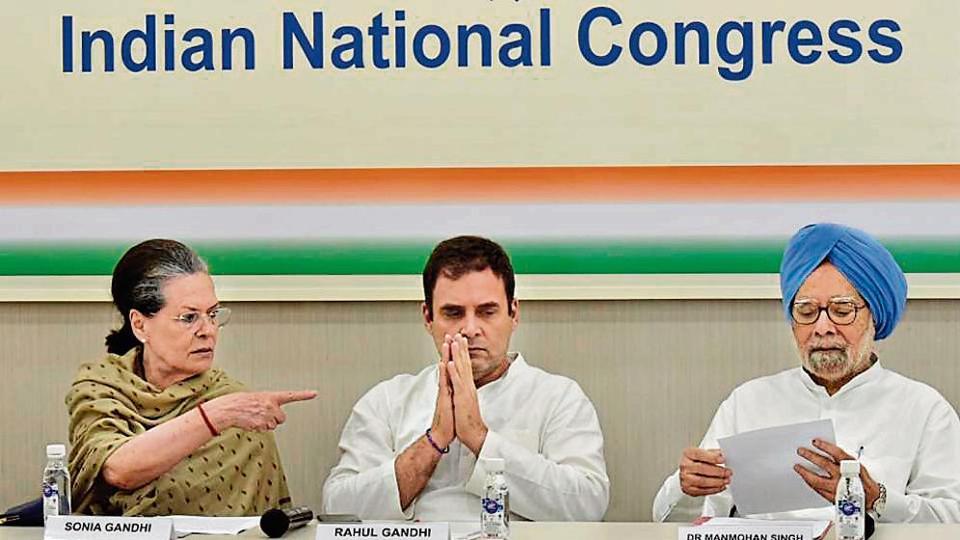
Already in disarray over a crisis of leadership, the Congress did not put up a united front on the government’s move to bifurcate Jammu & Kashmir into two Union territories and effectively revoke Article 370, which accorded special status to the region, with differing opinions aired by senior leaders of the grand old party.
On Tuesday morning, a day after the Rajya Sabha passed a bill that divided Jammu and Kashmir into two Union territories, Rahul Gandhi broke his silence on the issue and criticised the government. “National integration isn’t furthered by unilaterally tearing apart J&K, imprisoning elected representatives and violating our Constitution. This nation is made by its people, not plots of land. This abuse of executive power has grave implications for our national security,” he tweeted.
“Kashmir’s mainstream political leaders have been jailed at secret locations. This is unconstitutional & undemocratic. It’s also short sighted and foolish because it will allow terrorists to fill the leadership vacuum created by GOI [government of India]. The imprisoned leaders must be released,” Rahul Gandhi said in another tweet.
But hours later, senior leader Jyotiraditya Scindia backed the government’s decision, while questioning its procedure. “I support the move on Jammu And Kashmir & Ladakh and its full integration into union of India. Would have been better if constitutional process had been followed. No questions could have been raised then. Nevertheless, this is in our country’s interest and I support this,” he tweeted.
Other senior leaders who largely supported the government’s move included Janardhan Dwivedi, Deepinder Hooda, Jaiveer Shergill, Ashwini Kumar.
The Congress voted against the government in both Houses of Parliament but that didn’t stop the resolutions and legislation effecting the changes the government wanted in J&K.
Late in the evening, the Congress said the government’s move on Kashmir had grave implications on the “idea of India being a union of states”. “The CWC deplores the unilateral, brazen and totally undemocratic manner in which Article 370 was abrogated and the State of Jammu and Kashmir was dismembered,” read resolution adopted by the Congress Working Committee.
In the meeting, some members were of the view that the resolution should be in line with the popular perception but Tariq Hamid Karra insisted that the party should clearly nuance its stand on how the BJP violated constitutional provisions and parliamentary procedures in abrogating Article 370 and bifurcating the state.
Rahul Gandhi resigned as Congress President on May 25, taking responsibility for the party’s poor performance in the national elections but two months later, the party is yet to decide on a new president. In the interim, it has lurched from one crisis to another, seeing the mass defection of legislators in Goa, and the fall of its coalition government in Karnataka. Discordant voices in the Congress surfaced soon after Union home minister Amit Shah introduced a presidential order to effectively nullify Article 35A, which empowered the state to define permanent residents, on Monday in the RS.
Senior leaders Ghulam Nabi Azad, P Chidambaram and Kapil Sibal opposed the decision but the party’s chief whip in the Rajya Sabha, Bhubaneswar Kalita, resigned over the stand, saying the party was committing suicide by opposing the move.
In a letter, he said the party leadership asked him to issue a whip but he felt that the “whip was against the nation’s sentiments”. Thus, Kalita said, he decided to resign from the party.
On Monday evening, veteran leader Janardan Dwivedi took a stand contrary to the line the party had taken in the Upper House. He backed the government move, saying Article 370 was a “mistake of history” which has been corrected. “My mentor Ram Manohar Lohia was against Article 370 from the start. My personal view is that this is a matter of national satisfaction. A mistake made during independence has been corrected, even if belatedly,” he said. Mumbai Congress president Milind Deora also called for putting aside political differences while adding that India’s interest should be prioritised. “Unfortunate that Article 370 is being converted into liberal versus conservative debate. Parties should put aside ideological fixations and debate what’s best for India’s sovereignty, peace in Jammu and Kashmir, jobs for Kashmiri youth and justice for Kashmiri Pandits” he tweeted.
Former Congress MP Deepinder Hooda also tweeted his support for the move. “My personal view is that there isn’t a need to have Article 370 in the 21st century. The move is not only in the interest of the country but also for the benefit of J&K, which is an integral part of India. It is the responsibility of the government to implement the move in a peaceful environment,” he wrote.
Senior leader and former law minister Ashwani Kumar called the move a “daring resolve” in line with mood of the nation.
Party spokesperson Jaiveer Shergill, Rae Bareli legislator Aditi Singh, Rajasthan minister Ashok Chandna, Bihar leaders Sanjay alias Munna Tiwari, Udai Singh alias Pappu Singh and Kishore Kumar Jha also supported the government’s decision.
Congress leaders said the remarks by Deora and Hooda were part of a a “well-crafted strategy” in view of the upcoming assembly elections in their home states of Maharashtra and Haryana respectively. Elections in the two states are due later this year.
“I have nothing to do with those who don’t know the history of Congress and J&K. They should first read the history of J&K and Congress and then stay in Congress,” said Azad. During the discussion on the bills and resolutions related to J&Kin the Lok Sabha, Congress member Manish Tewari appeared guarded in his speech. He spoke against the manner in which the government carried out its move.
At the end of his speech, Shah asked him to clarify his party’s stand on the issue. “I just want a little bit of clarity from Manishji. He didn’t say whether the Congress supports the abrogation of Article 370 or not. Please make this clear,” Shah said. To this, Tewari replied, “There is a book in English... everything is not black or white. There are 50 shades of grey in between.”


