E-Paper



Delhi Jal Board likely to tap contaminated groundwater to bridge supply gap
It invites technology providers and institutions to install and operate systems that can remove high concentrations of dissolved salts and other contaminants.

 Prefer HTon Google


The Delhi Jal Board (DJB) has floated an expression of interest (EoI) for treatment technology that can make the city’s most contaminated groundwater fit to drink, as it looks to meet a summer supply deficit of around 250 million gallons per day (MGD).
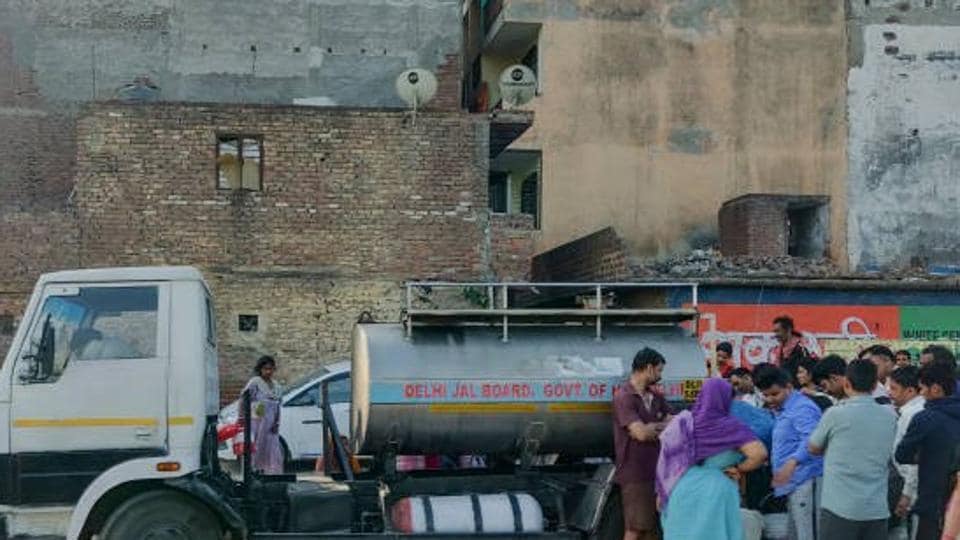
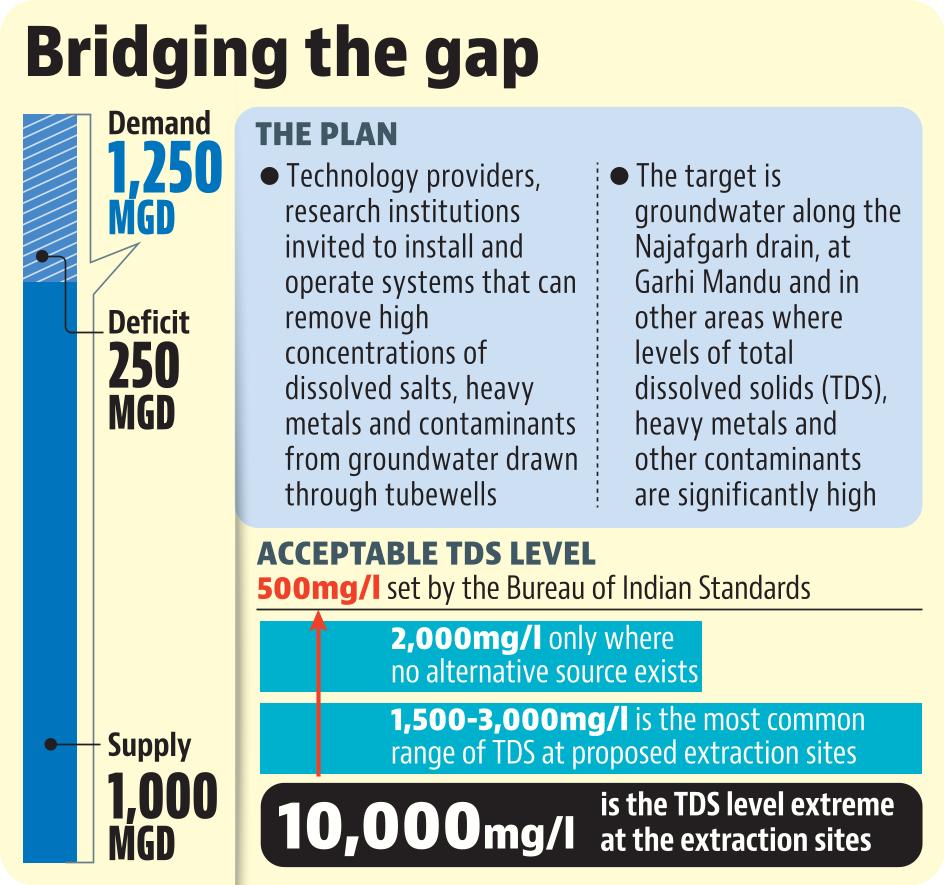
The EoI, issued on October 16, invites technology providers and research institutions to install and operate systems that can remove high concentrations of dissolved salts, heavy metals and other contaminants from groundwater drawn through tubewells.
The target is groundwater along the Najafgarh drain, at Garhi Mandu and in other areas where levels of total dissolved solids (TDS), heavy metals and other contaminants are significantly high.
“The proposed technology should be capable of treating groundwater with TDS levels of up to 10,000 mg/l or higher and producing drinking water conforming to World Health Organization (WHO) and Bureau of Indian Standards (BIS) norms,” DJB has specified in the EoI document.
DJB has invited proposals for capacities ranging from 10 MGD to 50 MGD or more, with modular designs that can be scaled up. Suggested technologies include high-recovery reverse osmosis and nanofiltration, though agencies may propose other proven solutions or a combination of technologies, a DJB official said, asking not to be named.
The initiative comes as DJB plans to install 300–400 tubewells across Delhi to supplement the city’s existing supply. Officials have identified 26 water extraction sites for installation of tubewells near the Najafgarh drain, where groundwater quality assessments have found high TDS levels.
Of 1,000 MGD (million gallons per day) water supply, around 135 MGD comes from groundwater sources, such as tubewells and Ranneywells. DJB operates more than 6,000 tubewells in high water table areas to augment the supply. In the absence of any external addition to Delhi’s water quota over the recent years, DJB, over the past five years, has been steadily increasing the groundwater extraction level, from 86 MGD in 2020 to around 135 MGD in 2025.
The 2025-26 economic survey tabled in the Delhi assembly states that the DJB estimates the city’s water demand to be 1250 MGD leaving a demand-supply gap of 250 MGD (million gallons per day). The daily water supply in Delhi has remained constant at around 1000 MGD in 2024, 2025 and 2026.
According to the annexure of the EoI document, groundwater in several parts of Delhi contains high levels of TDS, fluoride, nitrate, iron, manganese and heavy metals including arsenic, lead and mercury. For instance, the trial borewell number 17 along the Najafgarh drain produced water having TDS of 2,337 milligrams per litre (mg/l), against the acceptable limit of 500mg/l; uranium of 11 parts per billion; calcium of 141.6mg/l, against the acceptable limit of 75mg/l; chloride of 926mg/l, against the acceptable level of 250mg/l; Flouride of 1.5mg/l, against the acceptable level of 1mg/l.
This makes it unfit for direct human consumption. Long-term exposure to excess fluoride causes dental and skeletal fluorosis, and nitrate can cause methaemoglobinaemia, or blue baby syndrome, in infants. Arsenic is linked to skin lesions and cancers, and lead and mercury damage the nervous system.
The affected areas include stretches along the Najafgarh drain and groundwater-rich locations such as Garhi Mandu. TDS concentrations in these areas generally range between 1,500 and 3,000 milligrams per litre (mg/l), and may exceed 10,000 mg/l in some locations, the report says. TDS measures the salts and minerals dissolved in water. The Bureau of Indian Standards’ drinking water specification (IS 10500:2012) sets an acceptable limit of 500 mg/l, and allows up to 2,000 mg/l only where no alternative source exists.
DJB proposes to set up the treatment units on a vacant land parcel of around 20,000 square metres at the Ujwa underground reservoir (UGR). Ujwa site will be used for treatment and blending of water from sites along the Najafgarh drain. The treatment sites for other regions like Garhi Mandu will be established later. DJB has stated that the operators will have to first establish a pilot plant at a site identified by DJB for evaluation. The treated groundwater is to be blended with the existing supply at the Ujwa reservoir.
“Besides removing dissolved salts and heavy metals, the treatment systems will be required to reduce water wastage, maximise recovery and provide a plan for managing the concentrated reject water generated during treatment,” the officials added.
Bhim Singh Rawat, Yamuna activist and member of the South Asia Network on Dams, Rivers and People (SANDRP), said the type of contaminants in the groundwater will decide the efficacy of the project. “Right now, DJB is not even properly able to deal with ammonia spikes. How will they rely on treatment plants for removal of heavy metals? The Najafgarh drain carries a lot of industrial pollution and the treatment of a contaminated aquifer may be very difficult and costly to achieve. It will always leave scope for further contamination of aquifer nearby.”
Rawat said that DJB should focus on more sustainable and cost effective measures like reusing treated wastewater for non potable uses, reducing leakage and non revenue water and rain water harvesting at a mass scale. “First, we need to establish a clear baseline on water consumption demand and patterns across the city. Our planning will always remain flawed in the absence of such a scientifically established baseline,” he said.
Frequently Asked Questions