
 E-Paper



Domestic violence act: 20 years of power and protection
This month marks two decades of the domestic violence act. In a new series, HT looks at what’s working on the ground, and what’s not

 Prefer HTon Google


The first time he hit her, they had been married for less than a week. After that the beatings became routine. Sometimes there was too much salt in the food, sometimes too little. Anything could set him off.

K told me they had never even spoken when she married him at 18. But she felt she had no choice but to marry — she needed to lighten the load on her mother, a single woman, trying to make ends meet as a domestic worker. After marriage, K moved into a two-room dwelling she shared with her husband’s parents, his unmarried younger brother and a sister at Delhi’s Badarpur border. It was far from where her mother and younger sister lived. When she spoke to them on the phone, somebody from her husband’s family would always be around.
So she never told her mother about the beatings. When she complained to her mother-in-law, she was told, “All married couples fight. Learn to keep things to yourself.”
She wasn’t the only one. One in three women in India is subjected to domestic violence, according to the National Family Health Survey-5. Every day, 17 women were killed because of dowry, according to the National Crime Records Bureau’s Crime (NCRB) in India 2022. Domestic violence accounted for 31.4% of all crimes against women, the most frequently reported crime category against women, according to NCRB.
Domestic violence knows no geography, caste or religion; no socio-economic, ethnic or profession divide. Yet, despite being nearly ubiquitous, it remains a crime in plain sight, rarely spoken about and seldom making headlines unless the violence is egregious and causes serious injury or death. And there is marital rape. The government told the Supreme Court in October 2024 that it cannot be criminalised because it will “destroy the institution of marriage”.
Over 80% of women who have been subjected to violence by their husbands had not told anyone about it, said the National Family Health Survey 2019-21. Only 11.3% sought help and 6.3% went to the police.
For women like M, there is nowhere to go. Her husband beats her regularly. But, she believes, at least she has shelter, her children a home. “For some women, reporting a case to the police is not an option,” said Kumkum Kumar, director of programming with Breakthrough, an organisation that works to end violence against women.
“Because of their patriarchal upbringing, most women don’t even know how to talk about their situation,” said Anjali Thakur, operations lead at Shakti Shalini that works with survivors of gender-based violence and runs a shelter home in Delhi. Most accepted that an occasional slap is alright. “I remember one woman told me, “Once in a while is ok. But why does he hit me every day?”
The birth of a new law
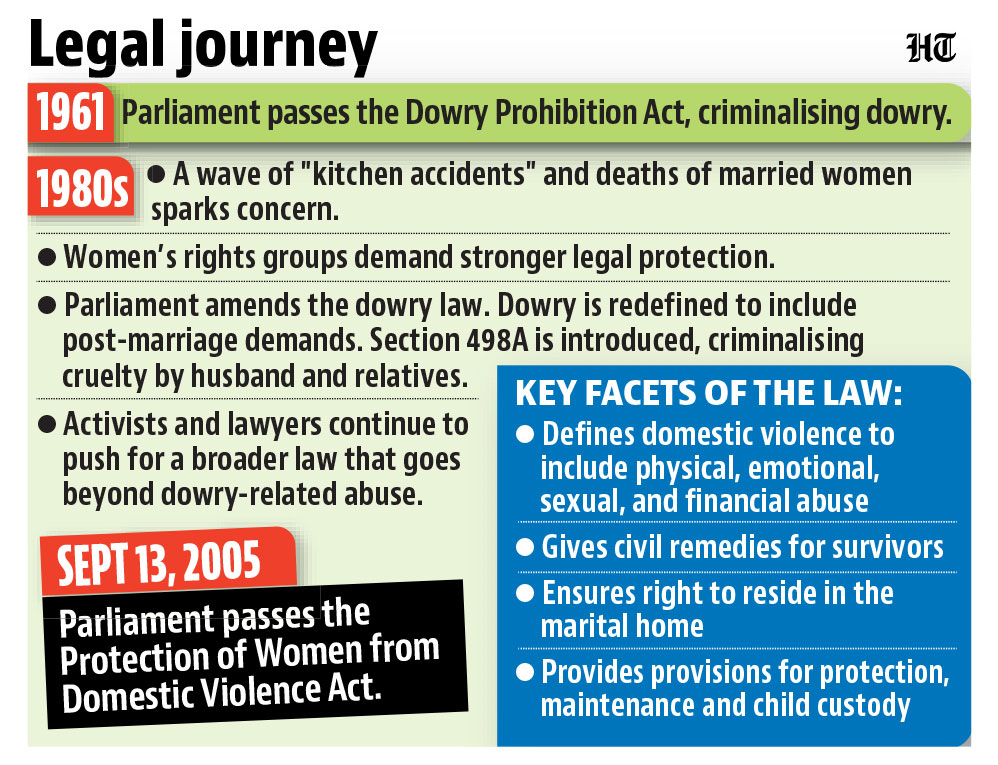
India has had a law against dowry since 1961. In the 80s, a spate of “kitchen accidents” resulting in an alarming number of deaths of young married women led to heightened activism by women’s groups demanding changes to the dowry law. Parliament responded with two amendments, one in 1984 and the other in 1986. The definition of dowry was expanded: Not just gifts at the time of marriage, but also demands made after marriage. In 1986, section 498A, which criminalised cruelty by both a husband and also his relatives was added. Moreover, if a woman died of burns or injuries within seven years of marriage, there would be a presumption of guilt against the husband and his relatives.
But the dowry amendments did not address violence against unmarried women and widows. It did not address violence from a woman’s birth family. It did not address non-dowry related violence against married women. It did not address those married women who didn’t want a divorce but just wanted the violence to stop. When she came into the women’s movement, the focus was rape and dowry deaths, recalled Flavia Agnes, the co-founder of Majlis, a Mumbai-based legal resource centre. “We had to shift the attention to domestic violence and change the idea that it happened only in poor families,” she said.
Also Read: Delayed justice to limited aid: The long wait for domestic abuse relief
At age 33, caught in a violent marriage, the choice for Agnes was: Remain in that marriage or choose poverty and destitution. She left and chose the latter.
Back then, there was no domestic violence law, but she was able to get a maintenance order of ₹500 for herself and ₹150 for each child. Then her husband quit his job, so even that money stopped. “I had to become self-reliant, get qualified, get a degree, and set up my law practice representing other survivors of domestic violence,” she said.
Spearheaded by Indira Jaising and the Lawyers Collective in consultation with women’s groups, the Protection of Women from Domestic Violence act, passed by Parliament on September 13, 2005, was intended to provide civil remedies. “There was a need to create an enabling environment in which a woman could assert her rights and seek legal recourse,” said Jaising.
What did women want? They wanted a place to stay, custody of their children, maintenance and compensation. And they wanted the violence to stop.
Under the umbrella of a single law, the domestic violence law gave women the right of residence in the marital home. It made provisions for maintenance, custody of children and compensation. Magistrates were empowered to pass protection orders. If orders are violated, it becomes a criminal offence.
“It was a fantastic law that gave women what they wanted,” said Gargee Guha who has 25 years of field experience working with Swayam, a Kolkata-based women’s rights organization.
Most crucially, it defined for the first time domestic violence to include mental cruelty, financial deprivation and sexual abuse.
Defining domestic violence
It was a match made in heaven, they said. He was from a well-established business family and had a foreign degree. L had grown up in New York, and matched his family in wealth.
From the beginning the rules were clear. Women in the family did not work. Her job was to have children and raise them in the “proper” way. When the kids, a girl followed by a boy, were old enough, she joined the family business as a “hobby” and was never paid a salary.
After 15 years of marriage, L’s husband decided he didn’t want to continue with it. It was over, he told her. She would have to move out.
He had never raised a hand on her. But, now after therapy, she recognises the taunts by him as emotional cruelty: You’re useless, my family doesn’t do things in this way, didn’t your mother teach you anything? And there was financial deprivation. No salary for working in the business. An allowance that had to be accounted for.
Using the domestic violence law, she was able to get a protection order from a Delhi court, as well as right to residence along with her children. But the court is still to decide on maintenance, even a year later.
Domestic violence has a wide definition in law, from mental cruelty to financial deprivation. Yet, judges tend only to look at physical violence, said Agnes, not just any physical violence but “brutalised bodies” she said.
Yet, financial violence is crucial to understanding how domestic violence unfolds. A wife who earns might be required to hand over her pay cheque to her husband — and then have to beg him for her own money. “I see a lot of cases where there is no physical violence but there is complete control over the wife’s finances,” said Monika Tiwary, survivor support lead who has been working as counsellor with Shakti Shalini
Very often there is no big showdown, but what Tiwary called the “small bickering” that leads to the loss of hope and confidence in a woman: Constantly criticising her cooking, controlling the quantities that are made so that she is forced to eat left-overs, berating her for not cleaning behind the corners, belittling her parents for not bringing gifts that are deemed good enough on festivals and occasions.
None of this is talked about when we talk about domestic violence. Nor is rape, which Tiwary calls a “dark reality of many marriages”. When sex itself is taboo, then talking about sexual abuse becomes that much more impossible. This is not about “bad touch” now taught in many schools but violation by an intimate partner. And most women do not have the language to express what is being done to them.
B’s husband expected sex twice a day. Didn’t matter if she wanted it or not, or if she had household chores to complete, or if she wasn’t feeling well. When she finally told her mother, the older woman frowned: “This happens with everyone. Get used to it.”
There are growing reports too of women speaking up against natal, or birth family, violence.
“A daughter can be stopped from going to school, or not allowed to choose her partner or profession,” explained Khadijah Farooqui, a feminist counsellor. “There is violence from brothers and sons.” The domestic violence act protects these daughters, sisters and mothers too.
Farooqui talked about one of the big wins. A young woman in 2013 got in touch with an NGO to file a report of domestic violence against her father. She had, against his wishes, got into IIT. And now, he was refusing to pay the fees and she would have to forfeit her admission. With no time to lose and with the help of the NGO, she went to court with what’s called a domestic incident report (DIR) saying her father’s refusal to pay, even though he had the funds, was a violation of her financial rights. It was a Saturday, the last day to pay was Monday. The magistrate gave interim orders to the bank to release the fee from the father’s account.
Today, said Farooqui, that woman is in Germany in a very good job.
If you or somebody you know is facing domestic violence and would like to seek help get in touch with: National Commission for Women:7827170170 (24x7) Shakti Shalini’s 24x7 helpline: 011-24373737 or Whatsapp: 7838957810Sneha, Mumbai: 9167535765 (Mon-Fri, 10am-6pm)Swayam, Kolkata, 9830079448, 9830737030 (Mon-Fri, 10am-6pm)Nazariya, a queer feminist resource group: 9818151707 (Mon-Fri , 10am-5 pm)


