E-Paper



Dowry deaths 25 times more frequent than rape murders | Number Theory
Outrage over Nikki Bhati's death highlights India's dowry-related violence, with 6,516 dowry deaths reported in 2022 and low conviction rates for offenders.

 Prefer HTon Google


The outrage over the death of 28-year-oldNikki Bhati in Greater Noida and the demands for swift justiceare borne outby data on such crimes available in India, with reported dowry deaths just the tip of the iceberg as far as violence married women face in their households is concerned.
According to the 2022 (latest available) data from Home Ministry’s National Crime Records Bureau (NCRB) 6,516 women died on account of dowry deaths (Section 304B of the Indian Penal Code) in India. This is more than 25 times the number of women who were killed after a rape or gang rape in the country that year.
Also Read | ‘They burnt my mother’: Greater Noida dowry death victim's son haunted by sight
The number of dowry deaths also puts into context the extent of under-reporting under the Dowry Prohibition Act of 1961. The 2022 NCRB report says just 13,641 women were victims in cases filed under this law. If this was the full extent of dowry harassment in India, it would imply that a third of those harassed for dowry (only the offence with the longest sentence is counted in NCRB data) die. Clearly, the data shows, most women do not seek recourse under the anti-dowry law till things reach, as was the case for Nikki Bhati, a point of no recourse.
Even when a case is lodged in the extreme scenario of a dowry death, justice is anything but expeditious. NCRB data shows 60,577 cases of dowry deaths were pending in courts at the end of 2022. Of these, 54,416 were pending from before 2022. Of the 3,689 cases in which trial was completed in 2022, only 33% led to convictions. Of the 6,161 cases which were sent for trial during the year, only 99 saw convictions. This means that there is a less than 2% chance that Nikki Bhati’s case will lead to a conviction within a year.
Dowry is perhaps India’s most normalised illegal activity, going by anecdotal evidence, but credible data on the prevalence of this menace is hard to come by. Yet there is enough evidence to flag this as a major problem. For example, a 2010 book (Human Development in India: Challenges for a Society in Transition) that covers the findings of the 2004-05 round of the India Human Development Survey (IHDS) shows that the average wedding spending for a bride’s family was 1.5 times more than the bridegroom’s family. Twenty four percent of families reported giving a TV, refrigerator, car or motor cycle as dowry; 29% of the respondents in the survey said that “it is common to beat a woman if…(her) family does not give expected money”.
Also Read | Jodhpur school lecturer sets herself, 3-year-old child on fire over dowry harassment
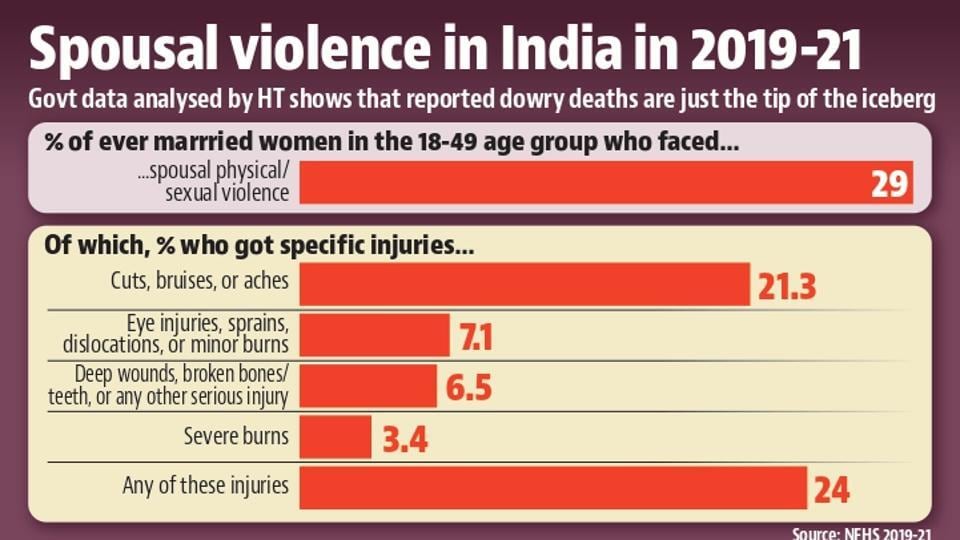
More granular data on dowry related violence would have been available if the National Family Health Survey (NFHS) collected data on it. While NFHS is the most reliable and granular source of data on intimate partner violence against women, dowry does not figure in the list of cases for violence. And yet, the kind of violence women face is alarming. The 2019-21 NFHS (latest round) shows that 29% of women who are or were married aged 18-49 years had faced physical or sexual violence by their husbands/partners. Of these women 24% had faced such violence in the year preceding the survey. Among the 29% who had ever faced such violence, 3.3% had suffered severe burns in the nature of injuries; 7.3% had faced eye injuries, sprains, dislocations, or minor burns; 6.2% had faced deep wounds, broken bones, broken teeth, or any other serious injury; and 21.8% had faced cuts, bruises, or aches.
To be sure, dowry isn’t the only reason why married women face violence in their households. However, there is good reason to believe that it is among the most important reasons. A 2024 article published in the Public Library of Science ONE, a peer reviewed journal, says, “The likelihood of experiencing violence was 3.64 times more likely among adolescent girls who reported that dowry was demanded by their in-laws than their counterparts”.
For the record, Nikki Bhati was set on fire in Kansa area of Greater Noida on August 21. Police have arrested all four of her in-laws for the murder.