
 E-Paper



Covid-19 vaccination drive widens, 50 million set for both shots by May 15
Anyone above 45 can get doses from today, experts see it as crucial in order to contain second wave.


As all Indians above the age of 45 become eligible for coronavirus vaccines starting Thursday, HT’s projections show at least 50 million people will have received both shots by the middle of May, and over 100 million by mid-June if the country can keep administering an average of 4 million doses a day, a pace that could help India turn the tide against the building second wave of infections.

Union health officials held a video conference with state officials on Wednesday to discuss preparations for the opening-up of the drive, suggesting administrators focus on improving coverage in underserved areas and focussing on ironing out teething problems that could occur. Experts have also called on the need to address vaccine hesitancy among people, especially in order to maintain and improve the pace of vaccination.
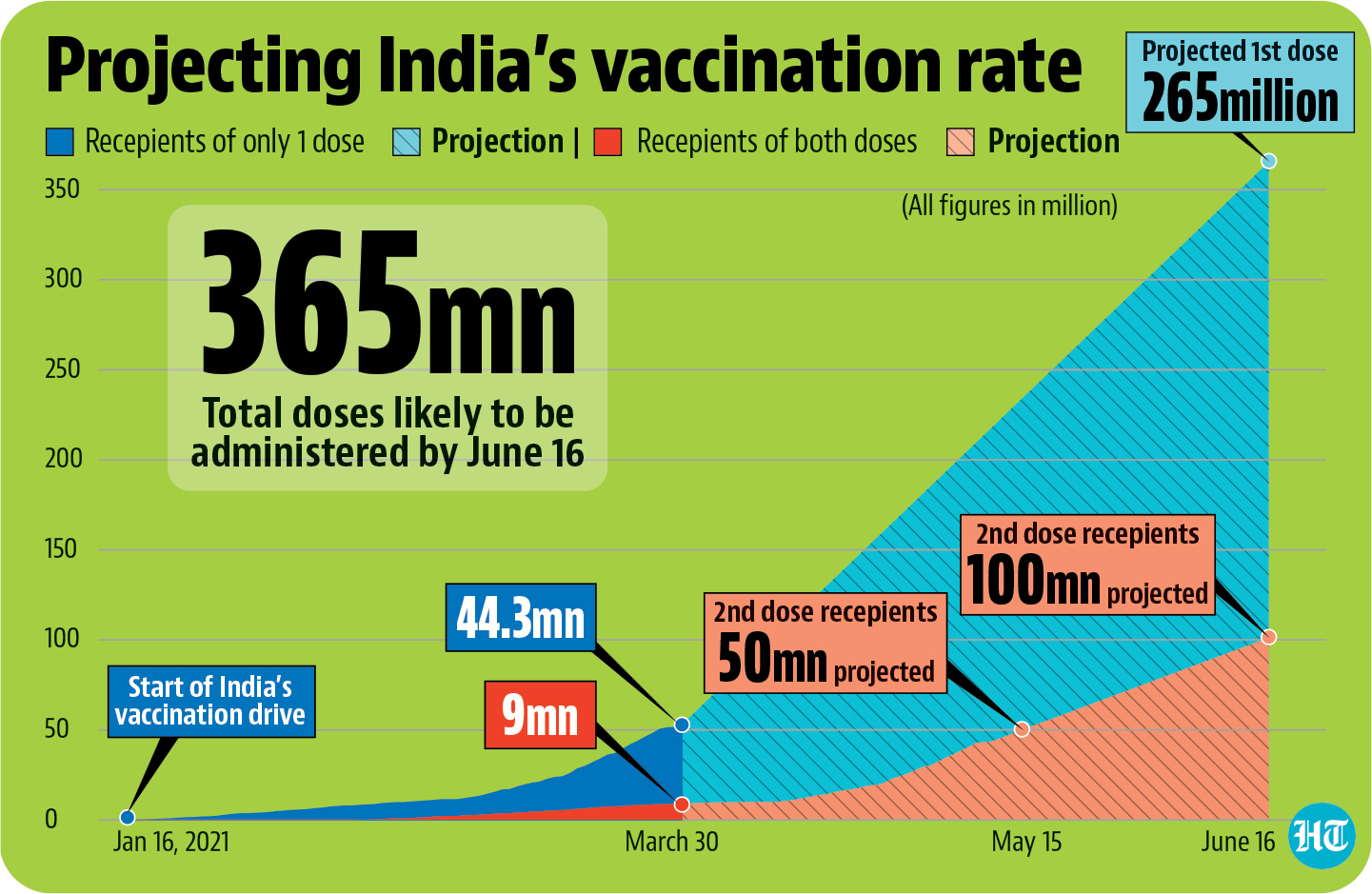
According to HT’s analysis of the trends, the total number of people who have received at least one shot of the vaccine is set to surpass 300 million in early June. Vaccination numbers for the second dose will particularly pick up pace through the second half of April.
These numbers are significant because India is in the grip of a second wave and case and death numbers are certain to rise through April in what is clearly going to be a race between the virus and the vaccine. India’s vaccine drive has seen a slow start, relative to the size of the country and the number of people that need to be vaccinated. Part of this can be attributed to vaccine hesitancy, but some of it is also because of the way the health ministry has chosen to go about the drive. Which is what makes April and May extremely important.
Going by trends in developed countries and the number of people likely to have been infected in India (around 200 million, give or take a few tens of millions), around 10 days after 50 million people have received two doses, the result will make itself evident in the trajectory of the disease. Around 10 days after 100 million people have received two doses, it will be even more evident. Which is what makes April 1, when India throws open vaccination to anyone over the age of 45 years, a key milestone — not only in the country’s fight against the disease but also the prospects for the economy in the year ahead. Put simply, how well the next 45 days go could decide whether India grows at 12.5% or 7.5%, the two ends of the range predicted by the World Bank for the country’s growth in 2021-22.
Also read | Mumbai reports 5,394 new Covid-19 cases in 24 hours, 616 buildings sealed
“While results may vary depending upon different locations, if we manage to immunise around 30-40% of people in major cities, and assume that 45-55% of residents have already been infected there, we should be in a reasonable shape and begin to see results of the vaccination drive with slowing case rates,” said Dr Gagandeep Kang, professor in the department of Gastrointestinal Sciences at Christian Medical College, Vellore, and one of the country’s topmost vaccine experts. “Of course, we need to keep in mind several caveats such as the duration of protection that being infected offers, emergence of new variants, etc,” she added.
She said that far greater coverage may still be needed to cover rural areas as well, and that India must eventually look to include every age group in the vaccination ambit, even children.
“In rural areas, we may need far greater vaccine coverage to see any difference in case rates, but ultimately our goal should be to get everyone immunised as soon as possible, including children.”
HT’s calculations are based on data released by the health ministry till Tuesday night, and the projections assume a pace of at least 4 million shots being administered a day, with a second shot being administered at a gap of six weeks (or 42 days) after a person receives the first shot.
A total of 62.4 million doses have been administered across the country till Tuesday night, with 53.4 million people having received at least one dose of the vaccine. A total of 9 million people have received both doses, and 44.4 million have received only a single dose, according to government data. These numbers remain significantly behind the government’s inoculation targets – the Centre has set a target of vaccinating over 300 million people by the end of July — a target that it will, most likely, miss.
In the two-and-a-half months since the start of the vaccination drive on January 16, India has administered at least one shot to only 18% of this goal. So far, the country has managed to completely vaccinate (with both doses) only 3% of the 300-million target, while another 15% have received only one shot.
HT’s vaccination projections are based on two assumptions. First, that the country will be administering 4 million doses a day on average from here on. While the current single-day record is just over 3 million doses (on March 16), the government has set a target of raising this to 5 million doses. The 4-million-a-day target seems especially achievable considering the inoculation drive will be further thrown open to everyone over the age of 45 years in the drive’s third phase starting Thursday. The second assumption is that everyone who has been administered the first dose of the vaccine will show up for the second dose in around six weeks.The projections show that second dose numbers will likely struggle to pick up pace through the first week of April as the final week for February (its corresponding six-week lag period) saw a low number of first shots being administered. This was because the first phase of the vaccination drive (which ended on February 28) started tapering off by the final week, and there also were three days of zero vaccination around that week – Covid vaccinations were suspended on February 21 in order to carry out the National Polio Immunisation Programme, and there were no vaccination the final two days of the month because officials were updating the Co-WIN platform for the March 1 launch of Phase 2.
Beyond April 15, however, second doses appear set to take off as around that time the country will start reaping the benefits of the March 1 launch of Phase 2 of the vaccination drive. While the first batch of around 41,000 people under Phase 2 received their second doses on Tuesday, this group likely consists of people who received the Covaxin shot, which requires a four-to-six-week gap between doses. In contrast, those who received Covishield at the start of March will likely start coming in for second doses in another two weeks as this vaccine requires a six-to-eight-week gap between shots. A key number to note here is that Covishield shots outnumber Covaxin by around 10:1, so once people who were administered the former start showing up for second doses through late April and early May, it will give a massive boost to numbers.
In the coming six weeks (till May 11), if everyone who has received one dose till Tuesday turns up at a vaccination centre to get their second shot, around 45 million people will have been completely vaccinated in the country. This boost is likely to push the number of fully vaccinated people to around 50 million by May 15. There is likely to be no supply constraint because the 120 million doses India has ordered from Serum Institute of India and Bharat Biotech (100mn from the former alone) will be delivered through April. Which means the success of the drive depends more on logistics, intent, and the willingness among people to take the jab (HT has launched a campaign exhorting them to do so).
Watch | Covid update: Russia’s vaccine for animals; Covishield’s shelf life extended; USA deaths
Beyond May 11 (when the six-week jump from March 31 ends), the projection assumes that the current two-week average of new shots being administered (average of 1.56 million every day) is retained or that conversely, the number of people receiving their first dose beyond that time period remains a steady 2.44 million (based on our 4-million-a-day shot rate).
This means the number of people who are fully vaccinated will cross 50 million around May 15, and 75 million by the end of May. The total number of people who have received at least one vaccine shot is expected to touch 300 million around the end of May with 225 million having received only one shot.
By June 16, nearly 100 million are expected to be fully vaccinated across the country, while another 260 million will have received only a single shot – taking the total number of people to have received jabs in the country to around 360 million.
To be sure, any vaccination projections are calculated estimates and may be subject to daily fluctuations as there is a wide time range (from four weeks to a maximum of eight) where people may return for their second shot, which may alter numbers at a daily level


