
 E-Paper



Earlier attempts to take action against PFI could not fructify: NIA
The federal anti-terror agency, after sharing a detailed 19-page dossier with the ministry of home affairs (MHA) in 2017, held several rounds to discussions with senior government functionaries on the issue, the people added.


The Popular Front of India (PFI), the Islamic organisation declared an “unlawful association” under the Unlawful Activities (Prevention) Act on Wednesday, was in the crosshairs of the National Investigation Agency (NIA) for at least six years but attempts to crack down on it could not fructify at the time due to variety of reasons, several people familiar with the developments said on condition of anonymity.
For starters, the people said, the government wanted to build a watertight case for a ban which could stand judicial scrutiny although there was enough evidence about the group’s association with global terror outfits such as Islamic State (IS) — particularly after several PFI members travelled to territories held by IS in Iraq, Syria and Afghanistan were caught by NIA and Kerala Police in 2016 and 2017.
They added that PFI was also found involved in organising a training camp in Narath, Kerala in 2013, as well as being involved in the targeted killings of Hindu leaders and CPI (Marxist) leaders in the state.
The federal anti-terror agency, after sharing a detailed 19-page dossier with the ministry of home affairs (MHA) in 2017, held several rounds to discussions with senior government functionaries on the issue, the people added.
While PFI had by then spread to states beyond Kerala, Karnataka and Tamil Nadu – notably Manipur, Assam, Uttar Pradesh, Delhi, Gujarat, Rajasthan, Maharashtra and West Bengal -- and its members had swelled to 50,000, the majority of the group’s violent activities were reported from the three southern states.
“NIA’s comprehensive dossier; its charge sheets; case documents etc; statements of IS operatives who were linked with PFI; CDs and pen drives and other material collected from Kerala, Tamil Nadu, and intelligence sources – all were legally examined at that time. Subsequently, ED had gathered substantial documents by 2018 about PFI’s funding activities in the Gulf countries,” said a senior security officer, asking not to be named.
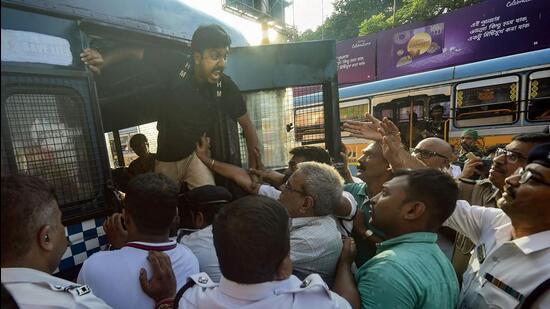
“In fact, a crackdown like the one last week carried out by NIA and the Enforcement Directorate (on September 22 when at least 106 persons, including the PFI’s top leadership and district heads, were arrested) was also considered at that time, but a decision was taken against it,” the officer added.
The move, however, was part of “discussions”, and not a “formal proposal” by NIA to MHA to ban PFI, said a second officer.
“It was clear from the beginning that PFI was pursuing a strong fundamentalist ideology and an anti-imperialistic stand was its hallmark. Its virulent reactions to any anti-Muslim developments taking place across the globe – be it Israeli attacks on Palestine, American actions on war against terror, blasphemy, instances of alleged social discrimination, etc, while altogether maintaining a soft approach towards other extremist organisations – all were being closely monitored,” the second officer said.
“However, the call in such matters is taken by the ministry,” he added.
A key reason why government didn’t go ahead could be because “there weren’t many cases pertaining to PFI’s violent activities in other states”, a third officer said.
In February 2018, the Jharkhand government banned PFI in its territory, saying the outfit was engaged in extremist activities but the ban was set aside by the state high court in August that year. The court noted that the state government did not follow the procedure to ban the outfit as it did not publish the notification in the official gazette. Following the high court order, Jharkhand reimposed the ban on PFI in February 2019.
Subsequently, the Uttar Pradesh government sent a proposal to the Centre in 2020 after PFI members were found involved in the anti-Citizenship (Amendment) Act, or CAA, protests. UP’s proposal was followed by Karnataka and Gujarat.
“The government wanted the ban to be bulletproof. That’s why the action was taken in the last one week,” said the third officer.
Former ED director Karnal Singh welcomed the government ban.
“PFI’s activities were definitely a threat to the internal security of India. They radicalised people and had links with foreign terrorist elements, apart from collecting funds for anti-national activities in the garb of donations. Any internal disruptions by an organisation like PFI can always be used by foreign organisations or powers,” he said. “So it was very important to ban it. Now, being a member, collecting funds, or even being remotely associated with PFI could be an offence.”


