
 E-Paper



'Far-seeing' lens needed for progress in India-China ties, says EAM Jaishankar
This is Jaishankar’s first visit to China since ties were hit by border skirmishes in April-May 2020


India and China must build on “good progress” in normalising their relations by addressing issues related to the border, including de-escalation, and avoid “restrictive trade measures and roadblocks” to economic cooperation, external affairs minister S Jaishankar told his Chinese counterpart Wang Yi on Monday.
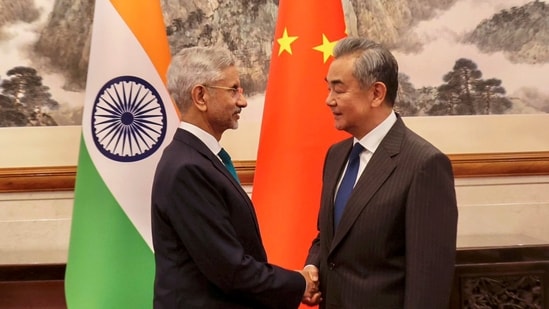
Jaishankar, who met Wang in Beijing after arriving in China to attend a meeting of foreign ministers of the Shanghai Cooperation Organisation (SCO), reiterated that stable bilateral ties can be built only on the basis of mutual respect, mutual interest and mutual sensitivity.
“We have made good progress in the past nine months for the normalisation of our bilateral relations. It is a result of the resolution of friction along the border and our ability to maintain peace and tranquillity there,” Jaishankar said in televised opening remarks during the meeting with Wang.
“This is the fundamental basis for mutual strategic trust and for smooth development of bilateral relations. It is now incumbent on us to address other aspects related to the border, including de-escalation...our bilateral relationship requires that we take a far-seeing approach to our ties,” he said.
In an apparent reference to Pakistan’s support for cross-border terrorism, Jaishankar told Wang that India hopes “zero tolerance for terrorism” will be upheld at the meeting of the SCO, whose main mandate is fighting terrorism and extremism.
Earlier, Jaishankar met Chinese vice president Han Zheng and told him the continued normalisation of bilateral ties can lead to mutually beneficial outcomes.
This is Jaishankar’s first visit to China since ties were hit by border skirmishes in April-May 2020, though he has met Wang on the margins of multilateral events several times since the two sides reached an understanding on ending a face-off along the Line of Actual Control (LAC) last October.
While the two sides withdrew frontline forces from the two remaining “friction points” of Demchok and Depsang along the LAC last year, the process of de-escalation and pulling back troops to peace-time positions is yet to be completed.
Jaishankar noted there were various dimensions to relations between major economies such as India and China and said that the normalising of people-to-people exchanges can foster mutually beneficial cooperation. “It is also essential in this context that restrictive trade measures and roadblocks are avoided,” he said without giving details.
He was apparently referring to China’s curbs on exports of rare earth minerals – used in everything from smartphones to electric vehicles and in many of which Beijing has a near monopoly - and fertilisers. The restrictions on rare earth exports have been officially raised through diplomatic channels by India, especially in view of the impact on manufacturers of electric vehicles.
Jaishankar said stable and constructive ties between India and China, which will benefit the two countries and the world, can be built by “handling relations on the basis of mutual respect, mutual interest and mutual sensitivity”.
He added, “We have also earlier agreed that differences should not become disputes, nor should competition ever become conflict. On this foundation, we can now continue to develop our ties along a positive trajectory.”
Referring to the SCO foreign ministers’ meeting on Tuesday, Jaishankar pointed out that the nine-member bloc’s primary mandate is to combat terrorism, separatism and extremism. “This is a shared concern and India hopes that zero tolerance for terrorism will be strongly upheld,” he said.
Jaishankar’s remarks assume significance as a recent meeting of SCO defence ministers couldn’t adopt a joint communique after Pakistan objected to a reference to the Pahalgam terror attack in the document. Indian defence minister Rajnath Singh refused to endorse the communique.
Pakistan was also backed by China during four days of hostilities with India in May, triggered by Operation Sindoor that was launched by New Delhi to target terror infrastructure on territories controlled by Islamabad.
The relationship between India and China has been “gradually moving in a positive direction” since Prime Minister Narendra Modi and President Xi Jinping met in the Russian city of Kazan in October 2024. “Our responsibility is to maintain that momentum,” he told Wang.
Recent meetings at international events offered opportunities for strategic communication, and Jaishankar said India expects that this process will now become regular and take place in each other’s countries.
India and China are also marking the 75th year of diplomatic relations, and New Delhi appreciates the resumption of the Kailash Manasarovar Yatra after a gap of five years, Jaishankar said, thanking the Chinese side for its cooperation on the pilgrimage to a holy mountain and a lake in Tibet.
A readout from the external affairs ministry described the talks between Jaishankar and Wang as “constructive and forward-looking” and said the two sides agreed to take “additional practical steps”, including travel to each other’s country and direct flight connectivity, to facilitate people-to-people exchanges.
Jaishankar underlined the need for cooperation on trans-border rivers, including resumption of the provision of hydrological data by the Chinese side, the readout said.
Wang said that at a time when “unilateral protectionism and bullying by powerful countries” have created severe challenges for the world, India and China should seek long-term strategies and find a way for the two sides to “get along with...mutual respect and trust, peaceful coexistence [and] common development”.
China is willing to strengthen communication and coordination with India to “jointly safeguard the multilateral trading system, the stability of the global production and supply chain, and the international environment of openness and cooperation”, Wang said, according to a statement from China’s foreign ministry.
The two sides can also work together to safeguard the common interests of the Global South and promote regional peace, stability, development and prosperity, he said.
At his meeting with vice president Han, Jaishankar said bilateral relations were “steadily improving” since the meeting between Modi and Xi in Kazan last October. “Continued normalisation of our ties can produce mutually beneficial outcomes,” Jaishankar said, adding that his discussions during this visit will maintain the “positive trajectory” in the relationship.
China’s state-run Xinhua news agency quoted Han as saying that China and India, as important members of the Global South, should be “partners contributing to each other’s success”. Han said both sides should steadily advance pragmatic cooperation, respect each other’s concerns, and promote the sustained and stable development of bilateral relations.
India and China reached an understanding last October to end the four-year military standoff in Ladakh sector of LAC. Two days after the understanding, Modi and Xi met in Russia and agreed to revive several mechanisms to normalise bilateral ties and to address the long-standing border dispute. Since then, there have been several meetings between the foreign and defence ministers and NSAs of the two countries.
Bilateral relations dipped to their lowest point in six decades after deadly clashes in the Galwan Valley in June 2020 killed 20 Indian soldiers and an unspecified number of Chinese troops.
However, ahead of Jaishankar’s visit, the spokesperson of the Chinese embassy in New Delhi said on Sunday that Tibet-related issues such as the Dalai Lama’s reincarnation are a “thorn” in bilateral ties. The spokesperson’s remarks came in the wake of the Dalai Lama’s announcement that only a trust set up by him can recognise his reincarnation. Beijing has insisted that the Dalai Lama’s successor must be approved by the Chinese government, while New Delhi has said it doesn’t take any position on matters concerning religious practices.


