
 E-Paper



FM lowers fiscal deficit target to 4.9% for FY25
While the full budget for 2024-25 has not provided rolling targets for the next two years, it envisaged that “an active and nimble fiscal policy strategy is a pre-requisite for smooth fiscal policy operations”


New Delhi: Union finance minister Nirmala Sitharaman on Tuesday made a downward revision in India’s fiscal deficit target for the current financial year from 5.1% of the gross domestic product (GDP) targeted in the interim budget in January to 4.9% on prudent expenditure management and buoyant revenue receipts.
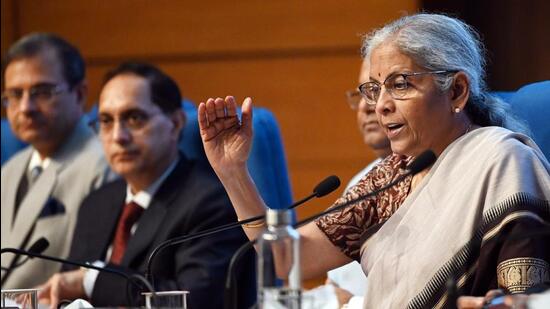
“The fiscal consolidation path announced by me in 2021 has served our economy very well, and we aim to reach a deficit below 4.5% next year. The Government is committed to staying the course,” she said in her budget speech in Parliament.
Sitharaman also hinted at a newer way to benchmark fiscal management. “From 2026-27 onwards, our endeavour will be to keep the fiscal deficit each year such that the Central Government debt will be on a declining path as percentage of GDP. “
While the full budget for 2024-25 has not provided rolling targets for the next two years, it envisaged that “an active and nimble fiscal policy strategy is a pre-requisite for smooth fiscal policy operations”.
Explaining this strategy, finance secretary TV Somanathan said, “Hereafter, it is not the intention to focus on the deficit number, but rather to look at what will keep reducing -- the debt to GDP ratio in normal years.”
“The reason for this is, a fixed figure, which historically was enshrined in the FRBM Act in past, does not take into account the specific debt dynamics of a fast-growing economy like India,” he added. The Fiscal Responsibility and Budget Management Act (FRBM Act), 2003 (as amended) became effective from July 5, 2004. It mandates the Central government to reduce fiscal deficit to an amount equivalent to 3% of GDP. It also prescribes the format for the medium-term fiscal policy statement to be presented to Parliament along with the annual financial statement.
Somanathan, who is also the expenditure secretary, said the figure of 3% “correctly or wrongly” came from Europe. “But the growth rates of those countries are very low. So, what is sustainable in a fast growing economy is very different from the debt which is sustainable in a slow growing economy. So, India is today the fastest growing large economy in the world. The deficit, which we can support in a particular year without expanding our debt, is not necessarily 3%. It is much more than 3%,”
“Yes, it is a new approach that the government has spoken about. And so each year’s calibration will be based on what will be a percentage which will keep our debt on a reducing path,” Somanathan said.
According to the budget, for the year 2024-25, total receipts other than borrowings and the total expenditure are estimated at ₹32.07 lakh crore and ₹48.21 lakh crore respectively. The net tax receipts are estimated at ₹25.83 lakh crore. And the fiscal deficit for FY25 is estimated at 4.9% of GDP.
While presenting the interim budget for FY25 on February 1 this year, finance minister Nirmala Sitharaman revised the fiscal deficit estimate for previous financial year (FY24) from 5.9% of GDP to 5.8% and set a target of 5.1% for the current financial year. But, according to data released by the Controller General of Accounts (CGA) on May 31, India’s fiscal deficit for 2023-24 came in at 5.63%, substantially below the revised estimate (RE) made in the budget on February 1. Besides, about ₹2 lakh crore dividend from the Reserve Bank of India (RBI) gave the government significant headroom to reduce fiscal deficit target despite raising capital expenditure.
D.K. Srivastava, Chief Policy Advisor, EY India said the government has accelerated the process of fiscal consolidation. “An important implication is that GoI’s gross and net market borrowings would be reduced in terms of magnitude which would now amount to ₹14.01 lakh crore and IRs 11.63 lakh crore respectively in 2024-25. This turnaround will facilitate a reduction in policy interest rates and encourage private investment.”
The discussion about doing away with a specific fiscal deficit target suggests that the government is thinking about implementing recommendations of the 2017 FRBM Review Committee report which was chaired by N K Singh. The report argued for “a move to public debt to GDP ratio as a medium-term anchor for fiscal policy in India”. The report had categorically recommended repealing the FRBM Act of 2003 and FRBM rules of 2004 and adopting “fiscal deficit as the key operational target consistent with achieving the medium-term debt ceiling”.


