
 E-Paper



Forms to verification: Challenges that authorities faced
In early 2015, the authorities took 600,000 yellowing, dog-eared copies of the 1951 NRC, along with the voter lists of 1961, 1966 and 1971 census, and started digitising them. Each entry in these documents was assigned a so-called legacy code – a unique combination – that could be used by descendants to establish their parentage.


Work on the National Register of Citizens in Assam began even before the first forms were given out.
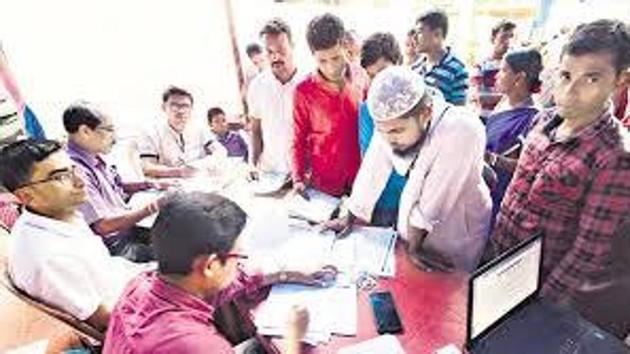
In early 2015, the authorities took 600,000 yellowing, dog-eared copies of the 1951 NRC, along with the voter lists of 1961, 1966 and 1971 census, and started digitising them. Each entry in these documents was assigned a so-called legacy code – a unique combination – that could be used by descendants to establish their parentage. In the course of four months, over 20.1 million legacy codes were generated.
As many as 95% of the 32.9 million applicants from 6.83 million families used these codes to fill up the NRC form. “This was the first big challenge which we overcame,” said an official closely involved in the exercise, recounting how they were not even sure if people would come forward to submit forms. The official didn’t want to be named,
“The biggest challenge was to convince them that this exercise is for the and not against them,” said a deputy commissioner involved in the process.
Over the course of four years, more than 55,000 officials sifted through 64.4 million documents, sitting in 2,500 Seva Kendras equipped with two laptops, one scanner, a printer and a generator. By August 2019, the whole process had cost Rs 12,000 crore.
“Each NSK {NRC Seva Kendra} was manned by a local registrar of citizens registration, two data entry operators, field and block level officers depending on the population the centre is catering to,” explained the deputy commissioner quoted above who also requested anonymity .
Each form was scanned by data entry operators at the NSK and assigned an application receipt number (ARN), a 21-digit number used to track the status of the application. The 120 TB data was put in a hard drive and sent to the centralized database in Guwahati.
This is where software giant Wipro came on board to process the data and helped with 53 different kinds of software applications.
Key among them was Docsmen, used to segregate 64.4 million documents into 83 broad categories like birth certificates, board and university certificates. This helped the authorities send them for backend verification to 75,054 certificate-issuing authorities in India while a few hundred were sent to 37 other countries.
“This software helped a lot in sorting out the documents. For example it could sort out all the birth certificates issued by a particular hospital from all the applications,” said an official familiar with the exercise.
Other applications such as E-Form 1 for offline decentralised data entry, E-Form 2 for corrections, CORRES to centrally check or update claims and ALX for an additional layer of checks.
Once the data was collated, the verification process began. Field officers were sent out to 6.83 million households for house-to-house verification.
In the interim, the state coordinator and his team came up with the idea of family tree verification, and the field officers were asked to collect family tree details from all households.
These handwritten documents were matched with computer-generated family trees and mismatches were called for over 900,000 hearings. In many places, impostors were caught as they were not recognised by the real family members.
The verification process was not without its challenges. For example, in a report to the Supreme Court made public in 2018, state coordinator Prateek Hajela demanded that five documents -- including refugee and migration certificates and ration cards -- should not be allowed, citing poor backend or no record with the issuing authority. In the case of refugee certificates submitted by families of post partition refugees from then East Pakistan, only 7.4% could be verified.
In the report, Hajela also sought a paradigm shift in the NRC motto to “no ineligible person should be included” from “no genuine person should be left out.”
The apex court allowed the submission of five documents but disallowed any alterations. For example, if a married woman had, by mistake, given the name of her father-in-law to trace her lineage instead of her father, she could not rectify it in the claims process.
This decision sped up the claims submission process – an exercise undertaken by those who were left out of the draft NRC published in July 2018 -- and eventually 3.62 million people filed claims. According to officials, over 1.4 million hearings were held.
Applicants received notices to appear for hearings even as recently as August 28, days before the publishing of the final list. They were robbed of any time to prepare for the hearing, which was held the very next day.
Sushanta Talukdar, a political commentator, said since the citizenship determination was a complex exercise it would be wrong to expect it will be foolproof. “But the problems that could arise in the process were taken cognisance of when the consensus was built. And people have other judicial avenues if they face wrongful exclusion,” he said.


