
 E-Paper



Four reasons people didn’t make it to the NRC list
The final list of National Register of Citizens excluded over 1.9 million people.


The final list of the National Register of Citizens (NRC) was released on Saturday and excluded a little over 1.9 million people. HT takes a look at the reasons why some people could not make it to the register:
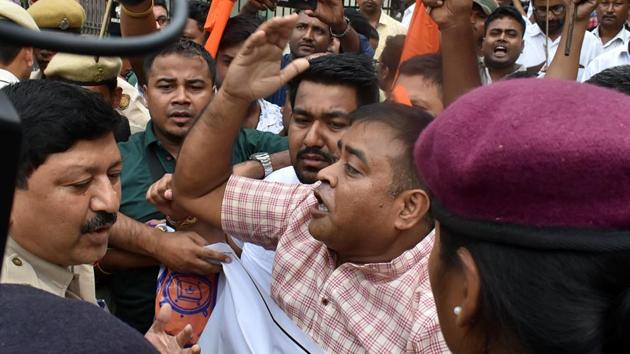
Babul Hajong
A Congress worker, Babul Hajong, said his wife, Monica, and daughter, Rashika, did not make it to the final NRC list as his father’s relief eligibility certificate, a yellowing frayed document he has laminated and kept safely, was not accepted. “My uncles and aunts are there in the NRC. So, I do not understand why have they rejected us,” he said. “I do not know what to do next,” he said. Hajong thinks there will certainly be adverse consequences for him and his family because of the exclusion.
Hajong lives in Derapathar, a village in the Lanka Circle of Hojai district, where people say mainly refugees settled there in 1967. The residents belong to communities like Hajongs, Garos, Dalus and Bengali-speaking Hindus, who fled post-partition violence in then East Pakistan and came to India before 1966.
Abu Sayeed Ahmed
Abu Sayeed Ahmed lives in Barpeta Road town of lower Assam and is used to authorities refusing to give him documents because his father has been marked a Doubtful (D) voter or a suspected foreigner. He is yet to get a chance to prove he is a citizen before a foreigners tribunal. “I have applied for a passport, but they refused it. I applied for a driving license thrice but they would not give me because my father is a D Voter,” he said.
That his father has been marked as a D Voter means Ahmed and his two sisters are also out of the NRC list because D voters, declared foreigners and those with cases pending in foreigners tribunals and their descendants are automatically excluded from the NRC.
He said 31 members of his extended family failed to make it to the final list.
Ahmed, who dropped out of college to work at a pharmacy, is worried that foreigners’ tribunals may not be fair. “They are known to declare foreigners even while people have documents,” he said.
Sayeed said his name not being in the NRC means that problems will only grow from here.
Champa Ghosh Karmakar
Champa Karmakar, a housewife in Hojai town of central Assam, could not make it to the final NRC list. Her husband Krishna Karmakar heads the Bharatiya Janata Party’s IT cell in Hojai district. Krishna Karmakar said he did not know which one of her documents got rejected.
Champa is from Hoogly district of West Bengal. She submitted documents from West Bengal--a birth certificate, another certificate issued by the village headman, and a school leaving certificate.
Krishna Karmakar said her name not being in the final NRC means multiple trips to foreigners’ tribunals to appeal her case. “They should bring in the Citizenship (Amendment) Bill to help people who are finding it difficult to prove their citizenship through documents,” he said, referring to legislation that promises citizenship to non-Muslim refugees from Pakistan, Bangladesh, and Afghanistan.
Tamej Ali
In June, Tamej Ali, a resident of Goraimari of Assam, was a happy man. In his large family of 36 people, 32 had made it to the draft NRC list and just four – most of them children – were out. But someone named John Kalita filed an objection against their inclusion. The family had no idea who Kalita is. The family had submitted as proof a document that showed his grandfather, Mecher Ali, as being included in the 1966 voter list, but to no avail. When the final NRC list came out on Saturday, the entire family found themselves excluded from the citizens’ register. “They said there was a legacy data problem. We can go to court but have never heard of a foreigners’ tribunal,” he said, referring to the quasi-judicial bodies that decide whether someone is an illegal immigrant.


