
 E-Paper



Fresh proposal for NRC divides Assam
Home minister Amit Shah told the Rajya Sabha on Wednesday that India would have a countrywide NRC and Assam would naturally be a part of it.


The prospects of another labyrinthine exercise to count Assam’s citizens and identify illegal migrants has baffled many and polarized opinions in a state that wrapped up the painstaking process only three months ago.
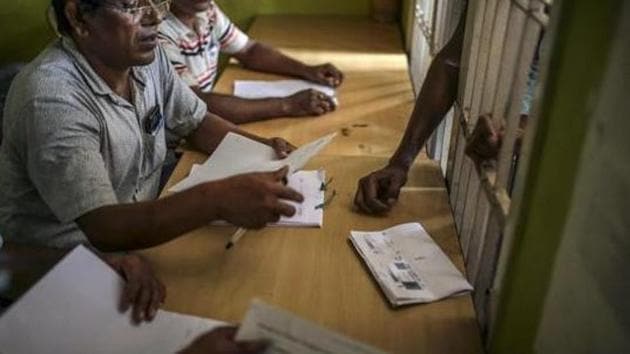
On August 31, Assam published the National Registrar of Citizens (NRC) which declared 1.9 million people of the state’s 32.9 million applicants virtually stateless.
Home minister Amit Shah told the Rajya Sabha on Wednesday that India would have a countrywide NRC and Assam would naturally be a part of it.
Almost on cue, Assam’s finance minister Himanta Biswa Sarma said in Guwahati that his government would ask the Centre to reject the Supreme Court-monitored NRC because it was “full of faults”.
“The state government cannot accept this NRC. People who should not have been included in the NRC have been included. And those who should have been included have been excluded,” Sarma told reporters.
In an interview to HT on September 3, Sarma had first suggested that Assam would be a part of another NRC soon.
The NRC, published in August, updated a citizens’ roll published back in 1951, also known as NRC 1951, in a state where locals have long alleged waves of illegal migration from neighbouring Bangladesh.
The process of updating the 1951 NRC, which started in 2015, had been quite elaborate. Citizens were required to show that they or their ancestors were present in Assam before March 25, 1971 through so-called “legacy data” comprising two sets of documents. One set would establish their ancestors’ presence in Assam before the cut-off date. They then needed to provide a second set of documents to trace lineage to their ancestors.
However, it’s easy for people to be struck off the list in a country where record-keeping is poor.
“We welcome a new NRC because the last one was faulty. It has excluded a lot of deserving Hindu Bengalis, while a lot of illegal Muslim Bangladeshis have found their names included,” said Abhijit Sarma of Assam Public Works, an original litigant in the case.
Many others slammed the move. “How can you say that the Supreme Court-monitored NRC was totally worthless? People with vested interest can only say this,” said Hare Krishna Deka, a former police chief who heads the Axom Nagarik Manch (Assam’s citizens’ forum).
Just because the outcome of NRC does not help the Bharatiya Janata Party (BJP), its government wants to reject it now, said Aman Wadud, a human rights lawyer who fought cases for people left out of the NRC.
The 1.9 million people left out of the current NRC have the option of proving their citizenship in so-called Foreigners’ Tribunals, which are quasi-judicial platforms.
“People have suffered so much in last four years and gone through uncertainties and sleepless nights, running around for documents, standing in long queues, travelling hundreds of kilometers for multiple hearings. If there is another round of NRC , people of Assam will suffer unimaginably,” he said.
Experts pointed to legal hurdles. “The Union government has to first nullify the order of the Supreme Court judgement that ordered NRC in Assam on December 17, 2014 in the first place,” said Upmanyu Hazarika, a senior advocate at Supreme Court.
Hazarika said Assam did not need a fresh NRC but a re-verification of the data. While a countrywide NRC will have 1951 as the cut-off date, the cut-off data for Assam NRC is 1971.
Anyone present in the state on March 25, 1971 is deemed to be a citizen. This has its roots in the so-called 1985 Assam Accord, an agreement signed by the then Union government and leaders of a six-year Assam agitation to oust illegal settlers.
“I think Shah’s statement was a message to Hindu Bengalis and also to a large section of the Assamese speaking people who want more people to be excluded,” said Sangeeta Barooah Pisharoty, the author of Assam: The Accord, the Discord.
Ripun Bora, MP and head of the Congress’s Assam unit, said Shah’s plan for a fresh NRC in Assam would “create turmoil, stall development, tear the social fabric of the country and lead to anarchy in the state.”


