E-Paper



Government will not raise stake beyond 48.9% in Vodafone Idea: Scindia
Union minister for communications Jyotiraditya Scindia had earlier said that increasing stake further in the financially struggling private telecom operator would turn it into a public sector unit

 Prefer HTon Google


New Delhi: The government will not increase its equity stake beyond 48.9% in Vodafone Idea (Vi) in the near future, Union minister for communications Jyotiraditya Scindia said at a media interaction on the sidelines of the the India Mobile Congress (IMC) event on Thursday. He had earlier said that increasing stake further in the financially struggling private telecom operator would turn it into a public sector unit.
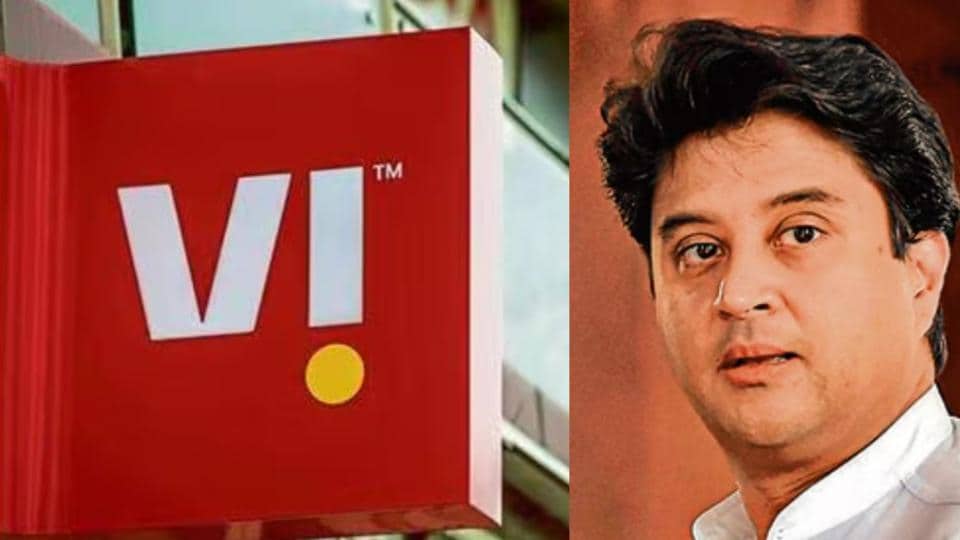
In April 2025, the government had increased its stake in Vi to 48.9% from 22.6%, following the conversion of ₹36,950 crore of the company’s spectrum payment dues into equity shares. A key objective behind the move was to avert a situation where the telecom industry is dominated by the duopoly of Airtel and Jio.
“We are a 49% equity holder. We do not, at this point of time, in the near future, believe in increasing our equity stake,” Scindia said at the second day of IMC 2025.
Speaking about the broader telecom and digital landscape, Scindia said the last decade had seen an exponential change. “We have today 1.2 billion subscribers. It’s the largest penetrated market in the world,” the Union minister said, adding that the country now accounts for 20% of the world’s mobile users.
Scindia noted that the digital economy, which currently contributes about 12-14% to India’s GDP, is expected to grow to 20% over the next 10 years. Referring to Prime Minister Narendra Modi’s inaugural address on Wednesday, Scindia said India has become the fifth country in the world to develop its own 4G stack — after Denmark, South Korea, Sweden and China — now operational across almost 1 lakh (100,000) towers. “Within just 20 months, we’ve built a fully indigenous 4G system, which will soon be upgraded to 5G. It reflects our vision of ‘Build in India, Build for the World’,” he said.
On the future of telecom innovation, Scindia said India is positioning itself as a global leader in 6G technology through the Bharat 6G Alliance, which now has over 80 members. The alliance aims for India to secure at least 10% of global intellectual property (IP) share once 6G standards are finalised.
India Telecom Technology Development Fund and cybersecurity initiatives like the Financial Fraud Risk Indicator are further strengthening the country’s digital ecosystem, he said. About 30 ministries collaborated for IMC 2025, with secretaries, ministers of state, ministers and other representatives taking part in multiple sessions in a day.