
 E-Paper



Amid wrestlers’ protest, BJP’s approach in dealing with deadlocks back in focus
Large-scale protests dominated the headlines when the Citizenship Amendment Act was passed in Parliament in 2019.

 Prefer HTon Google


The Union government’s approach to resolving deadlocks is back in focus with the ongoing protest by a group of wrestlers, who have levelled charges of sexual misconduct against a Bharatiya Janata Party lawmaker. The accusations have cast a shadow on the ongoing month-long celebrations to mark the government’s nine years in power at the Centre.
Also read: ‘Neither compromised nor defeated’: Wrestlers warn restarting stir if no arrest made
The face-off between the wrestlers, some of whom are Olympic medallists, and the government is the most recent example of public perception and pressure nudging the latter to act and end a protracted stalemate.
Less than a year after it came to power at the Centre in 2014, the government’s efforts to introduce land acquisition reforms hit a wall as it led to countrywide protests, and opposition from offshoots of the party’s ideological fount, the Rashtriya Swayamsevak Sangh. The government had to give in to the demands and Prime Minister Narendra Modi in a radio address in 2015 announced the withdrawal of the proposed reforms. Modi said the decision was made taking cognisance of “farmers being misled, and a fear psychosis created”.
Large-scale protests dominated the headlines when the Citizenship Amendment Act was passed in Parliament in 2019 to accelerate the grant of citizenship to persecuted minorities from the neighbourhood. Concerns and fears that the new law and the proposed National Register of Citizens would threaten the rights of minorities in India set the stage for another protracted agitation that saw women and children sit-in for months on end in the national capital and elsewhere.
The government was back to the negotiating table after farmers in Punjab, Haryana and Uttar Pradesh sat in protest for a year demanding the roll-back of the three farm laws passed in Parliament in 2020. After several rounds of talks failed to yield results, it was again Modi who announced the roll-back of the farm reforms.
In all these instances, the government was accused by the protestors and its political opponents of using a brute majority in Parliament to pass laws and overlook concerns. “Despite our party being an ally, whose core constituency is agriculturists and who repeatedly flagged concerns about the farm laws, the government did not heed our advice,” a leader of the Shiromani Akali Dali, a former ally of the BJP, said on condition of anonymity.
The current stand-off between the government and the wrestlers has been festering since January, when they first sat on protests demanding legal action against Brij Bhushan Sharan Singh, the BJP MP from Kaiserganj in Uttar Pradesh who is also the president of the Wrestling Federation of India.
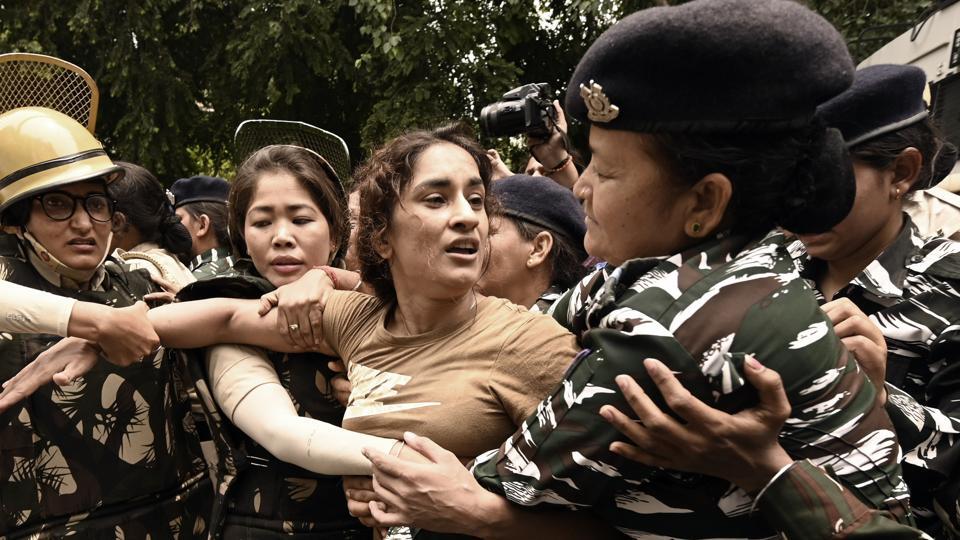
The government, which initially said the legal process to address the complaints was underway, had to step up efforts to resolve the crisis following a public outcry over the way the wrestlers were prevented from marching to Parliament on May 28 by police while the new Parliament building was being inaugurated.
Visuals of the wrestlers being dragged led to a deluge of criticism and condemnation from sportspersons and organisations, including the International Olympic Committee, United World Wrestling and the Indian cricket team that won the 1983 World Cup.
With the issue dominating headlines and invoking international reactions, home minister Amit Shah met the wrestlers and it was followed by sports minister Anurag Singh Thakur assuring the protestors of swift action.
While party leaders defend the government’s stance, some of them admitted that there seems to be a perception that the government acts after public pressure begins to mount. In the past nine years, there have been several large-scale protests over policy matters, forcing the government to backtrack.
While the government is “open to discussions” and “making amends”; there seems to be a perception that the government does not show alacrity in quelling protests and stemming narratives that are detrimental to its own image, a party leader said, seeking anonymity.
“There are various levels for negotiations. The government has various ways of reaching out talking to people, but most of the protests have been politicised, vested interests hijacked the issues and then the government’s reasoning was not accepted,” the leader said. “So, it is not right to say the government fails in problem resolution.”
A second leader, who has been part of backchannel talks with a group of protestors, said the government’s response has to be nuanced and calibrated, otherwise the fear of protest will derail policy decisions.
Tempers run high during stalemates, making engagement challenging, the second leader said, wishing to remain unnamed. “We listen, sometimes we face abuses, but it is our job to reach out. And this has been the template for addressing all protests and concerns,” he said.
The government’s claims notwithstanding, the SAD leader quoted above said that the government errs in not initiating discussions before moving ahead with legislative processes. “In the case of land acquisition reforms, union minister Nitin Gadkari was deputed to speak to farmers. Nothing came off it till the Swadeshi Jagran Manch threatened a stir. Similarly, the farmers were first dubbed as misled, then called anti-national, but eventually the PM apologised,” the SAD leader said.
Also read: Four wrestlers share audio, visual evidence against former WFI chief with police
On the delays in breaking logjams, the SAD leader said, “This is now a pattern for all protests. First thrust changes, then discredit the protest and when pressure increases, then backtrack.”
The government has, however, been successful in controlling the narrative on contentious issues, for instance, when Modi announced demonetisation of high-value currency in 2016 and when Article 370 was read down and the state of Jammu and Kashmir bifurcated in 2019.
“It was not an easy decision, but people have faith in the PM and when he spoke about the reasons for demonetisation, people supported it even as they faced difficulties. Similarly, the PM’s address about the lockdown in 2020 during the pandemic was well received. It was only after some state governments failed to look after migrants that a crisis erupted,” said the first BJP leader quoted above.


