
 E-Paper



Govt forms 5-point strategy for 12 states with sharp surge
The strategy was finalised after a high-level review meeting chaired by Union health secretary Rajesh Bhushan with senior officials of the 12 states and the UTs, according to a statement by the ministry of health and family welfare.


The Centre has asked the 12 states and union territories reporting a surge in the number of coronavirus disease cases to adopt a “five-fold strategy” to arrest the spread of the disease, an official statement said.
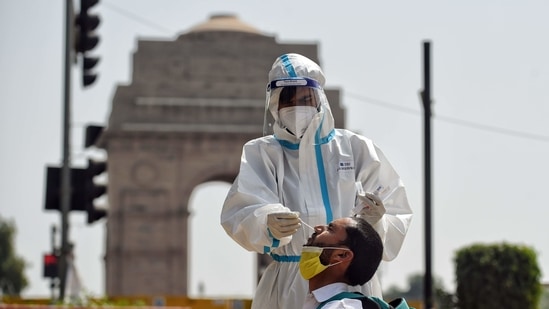
Besides the “strong advice” given by the Centre for a significant increase of testing in all districts in line with their positivity rate, the strategy to be adopted included effective isolation and contact tracing of those infected, re-invigoration of public and private healthcare resources, ensuring of COVID appropriate behaviour and targeted approach to vaccination in districts reporting large numbers.
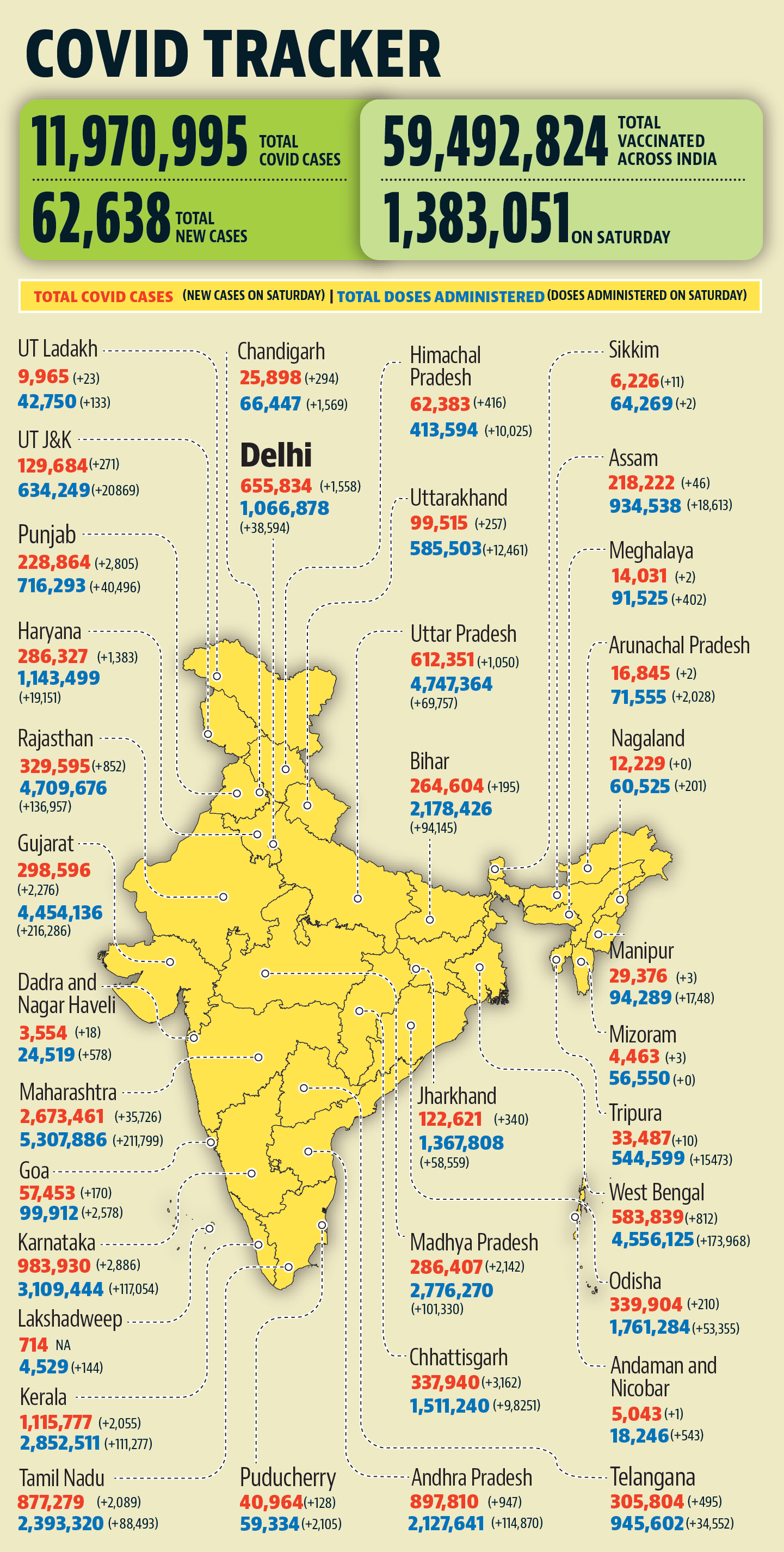
The strategy was finalised after a high-level review meeting chaired by Union health secretary Rajesh Bhushan with senior officials of the 12 states and the UTs, according to a statement by the ministry of health and family welfare. The states and Union territories are Maharashtra, Gujarat, Haryana, Tamil Nadu, Chhattisgarh, Madhya Pradesh, West Bengal, Delhi, Jammu and Kashmir, Karnataka, Punjab and Bihar.
“Through a detailed presentation, the states were informed that the country has seen the sharpest rise in weekly COVID cases and fatalities since May 2020 (7.7% and 5.1% respectively),” the statement said.
These states and union territories have been asked to optimally utilise all vaccines available without keeping a buffer stock and utilise all vaccination capacities both in public and private sector. The unused stocks of vaccines in the states should focus on the high-burden district, Centre told the states.
Also read | Delhi’s Covid-19 caseload from last 3 days higher than total cases last week
According to official data, there are 46 “most affected” districts that reported 71% of all the cases in the country and 69% of all the deaths recorded this month.
Maharashtra which has reported a record number of cases this week accounted for 25 of the 46 districts of concern. Maharashtra was followed by Gujarat with four districts of concern and Haryana and Tamil Nadu with three districts of concern each. In Delhi, one of the eleven districts has been identified as the most affected.
The states and union territories reporting a surge have been asked to significantly increase the number of tests being conducted and to ensure that the more accurate RT-PCR test accounts for 70% of the total tests being conducted.
In addition to testing, the states have also been asked to trace and isolate 30 contacts on average for every positive case within 72 hours.
“One infected person could spread COVID-19 to an average of 406 other individuals in a 30-day window without restrictions which could be reduced to just 15 by decreasing physical exposure to 50 per cent and to a further 2.5 (average) by decreasing physical exposure to 75 per cent,” the statement said.
In the meeting, it was pointed out that Punjab and Chhattisgarh, despite being smaller in population size than Karnataka and Kerala, were reporting higher number of deaths.
The data showed that almost 90% of all the deaths reported in the country were among those above the age of 45 years.
Also read | Over 59.4 million Covid-19 vaccine doses administered in India, says government
According to the statement, states have also been asked to ensure that Covid-19 appropriate behaviour is followed, especially in crowded places such as markets, inter-state bus stands, schools, colleges, railway stations. It was highlighted that the concept of ‘second wave’ reflected more the laxity among everyone regarding COVID-appropriate behaviour and virus containment and management strategy at the ground level.
The centre advised that celebrations of Holi, Shab-E-Barat, and Easter must be restricted to within homes and local leaders and religious heads should be roped in to create awareness among people.
States were also asked to make advance planning of logistics and infrastructure for 1-1.5 months as any unchecked spread of infection may overwhelm the local administration.
India on Saturday registered 62,258 new infections in a day, the highest single day rise so far this year, and also the highest since October 16 last when 63,371 new cases were reported in a span of 24 hours.


