E-Paper



Gujarat high court notice to Ajanta-Oreva group over Morbi tragedy
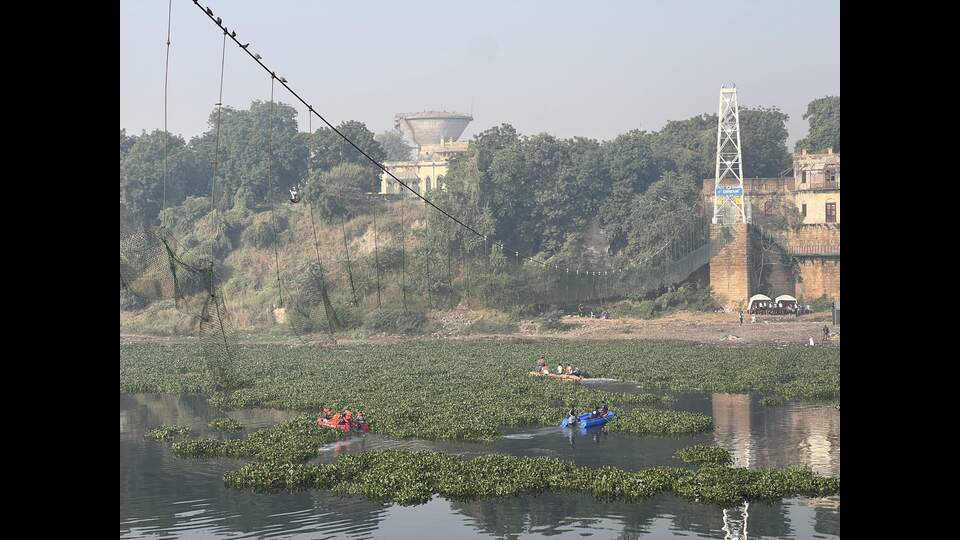
The group was awarded the contract to maintain and operate the British-era suspension bridge, which collapsed here on October 30, killing 135 people.

 Prefer HTon Google


Calling the Morbi bridge collapse that left 135 people dead on October 30, a “catastrophe”, the Gujarat high court on Wednesday shot down a plea by 46 councillors of Morbi municipality, demanding they be heard before any adverse order is passed regarding dissolving or superseding the civic body.
The court also issued a notice to Ajanta-Oreva Group, which was awarded the contract to maintain and operate the British-era suspension bridge, and which renovated the bridge shortly before the accident, on a plea demanding compensation from the company for the unfortunate deaths.
Also Read: Morbi councillors urge Gujarat govt to reconsider decision to disband civic body
Taking up the petition registered by the high court on its own, a bench comprising chief justice Aravind Kumar and justice Ashutosh Shastri noted that the councillors appear to have approached the court to “thwart the proceedings” and that mere apprehensions of certain future events do not entitle them to a hearing.
“During the course of the proceedings, we have observed as to what all are the powers available to the state and in this background and having regard to the catastrophe or the tragedy which had struck within the jurisdiction of Morbi municipality, also observed that there was default on the part of the civic body,” said the court.
It added: “Even before any decision is taken, and merely on the likelihood or apprehension that such action would be taken, the present application has been filed to thwart the present proceedings...If at all, there are any steps taken by the state, which obviously in the manner known to law, it would be open for the applicants to challenge the said decision.”
The bench pointed out that it asked the state during the previous hearings in November and December as to why the state has not exercised its power under section 263 of the Gujarat Municipality Act to supersede and dissolve the municipality, citing incompetency, default or abuse of power as reasons.
Also Read: Morbi civic body guilty of dereliction, says Gujarat high court
“What would be the (dispute) between the state and the civic bod as an off shoot of the tragedy would not be subject matter of this proceedings until the cognisance is taken by this court or the said issue is adjudicated by this court,” said the bench, dismissing the councillors’ plea.
During the proceedings, the court also sought a response from the Ajanta-Oreva Group by January 19 on a plea that has sought to make it a party in the case. The petition, filed by Dilipbhai Chavada, a resident of Ahmedabad, who lost both his brother and sister-in-law in the tragedy, has argued that Ajanta-Oreva Group should ordered to pay t compensation to the kin of the victims.
It is for the first time that Oreva – flagship company for Ajanta, the world’s biggest wall clock manufacturer – was issued notice by the court.
The more than a century-old bridge in Morbi city was reopened on October 26, on Gujarati new year, after being shut for nearly six months for repairs. Oreva was entrusted with the repair work. The bridge was crammed with people when it caved in around 6.40pm on October 30, killing 135 people.
On November 21, the Supreme Court the bridge collapse an “an enormous tragedy” while requesting the Gujarat high court to examine the matter on a periodical basis to ensure the investigation fixes accountability of those guilty of criminal negligence as well as to offer adequate compensation to the next of kin of 135 victims, which included 37 children.
Till now, nine people have been arrested — two Oreva group managers, two ticket-booking clerks, three security guards and two private contractors hired for the repair and renovation of the bridge. Jaysukh Patel, managing director of Oreva group, is yet to be called by the police for questioning. He has not appeared in public since the incident.
A first information report (FIR) registered by the police at Morbi ‘B’ division police station on October 31 does not name Oreva and its promoters. The FIR, seen by HT, shows “agencies responsible for maintenance and management of the hanging bridge” as the main accused, along with others whose names emerged during the course of investigation.
On November 1, the high court took suo motu cognizance of the collapse and issued notices to state government officials, including the home department and urban housing department, and the Morbi municipality and the State Human Rights Commission.
On November 15, it questioned why no bids were opened and criticised the way in which the contract was handed out for the operation, maintenance and repair of the bridge. It also pulled up the local civic agency, which appeared to avoid the court’s calls for a response.
The court also criticised the state government for the manner in which the one-and-a-half page agreement was signed between the Morbi municipality and the Ajanta-Oreva group in March this year to repair and maintain the bridge for fifteen years, suggesting protocols may have been violated. It had asked the government to file its reply in two weeks’ time.
The state government told the court on November 15 that a memorandum of understanding was signed between Morbi municipality chief Sandeepsinh Zala and Ajanta promoters on March 8, 2022 to operate, maintain and repair the suspension bridge for a period of fifteen years. This agreement was subject to approval from the general board of the Morbi municipality. The bridge was re-opened to public on October 26 by the private company without informing the authority about the kind of repair work done. There was no independent third-party certificate given regarding structural stability, holding capacity or fitness of the bridge.
“On the day of the tragedy, there were 3,165 visitors on the footbridge in the entire day. About 300 people were allowed to enter the bridge from both ends around 6.30 pm on that day and it appears that the bridge would have collapsed as a result of such a large gathering,” the state’s advocate general Kamal Trivedi told the court on November 15.
Trivedi told the court that prior to the MoU signed in March 2022, the bridge was maintained and operated by the same Ajanta-Oreva group for a period of nine years from 2008 to 2017.
On December 12, the state government submitted before the court the findings of Special Investigation Team (SIT) report which, among others, show lapse on part of Oreva in repairs, maintenance and operation of the bridge. There was no restriction on the number of persons accessing the bridge at a given point in time. Also, there was no restriction on sale of tickets leading to unrestricted movement on the bridge, according to SIT report.
“A perusal of the preliminary findings recorded by the Special Investigating Team would disclose that main cable was formed by 7 strands each comprising of 7 steel wires. Total 49 wires were clubbed together in 7 strands to form this cable and they were found and observed that out of 49 wires, 22 were corroded which would indicate that those wires were already broken before the incident. The remaining 27 wires are said to have recently broken. It would also indicate that no load test or structural test was conducted before permitting that opening of the bridge and repair work was completed on October 25 and bridge was opened on October 26,” the court observed on December 12 based on the SIT report.
It would also indicate that movement on the bridge was not regulated and several design faults were found in the bridge post renovation works which led to the failure of the bridge, the court had said.
In the aftermath of the tragedy, the state government suspended Sandipsinh Zala, then chief officer of Morbi municipality, who signed the MoU with the private firm.