
 E-Paper



Haryana power employees call off strike after government moves to block license to Gurugram private firm
Power company employees have called off their strike, which caused widespread outages, after the government promised there would be no privatisation.

 Prefer HTon Google


The Haryana government on Friday said it has told the state electricity regulatory commission to cancel the decision to award a parallel distribution licence to a private firm for Gurugram and Nuh that had triggered a strike by employees of state-owned power company and consequent blackouts in these areas for the past three days.
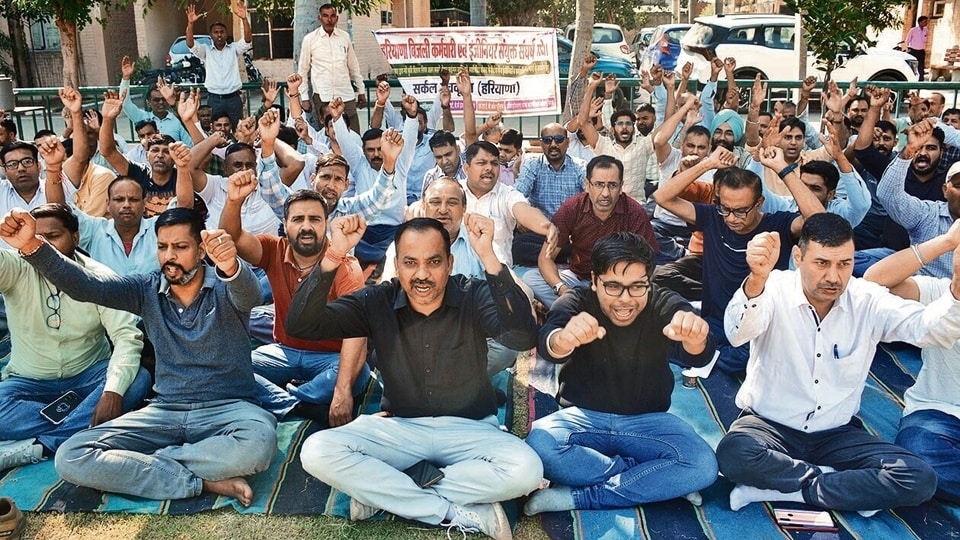
Chief Minister Nayab Singh Saini, at joint press conference with union representatives, said the strike had been called off. He added that the government had invoked Section 108 of the Electricity Act, 2003—which governs the power of state governments to issue policy directions to state electricity regulatory commissions—for approaching the Haryana Electricity Regulatory Commission (HERC).
Union welcomes government’s decision
All Haryana Power Corporation Workers’ Gurugram district union president Amarjit Jakhar said that they welcome the Haryana government’s decision not to grant licence to the Eleven Power Private Limited. “The government has also agreed to write to HERC to reconsider its decision to grant the licence which we wanted. Thus we had called off the strike,” he said, adding further meeting with the energy minister Anil Vij will take place on November 3.
He said the power utilities in the state are profit-making and bringing private players in it will ruin then.
HERC did not respond to HT’s requests for a comment on the matter.
Also Read | Haryana power employees’ strike disrupts supply across districts, 40,000 join protest
Eleven Power Pvt Ltd, which was given a 25-year parallel distribution licence for the Gurugram and Nuh revenue districts on October 19, did not comment on the state government’s move despite repeated calls and messages to its representatives.
The chief minister said the government had given assurances to the employees before they called off the strike. “Our employees will now immediately resume their duties. Our position is absolutely firm; there will be no privatisation of any kind,” Saini added.
“We have consistently maintained that we stand fully with the electricity employees’ union, and we reiterate that position today. It should be noted that the HERC is an independent agency operating under its own Act. ..Exercising our authority under Section 108, the government has directed the HERC to review the matter and effectively cancel that provision,” he said.
Employee unions had had argued that a private operator could potentially attract commercially lucrative urban and industrial consumers while the public distribution company-- Dakshin Haryana Bijli Vitran Nigam (DHBVN) in this case-- continued serving a larger share of rural and agricultural consumers. They had also raised concerns over the future of around 40,000 regular, contractual and outsourced employees and engineers of DHBVN.
Energy Minister Anil Vij had earlier indicated that the government would invoke Section 108 to address the dispute.
Also Read | Haryana unions call off 3-day strike after power cuts in Gurugram, other areas
Government cites public and consumer interest
In its written directions to HERC on Friday, the Haryana Energy Department said it noted the grant of the licence had faced opposition over alleged concerns relating to statutory requirements, minimum area of supply, capital adequacy, creditworthiness, technical capability and universal service obligations.
The state government said it was not presently going into the correctness of the findings recorded by HERC in its October 19 order granting the licence. Instead, it said its decision was based on the financial implications for the state government, consumer interest and wider public interest.
The government asked HERC to not to create, operationalise or effectuate a parallel distribution licence anywhere in Haryana.
The government’s intervention came after the employee agitation that started on October 21 caused widespread disruption to electricity supply across Gurugram and other parts of Haryana.
In Gurugram, residents in several areas reported outages lasting more than 24 hours, while some localities faced disruptions extending beyond 40 hours. Low voltage in some areas also affected water supply as pumps could not operate.
Police were deployed at substations and discom offices amid concerns over protests and law-and-order issues.
Also Read | Gurugram on outage alert ahead of power workers’ strike
Eleven Power’s plans and proposed investment
Eleven Power had maintained that its proposed network would provide consumers an alternative distributor and had planned phased development across Gurugram, Manesar, Sohna and Nuh.
The company had also said it planned to invest approximately ₹4,717 crore in developing the distribution network over five years.
Amid questions raised over its financial capacity, the company had said ₹91 crore had already been infused as equity for Phase I and that banks had issued in-principle sanctions of ₹205 crore for Phase I debt.
Karan Chopra, managing partner, Eleven Group, said the company’s initial paid-up capital of ₹1 crore at incorporation in June 2025 had subsequently been followed by a higher authorised capital of ₹1,500 crore.
Frequently Asked Questions


