E-Paper



Have past delimitation exercises led to gerrymandering?
Gerrymandering is the practice of manipulating electoral boundaries (constituencies) to favour a particular political party or group.

 Prefer HTon Google


Parliament reconvened on Thursday to debate and (possibly) vote on three bills which will lead to the reallocation of Lok Sabha seats among states, delimitation of constituency boundaries, and reserving 33% of the new constituencies for women. The women’s reservation part of the legislative agenda is, historically speaking, the least controversial.
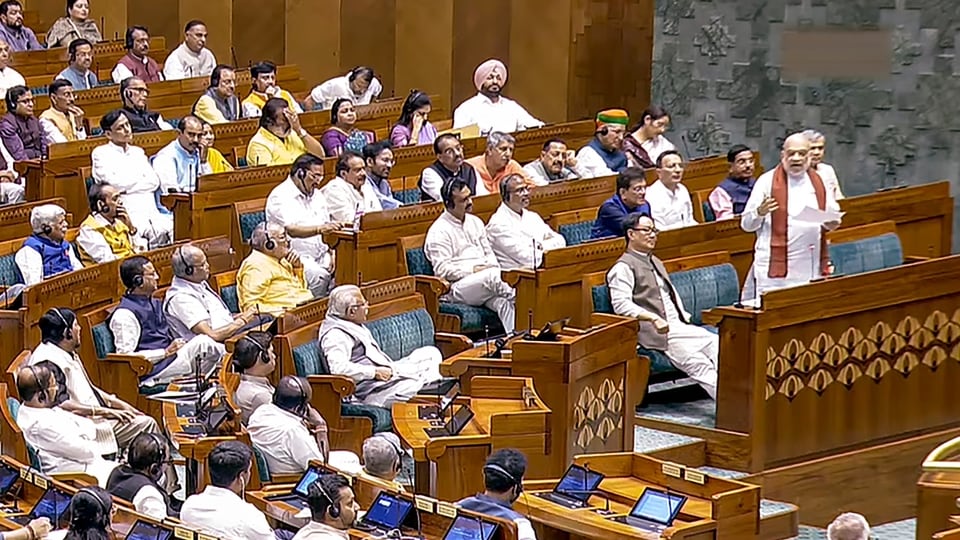
While the bills still do not state this in writing, the government insists — and the Union home minister confirmed in the House — that the state-wise proportion of Lok Sabha seats will remain intact after the changes. This brings us to the third exercise: delimitation, which will involve redrawing constituency boundaries.
Delimitation to redraw constituency boundaries
In a first-past-the-post (FPTP) system, translating vote shares into seat shares – the latter determines winning or losing power – is always difficult to predict. A key driver here is the nature of the contest. Fragmented contests can generate a higher share of seats even with lower vote shares than bipolar ones. However, redrawing constituency boundaries can also make a large difference.
This is especially true when political loyalties are divided along caste and religious lines, as is often the case in most parts of India. Theoretically, there also exists a possibility that a redrawing of constituencies which can confine opposition’s likely supporters (a particular caste or religion) into fewer constituencies can help a ruling party.
The perverse incentives around redrawing constituency boundaries are not unique to India. This feature and debate exist in many democracies and there is a term for it: gerrymandering.
No change in state-wise seat share?
At least one speaker from the Congress party in the Lok Sabha, Gaurav Gogoi, accused the government, claiming its real intention behind the proposed delimitation exercise is gerrymandering for political gain. How true are such allegations? It is impossible to answer this question now. To be sure, the currently proposed delimitation is not the first one in India’s history. What has been the past experience on this front?
A water-tight examination of this argument requires comparing the quantitative and qualitative changes in the attributes of constituencies in prior delimitation exercises.
Credible data on qualitative attributes of constituencies does not exist because electoral rolls are not disaggregated by caste and religion. This leaves us with a limited opportunity to compare the quantitative attributes of constituencies.
Gerrymandering concerns raised
Yesterday, these pages showed that the number of electors varies significantly across parliamentary constituencies even within states. This means that guidelines and legal provisions for the delimitation cannot help in creating ideal constituencies where each constituency has nearly equal number of electors.
The guiding document for the last delimitation only stated that the, “the constituencies shall be so re-delimited that population (on the basis of 2001 census) of each parliamentary and assembly constituency in a State shall, so far as practicable, be the same throughout the State”.
Clearly, there is no mandate to arrive at equal number of electors per constituency, only population. Even if the share of voting age population in each constituency’s population was the same, registered electors can always vary depending on deadwood electors, as the Special Intensive Revision (SIR) exercise has shown.
The new delimitation bill is yet to be passed, but there is no reason to believe that its guiding principles, at least on paper, will suggest something very different from the 2008 delimitation. We also have a preview of what a delimitation exercise under the current government will look like because delimitation has already occurred in the union territory of Jammu and Kashmir and in the state of Assam. These two did not undergo delimitation in 2008.
How does the 2023 delimitation in Assam and 2022 one in Jammu and Kashmir fare on the principle of constituencies being largely equal in terms of electors? Does it mark an improvement or worsening from the previous arrangement on this count when compared to the pre-delimitation arrangement?
Here is what the data shows.
Constituencies still show a very large variation in number of electors.
In Assam, the assembly constituency (AC) with the smallest elector count had just 50% of the average electors per AC in the 2024 Lok Sabha election, the first post-delimitation election. This number was 63% in 2019 Lok Sabha election. At the other extreme, the number has changed from 220% in 2019 to 156% in 2024.
To be sure, the overall picture is less drastic than what these extremes suggest but one-fourth of the state’s ACs had a divergence of more than 20% either way from the average number of electors per AC in 2024. This situation was pretty much the same in 2019 too. Things are not very different in pre- and post-delimitation Jammu and Kashmir as well. These trends also hold true when looking at parliamentary constituencies (PCs) in Assam and Jammu and Kashmir. (See Chart 1)

What about the 2008 delimitation which happened when the Congress, not the BJP was in power? A comparison of state-wise divergence between actual electors in a parliamentary-constituency (PC) and average electors per PC shows that extreme values existed both in 2009 and 2004, the post- and pre-delimitation elections. However, the degree of extreme divergence decreased in most big states after delimitation. Most big states also saw a decline in the number of PCs diverging by more than 20%. (See Chart 2)

As discussed above, quantitative distribution of electors is only one part of the debate in what the government will call delimitation and the opposition, gerrymandering.