
 E-Paper



HT Archive: Integration to integrity - The mission before India
On India's 50th Independence Day, introspection on governance is crucial; calls for reform highlight the need for stability, accountability, and transparency.

 Prefer HTon Google


(Edited excerpts of an article written by former Prime Minister Atal Bihari Vajpayee that appeared on August 15, 1997.)
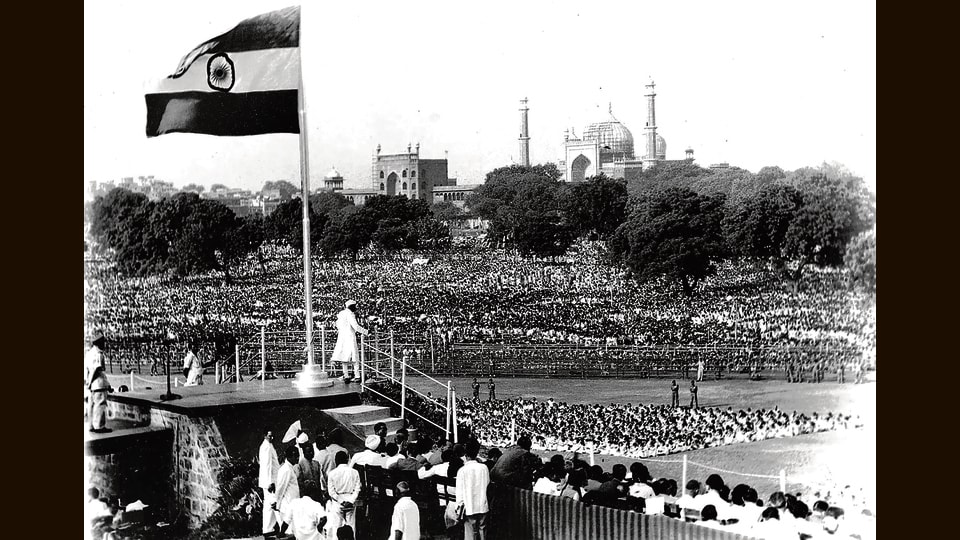
The 50th anniversary of India’s Independence is definitely an occasion to celebrate. But it is also an occasion for introspection, for taking stock of our system of governance and deliberating on what can be done to ensure both stability and accountability.
This means seeking a comprehensive answer to the question: Should we continue with the present framework of governance or should we make a radical departure and introduce changes in the system so that the lessons of the last 50 years are not wasted?
Also Read: Tales from Delhi of homes lost, hope found
In view of the experiences of the past five decades, a section of the intelligentsia today strongly feels that parliamentary democracy has “failed” and that India should adopt an entirely new system, for example the Presidential system.
This view has gained ground in the past one year of increasing political instability in the country and decreasing account ability of government. We all know that political stability is essential not only for maintaining law and order, but also to speed up the process of development.
Also Read: How Partition reshaped Delhi – and its soul
Of course, stability does not mean statism. It means a government that can function with near, if not absolute, unanimity on matters of governance. This unanimity is provided by any single party’s strength of numbers.
There are more than 100 parties in our country today. Thirty parties are in the Lok Sabha alone, not to speak of smaller parties. Today we have one-man parties, without any ideological identity or organisational apparatus. One such party has only one member who is a minister! Another party has only two members who also are ministers. One Prime Minister has been removed; another has taken his place. The government comprising 13 parties, now 14, is dependent on outside support from two parties.
The ruling party has split and nobody knows who belongs where. The predicament of these two parties is that they cannot afford to withdraw support, they do not have a choice. Yet, there is instability in the environment, though not in the number of those supporting the present government. It is against this backdrop that people have begun saying that the system should be such that a government lasts five years. In the Presidential system, the President cannot be removed no matter whether he is elected for a five or four-year term; he can, however, be impeached. Such a system has assured, in-built durability and stability.
Also Read: Foot soldiers who won India freedom
Yet another problem that stares us in the face today, and which needs to be solved immediately, is that in the race for power, political parties are displaying open disregard for the principles of realpolitik and constitutional ideals. This shows a lack of national character. Their main goal has become usurping power and retaining it by whatever means.
Standing at the threshold of a new millennium, we must ask ourselves two questions: Where is stability? Whatever happened to accountability? There is an accepted norm in the parliamentary system that when the minister is in the House, you can ask any question. But parliamentary democracy cannot ensure that the answer given by the minister will be right, responsible at least.
Neither can it ensure that the members asking questions will come prepared. I have seen members who, despite being in Parliament for five years, cannot ask a supplementary or sub-question. Few people do their homework. This is the state of our parliamentary experiment.
Also Read: When Delhi’s monuments became shelters
These days, when we talk of corruption, we talk in terms of crores. During the regime of Jawaharlal Nehru, one Calcutta-based company had given ₹10,000 to a friend of a Congress minister to contest an assembly election in Uttar Pradesh. The company had mentioned it in its accounts book. He was a petroleum minister. The company was raided, the accounts book seized and the entry against the minister’s name was discovered. Newspapers published it, we read them the next day. There was an outcry in the Lok Sabha.
In those days, ₹10,000 was a big amount. Nehru initially tried to defuse the matter because the minister was influential and close to him. But later he had to bow before the House, even the members on the government side demanded an investigation. The issue was serious. No one tried to cover it up. This was the response to corruption in those days.
Nehru handed over the investigation to a retired Supreme Court judge, informally if not formally. He looked into the matter and concluded that the minister should resign. The minister had taken only ₹10,000. Now it has reached crores, but no one resigns. In fact, there are politicians who seek to rule from jail by proxy.
One reason behind today’s rampant corruption is the phenomenal cost of elections. Parties have to collect money from people who seek returns. But this is only one reason. The other reasons is that our parties do not function in transparent manner. The BJP now insists on issuing receipts and maintaining full details of all donors. But which other party does so? And what about the “system”?
There is no mention of political parties in the Indian Constitution, which should have been there. Democracy runs on the party system. The parties should be registered, there should be proper membership, regular elections should be held in the parties, their accounts should be audited and made public to ensure transparency.
Every paisa should be accounted for. Sadly, all this does not happen. So, let there be amendments to the Constitution. Until now. no such effort has been made by successive governments. Even now no one is talking on these lines.
On this Independence Day, let us resolve to continue making efforts to build a new structure for a better political system, a system that is stable and transparent. We did not have the time to do so while framing our Constitution. Now we can rethink it while simultaneously working within the present structure.
The government, let us remember, should be free of corruption, it should be accountable and stable. Many contemporary leaders these days won’t talk of accountability; they openly ask “Why have you made corruption your main issue?” Our answer to this is: If corruption is allowed at high levels, what will happen to the common man? Our national life? Can it be limited to politics?
If the task in 1947 was to integrate the nation, then the task today is to restore integrity to public life. Let this be the goal set by all Indians on this 15th August.
HT Archive: Despite big economic gains, many gaps remain


