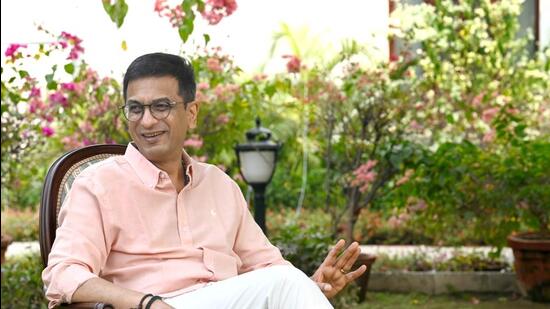
Chief Justice of India (CJI) Dhananjaya Y Chandrachud on Saturday emphasised the importance of restraint in the Supreme Court’s use of judicial powers when it comes to appointments within the judiciary, pushed back against the belief that judges must be atheists to remain objective, and underlined that true independence of the judiciary allows judges to decide impartially, regardless of whether the outcome favours or challenges the government.
CJI Dhananjaya Y Chandrachud at his residence in New Delhi on Saturday. (Vipin Kumar/HT Photo)
As he prepares to step down on November 10, the CJI delivered a candid reflection on his tenure in an interview with HT, highlighting a vision for India’s judiciary centred around judicial independence, restrained use of judicial power in appointments, and stronger support for bail at the trial court level.
“The Supreme Court should be very careful in using its judicial powers to facilitate judicial appointments,” the CJI said, underscoring the need for “constitutional statesmanship” and open dialogue with the government rather than resorting to judicial intervention in the appointment process.
Addressing judicial independence, he challenged the notion that a judge’s personal beliefs compromise impartiality, while urging the courts to support trial courts in granting bail to avoid undue detention before conviction.
In discussing judicial appointments, CJI Chandrachud acknowledged the limitations of the current collegium system but defended its role and authority in vetting candidates. “Obviously, no system is perfect,” admitted the judge, noting that both the collegium and the government play significant roles in the process. He advocated timely adherence to the Memorandum of Procedure, which mandates the government’s acceptance of reiterated Supreme Court recommendations. Yet, he cautioned against the Supreme Court leveraging its judicial power to enforce appointments, saying: “If we were to use our judicial powers to ensure that a particular appointment is made, we would be open to the criticism that we are using our judicial powers to essentially facilitate our recommendation.”
The CJI’s stance is markedly different from some prior benches that took a more interventionist approach to press for appointments through judicial orders. Justice Chandrachud’s tenure saw the dropping of a controversial contempt matter related to judicial appointments from the listing by a bench led by justice Sanjay Kishan Kaul (since retired) -- a development that stirred speculation and discussion over the judiciary’s role in such matters.
CJI Chandrachud also addressed public expectations of judicial independence, pushing back against the belief that judges must be atheists to remain impartial. “To say that you will not be able to do justice merely because you are a person of faith… is wrong,” he declared, underscoring that personal beliefs do not impede a judge’s ability to deliver fair judgments.
Responding to public critique that arose after he was seen visiting temples that some critics objected to while citing his role as a judge in the Ayodhya judgment and the ongoing Gyanvapi mosque case, justice Chandrachud maintained that judicial decisions should be evaluated based on legal reasoning rather than assumptions about personal beliefs, calling for an understanding that aligns judicial independence with “reasoned and documented” outcomes rather than religious neutrality.
The statements from the CJI came amid public scrutiny; judgments from benches he led in high-stakes cases, such as the constitutional challenge to the abrogation of Article 370 and the Adani-Hindenburg case, have both been hailed and criticised by various pressure groups.
Highlighting a key issue of his tenure, CJI Chandrachud expressed concern over the lower judiciary’s reluctance to grant bail, a stance he attributes to a “culture of distrust” within the judicial system. He revealed that the Supreme Court handled more than 21,000 bail cases during his term, a volume he believes should not reach the apex court if trial courts were more confident in upholding the principle that “bail is the rule, jail is the exception”.
The hesitancy, the CJI explained, arises partly from a pervasive fear among lower courts of facing backlash over bail decisions in high-profile cases. He urged higher courts to support trial judges in exercising discretion, cautioning that “undertrial custody should not become a penalty in itself”.
He further highlighted the need to avoid unjust detention due to delays in trials, stressing that cases cannot languish indefinitely and that detention without timely trial “should not result in a penalty”.
On gender diversity within the judiciary, CJI Chandrachud noted that strides have been made during his tenure to increase female representation in the judiciary. Justice Chandrachud underlined the importance of seniority and merit in appointments that he said was one of the reasons why no woman could be appointed as a judge in the Supreme Court even as the collegium headed by him appointed 18 judges during his two-year tenure. The CJI, however, acknowledged the rising numbers of women entering the judicial system at the district level. This influx, he believes, will eventually transform representation across all judicial levels.
“If we change the whole framework of the legal profession today… we will then change the position of women in the high court and Supreme Court for the future,” he remarked, stressing that efforts to promote diversity and equality within the profession must start at the foundational levels of recruitment.

 E-Paper