
 E-Paper



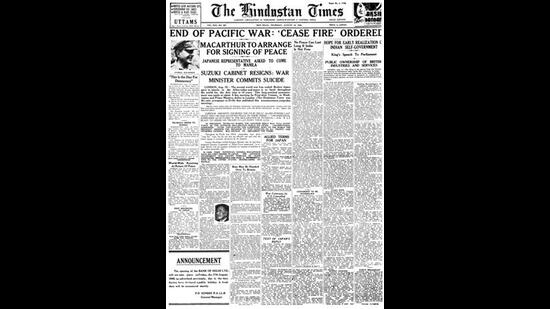
HT This Day: August 16, 1945 -- End of Pacific War: ‘Cease fire’ ordered
The second world war has ended. Broken Japan gave in utterly to the Allies today and peace is at hand throughout the world for the first time in 14 years.


The second world war has ended. Broken Japan gave in utterly to the Allies today and peace is at hand throughout the world for the first time in 14 years. This long-awaited announcement was made at about 6 this morning by President Truman in Washington and Prime Minister Attlee in London. (The Hindustan Times was the only newspaper in Delhi that published this announcement yesterday morning).
Exactly three weeks after the Potsdam ultimatum “surrender or be destroyed,” 10 days after the first atom bomb smashed Hiroshima and seven days after the Soviet declaration of war, Japan has admitted defeat.
Emperor Hirohito informed the four great Allied powers last night that he had accepted peace on their terms - unconditional surrender as outlined in the declaration of Potsdam- and w as ready to order his troops to lay down their guns.
In President Truman’s words, the Japanese reply was “full acceptance of the Potsdam declaration which specified unconditional surrender.” After announcing the surrender news to the world the president ordered the Japanese to stop fighting on all fronts and informed General MacArthur to implement the terms.
Throughout the Pacific area Allied commanders have given “cease fire” order, but the war does not officially end until after the formal signing of surrender documents by the Japanese.
General MacArthur notified Emperor Hirohito that he had been designated Supreme Commander of Allied Forces empowered “to arrange directly with the Japanese authorities for cessation of hostilities at the earliest practicable date.”
In firm terse sentences, General Macarthur gave his first orders to Japan. The Japanese government was told by wireless to cease hostilities immediately and send a representative to the United States headquarters at Manila.
“The representative will be accompanied by competent advisers representing the Army, the Navy and the Air Force,” the message said. “He must present documents authenticated by the Emperor empowering him to receive the requirements of the Supreme Commander.”
Elaborate arrangements were detailed for the safe conduct journey of the party by plane from Japan to the little island of le just west of Okinawa. They were told to use unarmed Zero model aircraft painted white with I green crosses beneath. Six hours’ advance notice of its departure was demanded.
At the same time General MacArthur ordered the Japanese Government and Imperial General Staff to put a radio station at his continuous disposal for sending further orders.
SUZUKI RESIGNS
The Japanese Cabinet resigned today and Premier Kantaro Suzuki went before the Emperor Hirohito to humble himself and his Government for having brought Japan to a disastrous defeat. Suzuki saw the Emperor again and the Imperial rescript was proclaimed making it final. The Emperor accepted the resignations of Suzuki’s Cabinet but asked Suzuki to carry on “pending the appointment of a new Premier.”
Emperor Hirohito himself explained the defeat by saying “the enemy has begun to employ his most cruel bomb” and should Japan continue to fight “it would lead to total extinction of human civilization.”
A Domei agency said Admiral Suzuki “expressed a desire to comply with His Majesty’s wishes” indicating that Hirohito had requested the resignation of the Cabinet. Suzuki’s last official act was to admonish the Japanese to obey the Emperor and mourn. His lot has been an unhappy one for he came to power after Koiso and assumed office when Japan had started on the down grade.
Weeping warlords bowing to the ground surrounded the bespectacled “Son of the Heaven” at the fateful Cabinet meeting in the Imperial Palace in Tokyo yesterday which marked the final collapse of their ambitions.
The Japanese News Agency today stated that the meeting was called on the personal initiative of the Emperor, and lasted for one and a quarter hours. The agency said: “His Majesty listened silently as his Ministers and military and naval chiefs offered their views. After they had spoken His Majesty was graciously pleased to take the final decision to accept the terms of the Potsdam declaration, since he thought that the Allied reply recognized his authority as sovereign rule, although such a course involved much that would be hard for his imperial ancestors and the nation to endure.”
The agency concluded: “All those present were profoundly impressed by the gracious concern of His Majesty for his subjects. They silently bowed obedience and wept.”
The Japanese War Minister, Korechike Anami, committed ‘hara-kiri’ to “atone for his failure in accomplishing his duties.”
This is the first suicide reported after the news of Japan’s surrender.
A “TEMPORARY” LOSS
A Tokyo broadcast to the “fighting fronts” picked up in New York today informing Japanese troops of the surrender said: “We have lost, but this is temporary “
The broadcast was given by Mr Kusuo Oya, Chief of the Japanese Broadcasting Company’s Overseas Bureau.
Mr Oya added that Japan’s mistake was “lack of material strength and necessary scientific knowledge an equipment This a stake we must amend.


