
 E-Paper



HT This Day: Dec 14, 1949 -- Lords approve India republic bill
The India (Constitutional Provision) Bill, which embodies adjustments to British law made necessary by India’s decision to become a Republic, was given unopposed passage by the House of Lords today.


The India (Constitutional Provision) Bill, which embodies adjustments to British law made necessary by India’s decision to become a Republic, was given unopposed passage by the House of Lords today.
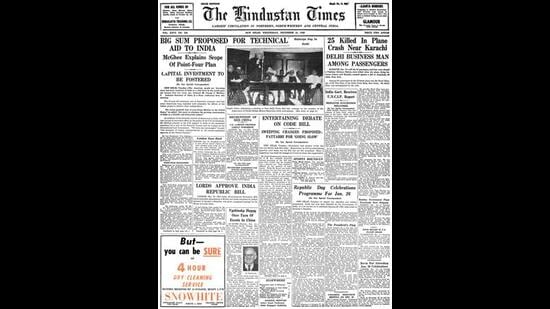
It had already been passed by the House of Commons and now only awaits the formal Royal Assent to become law.
The Bill ensures that the whole of the existing law will continue to apply to India, Indians and their property as if India had not decided to become a Republic.
Similar provisions will apply in colonial Protectorates and British trust territories.
Moving the second reading of the Bill, Viscount Jowitt, the Lord Chancellor, said that the Commonwealth could never claim to have been a wholly logical association of States.
The hallmark of the Commonwealth which distinguished it from any other association of States in the history of the world was that there was, and always had been, complete freedom extending to all its members.
“It is idle to pretend that some of us do not regret the formation of a Republic,” he added.
“Yet all of us recognize India’s right to work out her own salvation on whatever lines seem to her best to accord with her history, her traditions and her hopes for the future.”
Lord Jowitt said the legal implications of the new Indian Constitution which would come into force in January had to be considered.
What, for instance, would be the position of Lord Sinha, Indian peer, whom they all rejoiced to have as a member of the House of Lords?
Then there was Mr Madhavan Nair, who for many years had given most valuable assistance in the Privy Council.
What would be the position of all those people who with the necessary technical qualifications and degrees were carrying on their professions in Britain? It was to clear away these and similar difficulties that the Bill was introduced.
The Lord Chancellor said he regarded it as almost certain that in the future India would pass her own legislation dealing with citizenship.
He fully contemplated that when she did Britain would have to look at her own laws and perhaps produce legislation arising out of Indian legislation.
“I am certain we are all united in wishing India and the people of India happiness and prosperity for the future,” Lord Jowitt said.
BENEFITS FOR ALL
Lord Clydesmuir (Conservative) said the Bill conferred considerable benefits on India, but Britain should acknowledge the great benefits she and the sister nations of the Commonwealth obtained by continuance of India in their fellowship.
“One has only to look further east to China, where the spread of doctrines at variance with the conception of free nations is taking place, to realize that India, in a close and happy association with the rest of the Commonwealth, can make a great contribution to the stability and peace of the world.”
Lord Reading (Liberal) said the fact that the Bill was now on its unimpeded way to the statute book was one further testimony to the supreme fact that the Commonwealth was not a manufactured article but an organic growth.
Lord Pethick-Lawrence (Labour) former Secretary of State for India, said he sympathized with the regret that India should have become a Republic rather than remain a Dominion in the same position as the other Dominions. “But I understand also how difficult it would have been for that great people of 300,000,000 souls to have taken any other course than that they have actually taken.
“The important thing after all is that India has elected to remain within the Commonwealth. That is a tremendous fact, or great benefit to India herself and to this country and the rest of the Commonwealth. Without it our Commonwealth would have been cut into two.


