
 E-Paper



HT This Day: June 22, 1976 -- Triumph on smallpox front
India will celebrate the first anniversary of freedom from smallpox on July 5. According to the Union Health and Family Planning Minister, Dr Karan Singh, it is a “feat no less significant than the launching of a satellite.”


India will celebrate the first anniversary of freedom from smallpox on July 5.
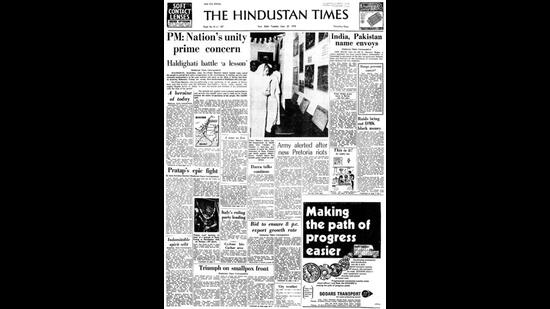
According to the Union Health and Family Planning Minister, Dr Karan Singh, it is a “feat no less significant than the launching of a satellite.”
World Health Organisation Director-General, Dr Halfdan Mahler has hailed India’s achievement as “accomplishing the impossible.” It was one of the greatest victories of the entire global smallpox campaign, he pointed out.
During the most intensive campaign in 1973-75, jeeps, motor launches and even elephants were used to reach inaccessible areas to combat the disease and prevent its reappearance.
The scale of the achievement can well be gathered from the fact that as late as 1974, 1,88,003 cases and 31,262 deaths were reported.
The last indigenous case was reported on May 17, 1975, from the Katihar district of Bihar. Thereafter, one case, imported from the Sylhet district of Bangladesh, was detected in Cachar, Assam, on May 24, 1975.
The credit for- the disappear of the disease, according to the health experts, goes to an interplay of a number of factors ranging from the epidemiological edge that smallpox has over other communicable diseases from the point of view of the control, the availability of good vaccine and the extremely competent management and execution of a well-defined eradication strategy.
Active co-operation between various agencies, like the WHO, the Central and the State Governments, the public and the private sectors, mass media, voluntary organisations and the people at large, was another crucial factor in making the campaign a success. Workers belonging to other departments were also mobilised for the purpose, particularly in Bihar.
The Central Government spent about four crore rupees during 1974-75 as assistance to the States for the appointment of additional staff and supply of vaccine. Another rupees four crore were spent by the State Governments on their own during the same year.
While there was a certain rigidity in the expenditure of Government funds, the WHO assistance was utilised in a more flexible manner, with the epidemiologists being given full authority over the funds to be spent within a given ceiling and guidelines. To ensure mobility of the personnel involved in the work, the WHO supplied 259 jeeps and 239 motor-cycles during 1973-75, To reach inaccessible regions, motor launches, boats and even elephants were hired.
Epidemiologically, the control of smallpox admittedly is relatively easy as compared to other communicable diseases. There is no human carrier stage as is the case of diphtheria and typhoid, nor any animal carriers as in rabies; and no insect vector as in malaria.
The achievement of zero status is the first stage in the eradication of smallpox. If no indigenous case is detected for a period of two years, after the last case the country will, by 1977, claim to have eradicated smallpox.


