E-Paper



Number Theory: NATO’s expansion & why it plans to ‘Trump-proof’ its Ukraine fund
The five charts here show what Sweden brings to the table

 Prefer HTon Google


The North Atlantic Treaty Organization (Nato) has started planning for a $100 billion aid programme for Ukraine, in order to “Trump-proof” its support to the embattled nation. However, the United States has urged caution over aspects of the proposal put forth by Nato secretary-general Jens Stoltenberg on Wednesday (CHECK). The proposal also backs taking over the Ramstein Group, which was set up by the US to coordinate military supplies to Kyiv from the West. This comes nearly a month after the military alliance officially added Sweden to its roster as its 32nd member on March 7. The five charts here show what Sweden brings to the table, what Nato’s enlargement means for the security paradigm in Europe, and the alliance’s dependence on the US, which makes it wary of a possible American pull-out in the case of a repeat of Donald Trump’s presidency.
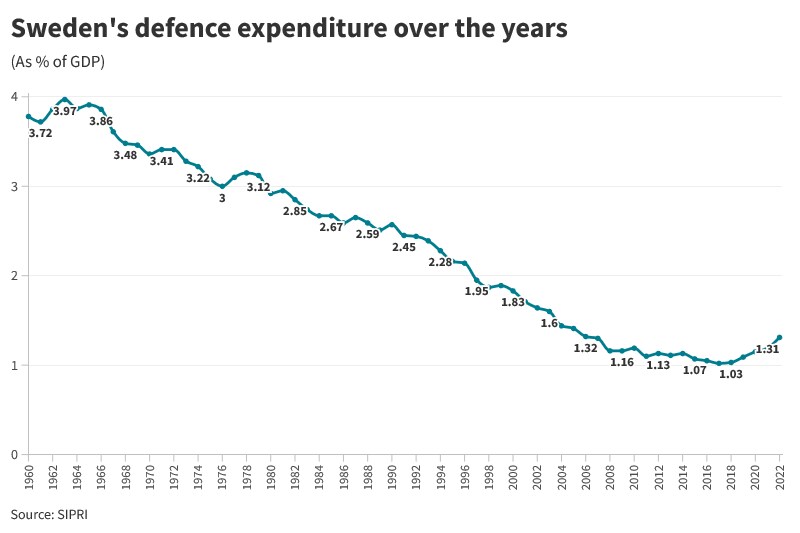
 What does Sweden bring to the table?Sweden has nearly consistently reduced its defence spending (seen as the proportion of its GDP) since World War II. However, this trend has seen a slight reversal since 2018. Defence spending was clocked at 1.31% of Sweden’s GDP in 2022, the highest this figure has been in the last 16 years, according to the Stockholm International Peace Research Institute (Sipri). However, despite its increased impetus on defence, the country’s defence budget pales in comparison to what larger Nato nations such as the US and the UK spend. To be sure, Sweden has always had a strong defence industry — even when its domestic defence spending was dropping, it was still exporting arms. The country has increased its share in global arms exports from 0.33% in 1950 to 1.03% in 2023, and ranks 14th in the list of top arms exporters globally.
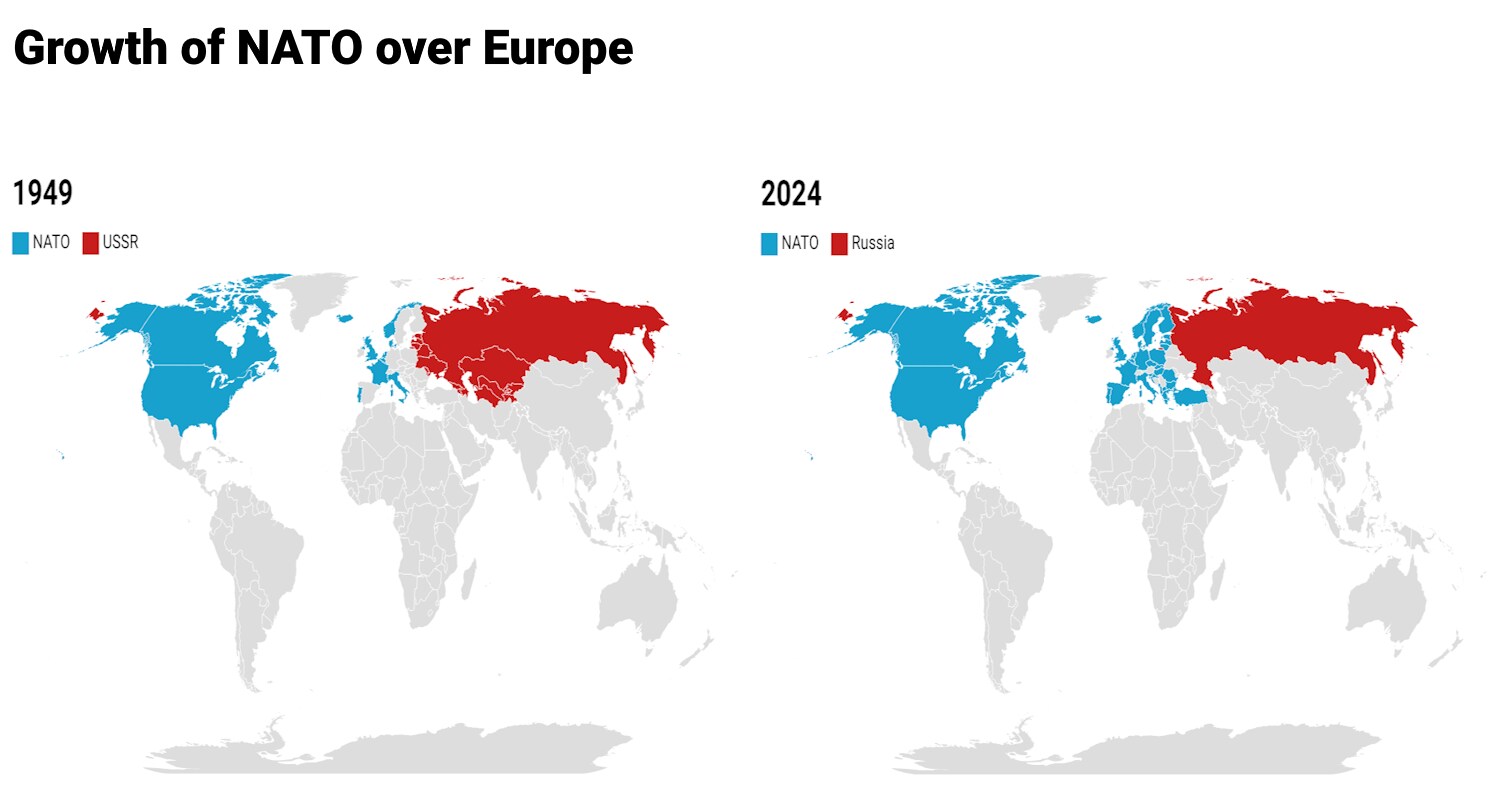
- How does enlargement impact Nato?In the past, Nato could expand itself while keeping its expenditure in check due to the relatively benign security environment in Europe. However, with a hostile Russia, this can no longer be the case. A report by Center for Strategic & Intelligence Studies released in 2021 estimates the cost for Nato to defend Sweden during an incursion could be as high as $6.4 billion, as one-time costs, with further annual costs of $1.1 billion as the war prolongs. Meanwhile, for Georgia, an aspiring member, the cost to hold its borders in the event of an attack could be as high as $6.95 billion as one-time cost with $7.12 billion as annual costs thereafter. Map 1 and 2: Enlargement of NATO
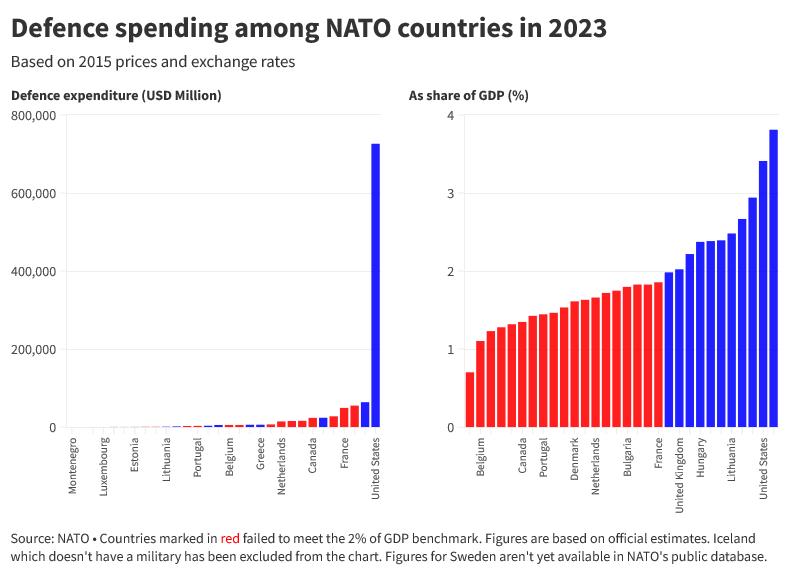
- Dependence on the United StatesNato members voluntarily provide the personnel and equipment required for its operations, on the basis of their capabilities. This system puts an unequal share of burden on the larger members — largely the US. In 2014, all members agreed to spend an equivalent of 2% of their GDP in defence. However, estimates for 2023 shows that only 11 countries have fulfilled this objective. That is just 35% of the members, including Iceland, which has no military. Nato countries spent an estimated $1.10 trillion in real terms on defence in 2023. However, the US alone accounted for more than two-thirds (67.6%) of this. Nato’s heavy reliance on the US has led to criticism that Europe has “outsourced” its security to one country. This is why a return of Donald Trump, who has threatened to pull the US out of NATO, could pose a significant threat to the bloc’s existence.
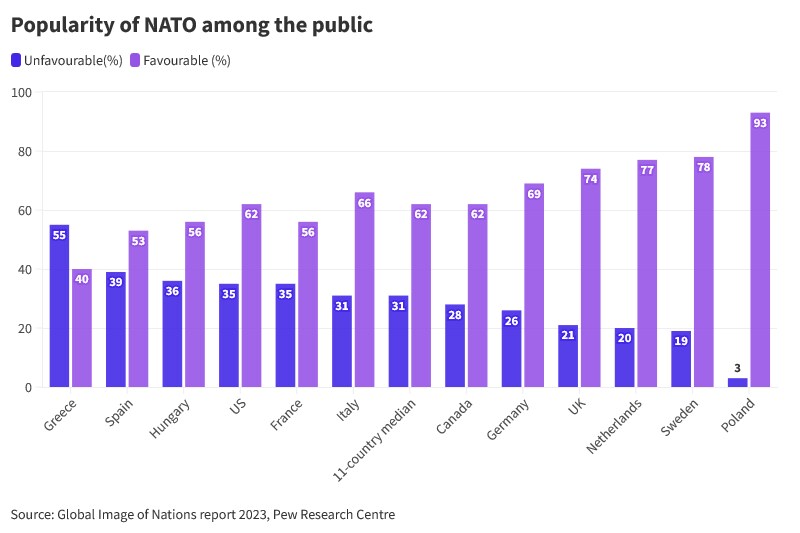
- But Nato’s popularity has increased among its membersA majority of people in Nato nations have a favourable view of the bloc. According to Pew Research Centre, as much 78% of people in Sweden harboured a favourable opinion of Nato in 2023. This is an uptick compared to 2016, when only 58% of Swedes had a positive opinion. The Ukraine war, in particular, appears to have had an impact on the bloc’s popularity, with a rise in ratings among most surveyed countries in 2022. It’s popularity also varies according to political ideology. In the US, as much as 55% of conservatives don’t view the alliance favourably, while as much as 78% of liberals had a favourable opinion. This stark polarisation in views also shows how domestic politics have increasingly been impacting Nato.
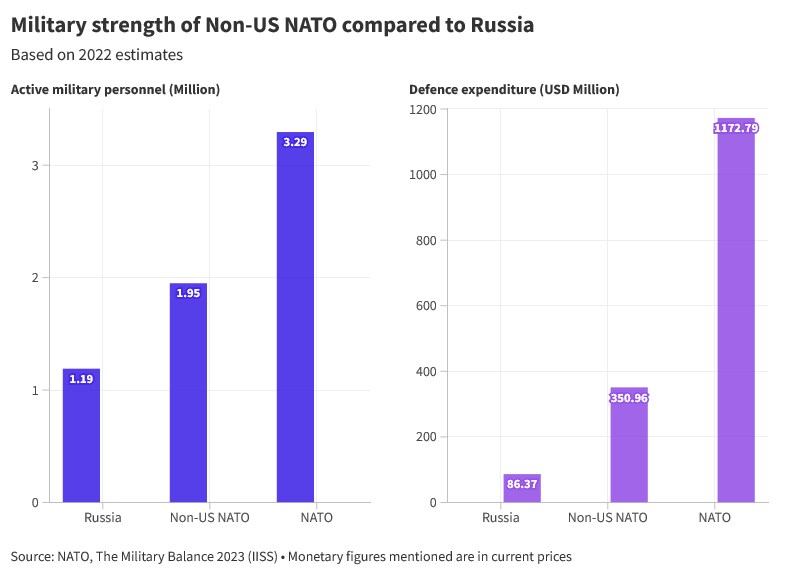
- A Nato without the US can hold-off Russia on paper, but ground realities are more complexThe nominal defence budget of Russia in 2022 was estimated to be $86.37 billion. Meanwhile, non-US Nato nations combined spent four times that ($351 billion) on defence. Furthermore, Nato countries without the US had an estimated 1.95 million active personnel in 2022, while for Russia, this figure stood at around 1.19 million. These figures flatter Nato’s European members, but they might not offer a comprehensive picture, as their combat-readiness remain questionable. “Nato’s European land forces are currently not at sufficient readiness to meet the requirements of the Nato Force Model by the end of 2023. Achieving required readiness levels will need ambitious improvements to collective training, equipment availability, and logistic stockpiles,” said a recent report by The International Institute for Strategic Studies (IISS).