
 E-Paper



Imprisonment to bail: How the 32-yr-old legal journey unfolded
A bench comprising justices L Nageswara Rao and B R Gavai found his conduct inside and outside the prison satisfactory and granted him bail on Wednesday.

 Prefer HTon Google


After 32 years of wait, the Supreme Court’s bail to A G Perarivalan— a life convict in the Rajiv Gandhi assassination case — is being viewed by his support system as a milestone in a long journey.
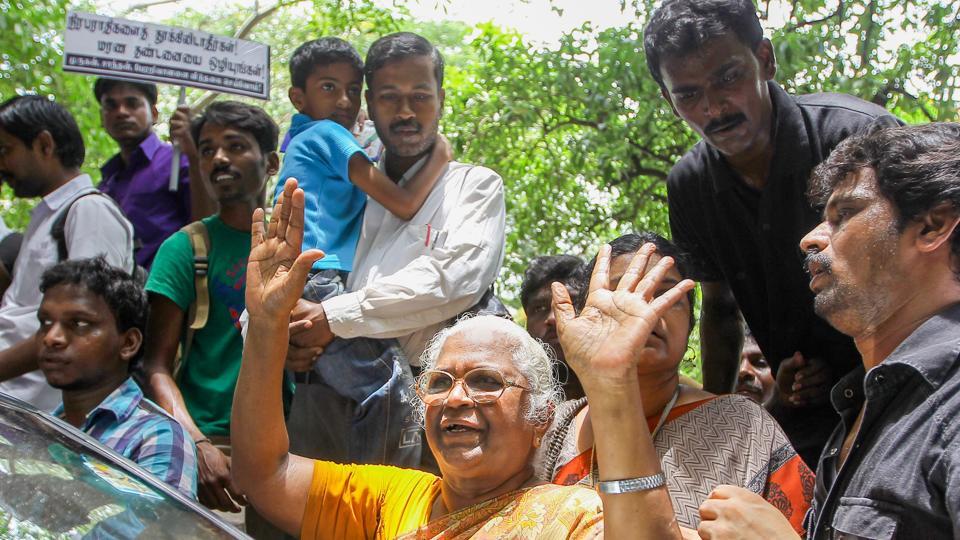
Besides lawyers, his septuagenarian mother Arputham Ammal has flown across the country to meet every political leader under the sun, to help in the release of her son. “It has been a very long legal battle and today marks an important part of that journey,” said a person closely associated with Perarivalan, pleading anonymity.
Perarivalan is currently on his third parole to undergo medical treatment for various illnesses that he developed while serving his jail term, much of which was in solitary confinement. While he has been fighting to be released, claiming innocence in the case, this is the first time he has received bail.
“He has been on parole for over 10 months and we had submitted details of his good conduct in prison (for over 30 years), which has been a valid point in him getting the bail. We will have more clarity once we receive the court’s order,” said Perarivalan’s advocate K Sivakumar. “In recent months, the Supreme Court has been granting bail for several life convicts. Today, we received it. We hope this is a forerunner to his release.”
A bench comprising justices L Nageswara Rao and B R Gavai found his conduct inside and outside the prison satisfactory and granted him bail on Wednesday.
On May 19, chief minister (CM) M K Stalin had granted him parole on medical grounds based on his mother’s request that he had high blood pressure, kidney infection, rheumatism, and gastrointestinal disorders which required continuous medical treatment. The parole was extended. A parole has several conditions, including him not being allowed to meet people but a bail gives him more relaxations. Perarivalan is among the seven life convicts in the Rajiv Gandhi assassination case. The former prime minister was assassinated on May 21, 1991 in Tamil Nadu’s Sriperumbudur by a woman suicide bomber Dhanu, belonging to the Liberation Tigers of Tamil Eelam (LTTE). A total of 16 people died in the incident.
All political parties in Tamil Nadu except the state’s Congress unit have been in favour of the release of the seven convicts. “Congress has been saying from the beginning that we will accept what the Supreme Court orders in Rajiv’s assassination,” said Tamil Nadu Congress Committee president K S Alagiri. “It was the SC that punished them, reduced their sentence and now it has given bail. We don’t have any different opinion on this now.” After the DMK formed the government in May, Stalin had written to the President seeking their release.
Perarivalan was 19 when he was arrested for buying two nine-volt batteries which were used in the bomb that was detonated. He has since maintained that he was unaware of the purpose for buying the batteries.
In October 2017, a former CBI officer, V Thiagarajan, who recorded Perarivalan’s statement in 1991 told the Supreme Court that he had omitted the part of his statement where he said he was not aware of the purpose for which he bought the batteries. K T Thomas, one of the Supreme Court judges who was part of the bench that sentenced Perarivalan among others to death had written to Sonia Gandhi noting that the CBI’s investigation had several flaws. Their death sentences were later commuted to a life sentence.
In 2018, the Tamil Nadu cabinet unanimously passed a resolution for the release of all seven convicts and sent it to governor Banwarilal Purohit. Three years on, the central government informed the Supreme Court (which termed the governor’s delay extraordinary) that he was waiting for the probe by the MDMA (Multi-Disciplinary Monitoring Agency- the CBI’s the Research and Analysis Wing) set up to examine the larger conspiracy behind the assassination to be completed. In January 2021, the SC gave the governor a week’s time to decide but he stated that the President was the competed authority to decide on remission.
The bail order was a vindication of the state government’s stand, says DMK spokesperson and advocate S Manuraj. “The original petition sought the SC’s intervention in the Article 161 process because the convicts had urged the Governor to consider their release and the state cabinet passed a resolution to this effect,” said Manuraj.
Additional solicitor general KM Nataraj appeared for Centre and informed the Court that the President is yet to decide on the mercy plea. “It is a serious issue where he is responsible for a former Prime Minister’s death. He was a death row convict who has already been granted commutation... For his entire life he has to remain in jail.”


