E-Paper



In 1911, why did British India shift its capital from Calcutta to Delhi. Decoding the reasons behind the move
Delhi’s history, location and political significance all played a role in the British decision to move the capital from Kolkata in 1911

 Prefer HTon Google


Today, Delhi is synonymous with political power in India. Parliament, the President's residence and the Union government's headquarters are all located in the city. However, more than a century ago, the seat of British power was elsewhere.
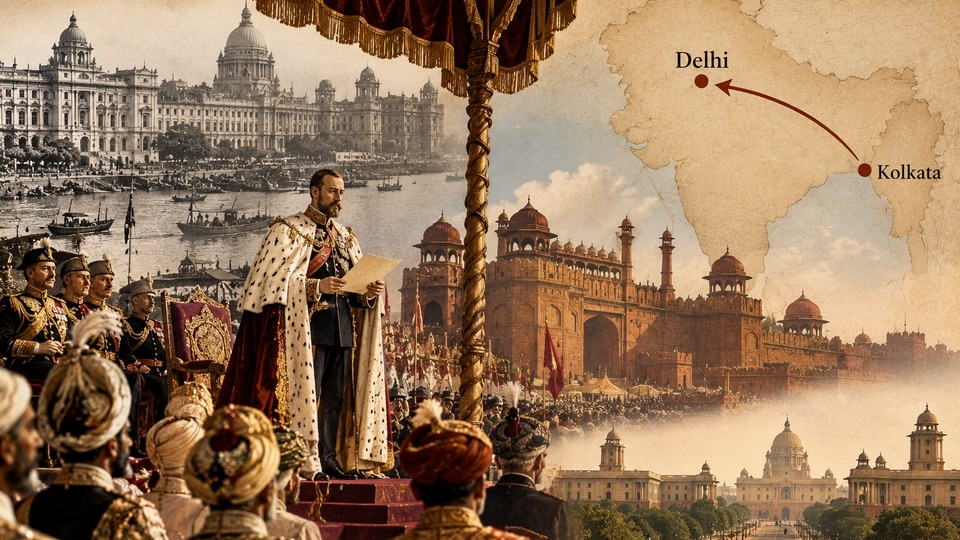
Until 1911, Calcutta was the capital of British India. That changed on December 12, when King George V announced at the Delhi Durbar that the seat of government would be transferred to Delhi. The decision also marked the beginning of the construction of an entirely new imperial city, which would come to be known as New Delhi.
Why Delhi?
One of the main reasons for choosing Delhi was its long history as a seat of power. Before British rule, Delhi had been the centre of several kingdoms and, most notably, the Mughal Empire. The British were well aware of the city's association with the Mughals.
Their decision to hold imperial Durbars in Delhi in 1877, 1903 and 1911 can be seen as an attempt to connect the British Raj with the city's tradition as a centre of imperial power. The 1911 Durbar was particularly significant, as it was there that the transfer of the capital from Calcutta to Delhi was announced.
The choice of Delhi was also driven by practical considerations. Calcutta was located in the eastern part of British India, making it relatively remote from several key regions. Delhi, by contrast, was more centrally located and had strong transport connections.
At the beginning of the 20th century, Delhi was an important railway and commercial junction. Its railway network connected the city to several parts of the country. Travel to Shimla, the summer capital of British India, was also relatively convenient, with the hill station accessible by train.
The political climate in British India also played a role in the decision. The controversial partition of Bengal had triggered a wave of nationalist unrest in the region. Although the partition was eventually annulled, it had already damaged the image of the Raj. The capital's close association with Bengal had also become a political liability for the British administration.
The announcement of the capital's transfer to Delhi, along with changes to Bengal's administrative structure, was therefore part of a broader effort to address political discontent. Both decisions were announced against the backdrop of wider political and administrative reforms discussed during the 1911 Delhi Durbar.
Delhi becomes New Delhi
The decision to transfer the capital to Delhi did not mean that the entire British administration simply moved into the existing city. Instead, a new administrative centre was planned on Raisina Hill, on the outskirts of Delhi.
The new imperial capital was designed by British architects Edwin Lutyens and Herbert Baker. They laid out its grand avenues and designed many of the government buildings that would eventually form the heart of New Delhi.
The new capital was formally inaugurated in 1931.
Delhi's selection as the capital was therefore shaped by both practical and symbolic considerations. Its central location and extensive transport links made it an accessible administrative centre, while its long history as a seat of political power gave the city a significance that few other places could match.
More than a century after the 1911 announcement, Delhi remains the political centre of India, combining its geographical importance with a deep historical association with power and governance.