E-Paper



In a first, Uttarakhand uses drone to redirect elephants back into forest
Uttarakhand is the first state in the country to have a have dedicated drone force for surveillance and monitoring its wildlife.

 Prefer HTon Google


For the first time, the Uttarakhand forest department used a drone to redirect an elephant herd back into the forests after it had raided a sugarcane field in Terai area of Udham Singh Nagar on Friday, a top official said.
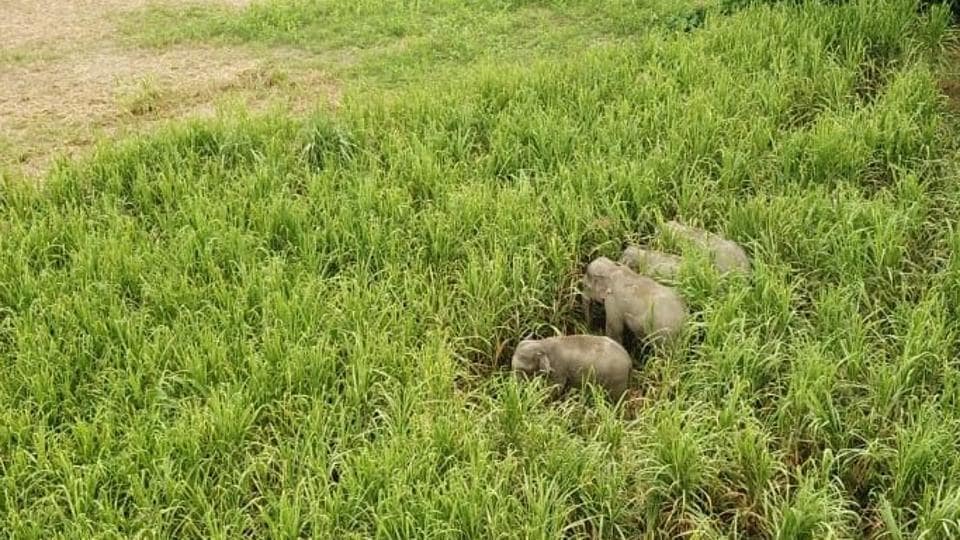
Parag Madhukar Dhakate, coordinator of the drone force and chief conservator of forests (CCF) western circle, Kumaon, said for the drone was used to redirect the elephant herd that had ventured into agricultural fields in Shantipuri village of Udham Singh Nagar district, about 250 km northeast of .Dehradun.
“When elephants raid sugarcane fields, it becomes difficult to track them as sugarcane is as high as the height of elephants. Also, the leaves of sugarcane are razor-sharp and forest staffers suffer cuts when they chase elephants. So we used a drone to track the movement of the elephant herd on Friday to reroute them towards the forest area”, he said.
The department has procured eight high-tech drones recently with a flying range of 7 to 20 km to be used for man-wildlife conflict mitigation, keeping tabs on encroachments in forests, poaching activities, movement of animals, counting of certain species, illegal mining, illicit felling of trees, monitoring of water holes and aerial patrolling in protected areas like Corbett and Rajaji National Park where the same becomes challenging during the monsoon period.
Uttarakhand is the first state in the country to have a have dedicated drone force - a fleet of 10 for surveillance and monitoring its wildlife, especially in the context of various threats to wildlife and the environment.
Also read: To de-stress elephants, Corbett administration to introduce activities, football
“Once the drone is airborne, they get a live feed and geo-location of the elephants. This helps us in finding the exact location, numbers and movement of the elephants which helps them in mapping and planning how and from which direction the ground staff, should coordinate to reroute the elephants towards the forest area,” Dhakate said
Dhakate said these eight drones each one of which cost up to Rs 2 lakh will be sent to each forest division of the state where they will be used for various purposes.
“We can fix the path of these drones which have range varying from 7 to 20 km and use them according to our requirements. We have also trained our ground staff to fly these drones from various forest divisions of the state,” he said.
Ritesh Joshi, scientist with conservation and survey division at the Union ministry of environment and forests who has studied elephants in Uttarakhand and authored a book ‘Secret life of Elephants, said it was a very good move given the good flying range of these drones.
“It will help the forest department to monitor, keep a tab on various activities in the protected areas of the state and fine tune its conservations and protection efforts”, he said.
Joshi said the man-elephant conflict was increasing in the state due to fragmentation of traditional elephant corridors, availability of easy food sources near the fringe of forests, near villages and increase in human population and jumbo population.
“Elephants have a very strong memory, once they find a food source whether vegetable leftovers or sugarcane fields, they will keep going there again and again and come into conflict with humans”, he said.