
 E-Paper



In limbo for a year, B’luru parking policy process reviewed
Several proposals have been made in connection with the policy, including increasing fees, greater monitoring and awareness to discourage residents to not depend on private vehicles, especially cars.


Despite being approved over a year ago, the work on implementation of parking policy in Bengaluru has not made any progress. The Urban Development Department (UDD) held a meeting to review the progress in this regard, on Friday.
“We have already identified the roads and the locations. Out of the eight zones, the programmes have already been approved in five zones by the Bruhat Bengaluru Mahanagara Palike (BBMP) special commissioners,” UDD additional chief secretary Rakesh Singh said.
“The remaining three (zones) will be done in another five days. We immediately want to call for tenders and make these places active before September 20. So by October 2, it should be totally operational,” Singh said.
Several proposals have been made in connection with the policy, including increasing fees, greater monitoring and awareness to discourage residents to not depend on private vehicles, especially cars.
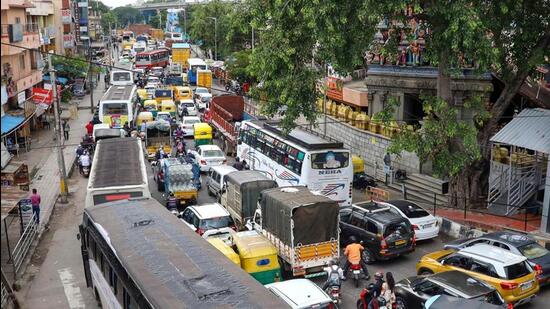
With over 10 million vehicles in Bengaluru for a population of around 12 million, India’s IT capital has battled with the challenges of growing dependence on private transport. The situation deteriorated further after Covid-19 pandemic and people avoiding public transport due to the fear of contracting the virus.
There have been several proposals to increase the price of parking as a means to discourage vehicle users but this has not proved to be an effective deterrent, an official said.
The broader objective, as per the policy, is to reduce demand for private vehicles by getting more people to adopt sustainable mobility and non-motorised options which requires higher focus on energies and resources on building infrastructure like better footpaths, safe cycling infrastructure and integrated public transport network among other measures. “Thereby, over time, the need to commute by private vehicles would reduce and land allocated for parking can be reclaimed and put for more productive use,” the policy envisions.
But the problem has largely been with implementation and lack of a holistic vision .
Government authorities like the BBMP and the Department of Urban Land Transport (DULT) are attempting to fix this problem from the last decade.
Rampant corruption has only added to the challenges.
For instance, the Brigade (Road) Shops and Establishments Association, a forum comprising all business owners in Bengaluru’s biggest commercial localities, had taken over the parking on the street between 2004-2019, however, the forum gave up the work alleging bribe demands by officials.
“We had brought in an automated system and were giving the BBMP huge revenue but they were greedy. They gave nothing, only troubled people who did something good for the public,” the association secretary Sohail Yusuf said.
“They even demanded money during the lockdown even though we were already paying them ₹2.25 lakh a month and no collection was being done on the street,” Sohail Yusuf said.
The parking policy is an extension of a series of similar measures to contain traffic in Bengaluru.
The Bengaluru city police have begun experiments to reduce congestion in key junctions and have also tasked a private agency to study the trends, changes and its impact for which data is being collected and the same will be used to implement longer-term solutions.
According to the government data, the number of vehicles in Bengaluru has increased from 50.33 lakh in 2011-12 to 1.04 crore till March 2022. Of the total vehicles registered in the city, more than 69.31 lakh are two-wheelers and 21.97 lakh are cars, according to a media report.
According to the city traffic police department, of the total vehicle density, two-wheelers account for 70% of all vehicles, 15% are cars, 4% are auto rickshaws and the remaining are buses, vans and tempos.


