
 E-Paper



Revised income tax slabs: How much do you save? Calculation of benefits
Revised income tax slabs: Nirmala Sitharaman announced that annual incomes up to ₹12 lakh will be tax-free to stimulate consumption.

 Prefer HTon Google


Revised Income tax slabs: Union finance minister Nirmala Sitharaman on Saturday announced that annual income up to ₹12 lakh will no longer attract any tax. The government cut personal income tax rates for some individuals in a bid to boost consumption across Asia's third-largest economy, which is projected to grow at its slowest pace in four years.
Currently, under the new regime introduced in 2020, annual income of up to ₹15 lakh attracts a tax rate of between 5% and 20%, while income of more than ₹15 lakh is taxed at 30%.
Follow Income tax slabs live updates
Following are revised slabs and rates under new tax regime announced in FY26 Budget:
- Income up to ₹4 lakh (per annum) ----- Nil
- Between ₹4 and 8 lakh ---------------- 5 per cent (tax)
- Between ₹8 and 12 lakh --------------- 10 per cent
- Between ₹12 and 16 lakh -------------- 15 per cent
- Between Rs16 and 20 lakh --------------- 20 per cent
- Between ₹20 and 24 lakh -------------- 25 per cent
- Above ₹24 lakh ------------------------- 30 per cent
* Under the new tax regime, a nil tax slab will apply to annual incomes up to ₹12 lakh ( ₹12.75 lakh for salaried taxpayers with a standard deduction of ₹75,000).
Also Read | Massive announcement by Nirmala Sitharaman, middle-class gets new income tax structure
How much are you going to save?
- Under the new tax regime, individuals with a total income up to ₹7 lakh do not have to pay any tax due to rebate.
- The finance ministry said the rebate for individuals under the new regime should be increased so that they do not pay tax if their total income is up to ₹12 lakh.
- Marginal relief, as provided earlier under the new tax regime, is also applicable to income marginally higher than ₹12 lakh.
Calculation of tax benefits is given below:
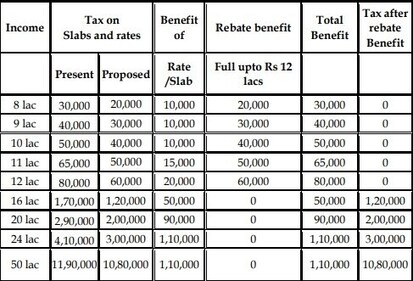
“The revamped tax slabs under the new tax regime as introduced by the Finance Bill 2025, aim to provide significant relief to taxpayers by extending the reduced personal income taxes up to ₹1.10 lakh. Under the new regime, individuals with an income of up to ₹12 lakh, excluding certain incomes such as capital gains subject to special tax rates, would be eligible for a full tax rebate under Section 87A, resulting in zero tax liability. This overhaul replaces the previous system and proposes to significantly reduce tax burden, under which an individual paying ₹80,000 in taxes would now effectively pay nothing against a total income of ₹12 lakh. Notably, the Finance Act 2023 had already established the new regime as the default framework,” said Sohrab Bararia, partner, Grant Thornton Bharat.
“For salaried individuals, the standard deduction was already increased to ₹75,000, effective July 2024. This enhancement, combined with the revised tax slabs, ensures that salaried individuals earning up to ₹12.75 lakh annually will have no tax liability. This would definitely help increase the disposable income and is expected to positively impact the consumption and savings patterns of Indian households,” he added.
Sitharaman laid out a blueprint for the next generation of reforms, including raising the FDI limit in the insurance sector, simplification of tax laws, and cutting duties on intermediaries while providing enhanced fiscal support for welfare measures.
This she did while sticking to the fiscal consolidation roadmap that projected the fiscal deficit to come down to 4.4 per cent of the GDP in the financial year 2025-26. For the current financial year, the fiscal deficit has been pegged at 4.8 per cent of GDP.
To bridge the fiscal deficit gap, the government is set to raise resources from the market to the tune of ₹11.54 lakh crore on a net basis for the next fiscal year.


