
 E-Paper



Increase in flash floods, hotter days for Tamil Nadu by 2080s: Report
According to the report, extreme rain is an overall increasing pattern thereby increasing the possibility of storm and flash floods in the 2080s while summer days where the temperature is more than 40°C is projected to increase drastically.


The projections made by Tamil Nadu government based on the Global Climate Models (GCMs) in connection with how the climate change will affect the state’s weather shows an increase in the flooded area ranging from 12.6% to 26.4%, according to a report.
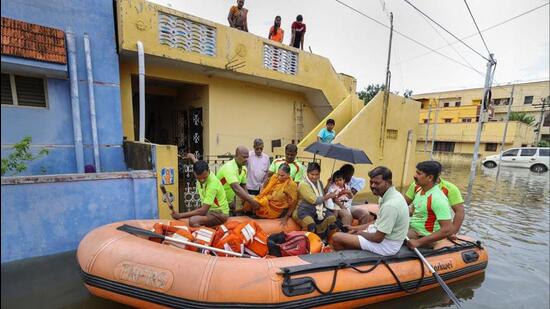
According to the report, extreme rain is an overall increasing pattern thereby increasing the possibility of storm and flash floods in the 2080s while summer days where the temperature is more than 40°C is projected to increase drastically.
“Tamil Nadu is also one of the extremes-prone states in India that faces more extremities of cyclones and drought recurrently,” read the state’s 39-page climate change mission document.
“With respect to extreme weather events future projections clearly indicate an increased probability of extreme temperature spells that would be expected to be very detrimental for public health,” read the report.
In November, the state set up a specific purpose vehicle (SPV) —Tamil Nadu Green Climate Company — first of such efforts to professionally manage the three aspects, including climate change mission, green mission and wetlands mission. The projects have been prepared under Tamil Nadu Climate Change Mission which has also identified Ariyalur as the most vulnerable district due to its high sensitivity and low adaptive capacity to climate risks followed by eight other districts such as Nagapattinam and Thanjavur.
“Though there is fairly enhanced community awareness, there is still a relative absence of robust regional climate models and vulnerability studies, making Tamil Nadu potentially highly sensitive and vulnerable to climate change and its impacts,” the report said.
In terms of temperature and rain, district wise studies in Chennai, Kancheepuram, Kolli hills, Cuddalore and Thanjavur have indicated a varying extent and pattern. The probability of one day rainfall is higher than five day rainfall which implies that the duration of extremes will be reduced but the intensity will be increased. It was further explored that internal climate variability of El Niño Southern Oscillation (ENSO) also contributes to the north east monsoon rainfall in the coastal districts of Tamil Nadu. These consequences will have a profound impact on agriculture, health, water resources, and coastal and economic sectors.
The study also shows that Tamil Nadu will be adversely affected by warmer conditions by the last quarter of the century, which will make the environment hostile for ecosystem and crop productions, and the change may increase the occurrences of heat waves and health hazards in the future.
In the state’s capital of Chennai, an impact analysis shows that the increase in temperature, erratic rain, sea-level rise, and other climate extremities will affect the key sectors such as water, infrastructure, health, biodiversity, energy, and transport. The climate change impact study on the occurrence of fluvial flooding in the Adyar sub-basin has predicted that for the 100-year return period, the peak discharge for the future climate scenario will increase by 34.3%–91.9% when compared to the present climate scenario. It is expected that there will be a 2.0°C increase in the Thermal Heat Index (THI) during winter and post-monsoon months in the mid-century scenario.
The state has sanctioned ₹3.80 crore for 38 districts ( ₹10 lakh for each district) for efforts towards managing the climate change.
“When you make a mission document it commits you to keeping an action plan. This is a first of its kind in India. While there are projections, analysis, there is no mission anywhere,” says Supriya Sahu, principal secretary, department of environment, climate change and forests, Tamil Nadu who prepared the document.
The goals of the mission include working towards reducing the greenhouse gases, developing methods for emission reduction by use of efficient public transport systems, and enhancing the tree and forest cover of the state from 23.7% to 33% in the next 10 years.
‘Focus on gender mainstreaming’
As various studies have indicated that climate change affects women more, the state aims at ‘gender mainstreaming’ in climate action for women and children as a “prime focus”. The mission’s idea is to follow a “one health approach” to bring the impact of climate change on the environment, animals and human health under one umbrella.
“This approach will help the state to develop an expertise in the sector by collaborating with experts from the fields of veterinary, medical and public health taking into account the dynamic nature of ecosystems in a changing climate,” the document said.
A climate studio at the Centre for Climate Change and Disaster Management, in Chennai premier varsity Anna University was formed in 2019 which has now been made fully operational with the state-of-the-art climate modelling tools.
The government has also issued orders for chief minister’s green fellowship programme launched in 38 districts of Tamil Nadu at a cost of ₹6 crore for two years and the fellow’s role is to inform policy makers on environmental issues at the district level.
To involve youngsters, 25 schools will be selected to implement several green measures like promoting energy efficiency through using solar equipment, adapting rain water harvesting, composting, creating vegetable garden, medicinal garden and planting of fruit trees, reducing water use, recycling of waste water, creating a plastic free environment etc.
The electricity requirements for the 25 schools will be met by solar powerto be implemented at a total cost of ₹5 crore.
A Blue Flag Certification Programme in 10 beaches across the state for five years will be implemented with the financial outlay of ₹100 crore.
“Though the policies are at a macro level, our action plans are rooted and doable. People don’t need to be alarmed with these numbers but they have to be conscious to adapt to the situation. We cannot think of it as business as usual,”Supriya Sahu said


