
 E-Paper





Rajeev Jayaswal is a senior journalist, author and communication strategist with over three decades of experience covering India's economy, energy, trade and public policy. He is Senior Editor at Hindustan Times and author of The Lobbyists, recognised for insightful reporting, in-depth analysis and policy-focused journalism.
India and EFTA set to ink key trade pact
India and the European Free Trade Association (EFTA) group of nations- Iceland, Liechtenstein, Norway and Switzerland – are set to sign FTA.
Updated on: Mar 9, 2024, 01:19:30 IST

Share via
Copy link
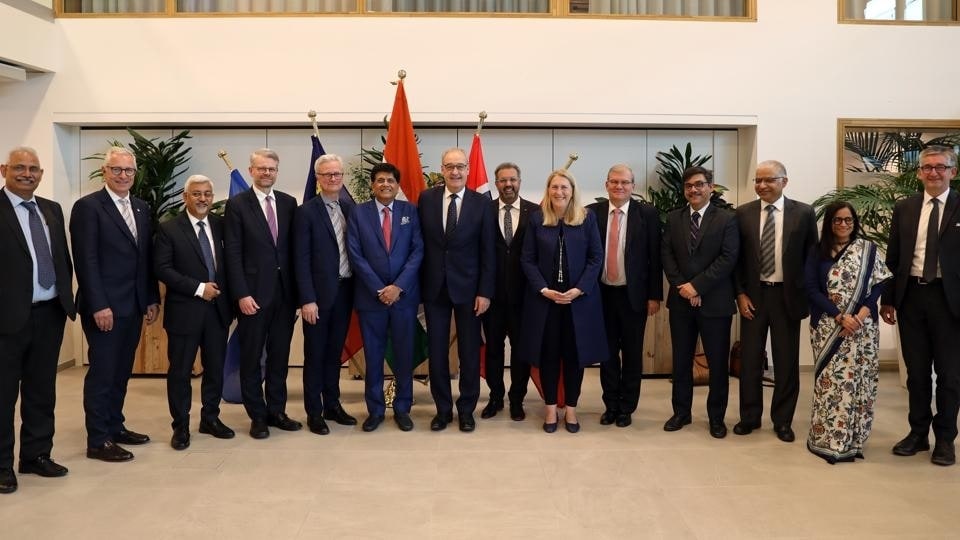
India and the European Free Trade Association (EFTA) group of nations -- Iceland, Liechtenstein, Norway and Switzerland – are set to sign a free trade agreement (FTA) on Sunday, which will be the third major trade deal of the Narendra Modi government since early 2022, when New Delhi signed separate bilateral agreements with the United Arab Emirates (UAE) and Australia.
Read here: EFTA hopeful of finalising India trade deal in ‘days or weeks’: Norway minister
A formal signing ceremony is expected on Sunday morning in New Delhi, which will be attended by senior officials of India and four EFTA countries, people aware of the development said requesting anonymity. Talks on the India-EFTA deal began in January 2008 but remained dormant since 2013 until they were revived last year.
“It is a win-win deal for both parties as they have taken care of sensitivities of each other. It is also very significant in the sense that it will be the first FTA with any European entities,” one of the people with direct knowledge of the matter said. The UK and the EU are also engaged with New Delhi to forge bilateral deals, but it is unlikely before the general elections in India, he said. The Election Commission may announce polling dates next week.
“The Trade and Economic Partnership Agreement (TEPA) between India and EFTA covers wide-ranging matters such as trade in goods and services, rules of origin, intellectual property rights (IPR), investment promotion, trade facilitation and sustainable development,” a second person said. TEPA is expected to help India bridge a huge gap in the balance of trade, which is in favour of the European nations, particularly Switzerland, he added. In 2023, India’s trade deficit with the EFTA states was more than $18.57 billion mainly on account of gold imports.

According to government data, India’s exports to the EFTA region during January-December 2023 was $1.87 billion, while its imports from the bloc of countries that aren’t members of the EU was in access of $20.45 billion, with Switzerland’s share alone pegged at $19.65 billion due to gold purchases.
In the case of gold imports, India may allow a quota-based concessional duty regime for EFTA states on the lines of an existing arrangement with the UAE.
Read here: India, EFTA wait to unveil free trade agreement
India’s key imports from the four countries are gold ($20.7 billion in 2021-22), silver, coal, pharmaceuticals, vegetable oil, dairy machinery, medical items, crude and scientific equipment. It exports chemicals, iron and steel, gold, precious stones, yarns, sports goods, glassware and bulk drugs to these nations.
ABOUT THE AUTHOR
Rezaul Hasan Laskar is Foreign Editor with the Hindustan Times, which he joined in 2015. He began as a journalist in his hometown of Shillong in northeast India and has worked in newspapers and wire services over the years. He moved to New Delhi in 1997 and initially focused on defence, national security, Jammu and Kashmir and the northeast, while also working of foreign policy and international relations. He has been part of the media delegation accompanying PMs on foreign visits and has reported from destinations ranging from Tibet to Ukraine. Between 2007 and 2013, he was the Press Trust of India correspondent in Pakistan, one of only two Indian journalists allowed to report from the country. He extensively covered Pakistan’s domestic politics and the life of the common people, as well as the fallout of the 2008 Mumbai attacks on India-Pakistan relations and the subsequent trial in Pakistan of the suspects involved in the attack. As part of his reportage in Pakistan, he travelled the breadth of the country, from the Swat Valley to Balochistan. Reza’s first gig in journalism was writing a weekly music column, and music – especially classic rock – remains a keen interest. He is also a movie buff and a keen photographer.


