
 E-Paper



India, Australia sign 3 pacts to deepen defence ties
India and Australia signed three military agreements to enhance defense ties, focusing on cooperation in maritime security and joint operations.

 Prefer HTon Google


NEW DELHI: India and Australia on Thursday signed three key agreements to deepen their military ties including a pact on information sharing, a memorandum of understanding on submarine search and rescue cooperation and terms of reference on the establishment of joint staff talks between the two armed forces, the defence ministry said.
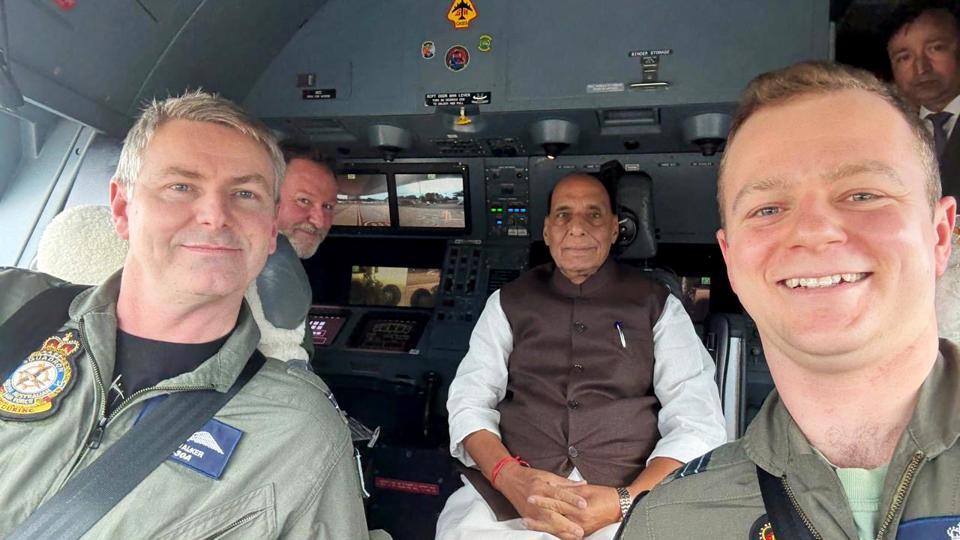
The agreements were signed in Canberra after defence minister Rajnath Singh held talks with Australian deputy prime minister Richard Marles (who also holds the defence portfolio), with the two leaders reaffirming their shared commitment to deepening defence cooperation in areas including military exercises, maritime security, defence industry collaboration and joint research in science and technology.
The meeting marked five years of the India-Australia comprehensive strategic partnership.
Singh reiterated India’s stand on the threat of terrorism in the context of Pakistan, stressing that “terror and talks cannot go together, terror and trade cannot go together and water and blood cannot flow together.” Australian PM Anthony Albanese briefly joined the meeting to welcome Singh who is on a two-day visit to that country for the inaugural Australia–India Defence Ministers’ Dialogue.
“The dialogue reflected unprecedented progress in the bilateral defence partnership and ministers’ ambition to enhance cooperation, following the four bilateral meetings between the ministers since the elevation of the Australia–India comprehensive strategic partnership in 2020,” the two sides said in a joint statement.
Singh and Marles advanced their Prime Ministers’ long-term vision for collaboration between the two countries to enhance collective strength, contribute to both countries’ security, and make an important contribution to regional peace and security, the statement said. “They discussed a joint maritime security collaboration road map to advance maritime cooperation, and looked forward to Prime Ministers renewing and strengthening the joint declaration on defence and security cooperation.”
The two ministers welcomed the ongoing progress in defence cooperation among Australia, India, Japan and the United States, underscoring the growing strategic convergence among the partners. “They reaffirmed their commitment to enhancing collaboration on maritime domain awareness and looked forward to a second collaborative activity on the margins of Exercise Malabar in November 2025. Australia and India expressed strong support for initiatives that advance closer maritime surveillance cooperation among the four partners (Quad),” the joint statement added.
The two leaders also affirmed the importance of enhancing cooperation with regional partners to help maintain “a free, open, peaceful, stable and prosperous Indo-Pacific.” “Ministers underscored their strong support for freedom of navigation and overflight, unimpeded trade in the region, and other lawful uses of the sea consistent with international law, particularly the 1982 United Nations Convention on the Law of the Sea.”
The developments in the Indo-Pacific, where China seeks to boost its presence, were in sharp focus in March- too when chief of defence staff General Anil Chauhan visited Australia.
Both India and Australia, along with the other Quad nations the US and Japan, stand for a rule-based international order for peace, prosperity and stability in the Indo-Pacific. China is seeking to boost its influence in the region by setting up military bases, pushing countries to advance its maritime claims and forcing strategic concessions from vulnerable states.


