E-Paper



India, Austria FMs back peaceful resolution of Ukraine conflict
The agreement on ‘Comprehensive Migration and Mobility’ was the most consequential of five agreements inked by the two sides, and Schallenberg said it is of “strategic importance for Austria” because the country had to cope with more than 100,000 asylum seekers in 2022, the highest number ever.

 Prefer HTon Google


External affairs minister S Jaishankar and his Austrian counterpart Alexander Schallenberg on Monday strongly backed a peaceful resolution of the Ukraine conflict, as India and Austria signed five agreements, including a key pact aimed at facilitating the movement of professionals and halting illegal migration.
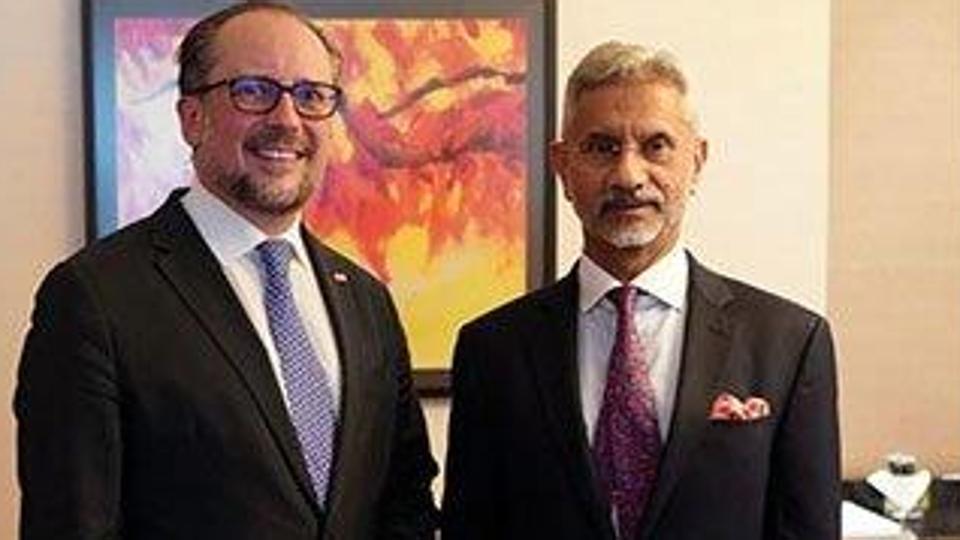
Addressing a joint news conference with Schallenberg in Vienna, Jaishankar said India remains “deeply concerned” by the Ukraine crisis as this is “not the era of war”. He emphasised the conflict’s fallout on developing countries in terms of increased prices of food, fuel and fertilisers, and said India, as G20 president, has the responsibility for raising this issue on behalf of the Global South.
Also Read: ‘Increasingly anxious about…’: Jaishankar on effects of Russia-Ukraine war
Austria, Schallenberg said, perceives India as a “voice of peace and reason” in the context of the Ukraine conflict, which cannot be ended on the battlefield. He, however, said though hostilities were raging less than 500 km from Vienna, it was not a European war because its repercussions are being felt by millions around the world affected by “soaring food and energy prices”.
Schallenberg emphasised Austria needs allies and friends such as India as the world grapples with the impacts of the Covid-19 pandemic and the “brutal war in Europe”. He said, “India carries a very strong weight when it comes to multilateralism, democracy, defending a rules-based international system.”
He said, “In this respect, we count on India as a voice of peace and reason, and I may say that India always had a tradition of balancing world powers...The Indian voice is an important one because we do share another view – peace can only be done at the negotiating table, never at the battlefield.”
Jaishankar added, “We sincerely believe that this is not the era of war. Differences must be settled on the negotiating table. It is imperative that there is a return to dialogue and diplomacy. Prolonged conflict will not serve the interests of any party.”
In this context, Jaishankar noted Prime Minister Narendra Modi spoke to Russian President Vladimir Putin and Ukrainian President Volodymyr Zelenskyy to “press India’s point of view”. India is also “increasingly anxious” about the conflict’s impact on the accessibility and affordability of fuel, food and fertilisers.
Responding to a question about India mediating between Russia and Ukraine, Jaishankar reiterated India’s stance about a return to dialogue and diplomacy. He said priorities were changed with time, with the focus shifting from evacuating more than 20,000 Indian students from the conflict zone to strongly pressing for negotiations.
While the United Nations secretary-general and Turkey-led negotiations that resulted in the Black Sea Grain Initiative, India did its bit to “support and address specific concerns”, he said without giving details. In the case of the safety of the Zaporizhzhia nuclear power plant, India did whatever was possible to “create more stability”, Jaishankar said.
India has so far refrained from publicly criticising Russia’s invasion of Ukraine, though it pressed for the territorial integrity of all states to be respected while backing a negotiated resolution.
Also Read: Jaishankar remembers Sushma Swaraj for bolstering ties with Indians abroad
The agreement on ‘Comprehensive Migration and Mobility’ was the most consequential of five agreements inked by the two sides, and Schallenberg said it is of “strategic importance for Austria” because the country had to cope with more than 100,000 asylum seekers in 2022, the highest number ever.
Most illegal migrants came to Austria via Serbia and there were “exploding numbers of Indians coming illegally”, he said. The number of asylum applications from Indians jumped from 600 in 2021 to 18,000 in 2022. The numbers decreased after Austria pressured Serbia to align its visa liberalisation policy with European Union policy, he said.
Schallenberg hastened to add that Austria welcomes foreign students and skilled workers, including from India. “The problem is not immigration...We want that, we need that. The problem is ‘illegal’ immigration,” he said, adding both countries want immigration not to be controlled by human traffickers.
Tens of thousands of Indians living in Austria are an “enriching part” of society, and the agreement is exemplary because India will take back people who come illegally while Austria will make migration and mobility easier for students and skilled workers, Schallenberg added.
Jaishankar made it clear India is a strong votary of legal migration as illegal movement enhances the vulnerability of people involved. “We want a fair, legal and equal opportunity to demonstrate the contributions of Indian skills and talents,” he said, adding the pact will enable “demands for skills and talents to be synchronised with availability”.
India recently concluded similar pacts with Denmark, France, Germany, Portugal and the UK.
The four other agreements signed by India and Austria are a joint declaration on a working holiday programme, an agreement on visa exemption for holders of diplomatic passports, a memorandum of understanding for cooperation in culture and arts during 2022-26 and an arrangement allowing family members of diplomatic missions to take up gainful occupation.