
 E-Paper



India, Bangladesh sign seven agreements, revive railway link
The seven agreements signed during the virtual summit include cooperation in the hydrocarbons sector, agriculture and textiles, high impact community development projects to be carried out by India, and trans-border elephant conservation


India and Bangladesh signed seven agreements in areas ranging from hydrocarbons to agriculture and revived a cross-border railway line that was snapped 55 years ago at a virtual summit on Thursday, giving a boost to connectivity initiatives and energy cooperation.
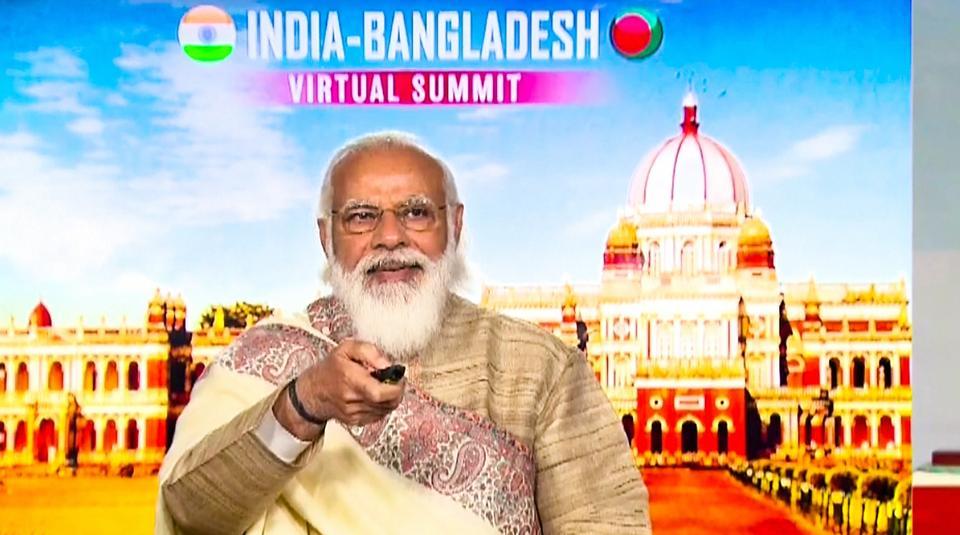
Prime Minister Narendra Modi, in his opening remarks at the summit with his counterpart Sheikh Hasina, described Bangladesh as an important pillar of India’s “neighbourhood first” policy.
Both countries, Hasina said, could move up global and regional value chains by further integrating their economies, and connectivity initiatives such as the revival of the Chilahati-Haldibari rail link will be catalysts for this process.
Hasina used the summit to raise the sharing of Teesta waters and repatriation of Rohingya refugees to Myanmar – two issues on which Dhaka has repeatedly sought greater cooperation from New Delhi.
She highlighted the need for early signing of an interim agreement for sharing Teesta waters finalised in 2011, and Modi reiterated “India’s sincere commitment and continued efforts” in this regard, according to a joint statement.
The agreement on the Teesta, held up by opposition from West Bengal chief minister Mamata Banerjee, has become an irritant in bilateral ties.
Pointing to India’s election as a non-permanent member of the UN Security Council for 2021-22, Hasina “expressed Bangladesh’s expectation to see India assist in the repatriation of the forcibly displaced Rohingyas back to Myanmar”, the joint statement said. Modi appreciated Bangladesh’s generosity in sheltering 1.1 million forcibly displaced persons from Myanmar’s Rakhine state and both leaders reiterated the importance of their “safe, speedy and sustainable” return.
The seven agreements signed on Thursday cover cooperation in the hydrocarbons sector, agriculture and textiles, high impact community development projects to be carried out by India, trans-border elephant conservation, supply of equipment for improving garbage disposal in Bangladesh’s Barishal city, and creation of a CEOs Forum.
The agreement on hydrocarbons will help streamline investments, technology transfers and joint studies and promote hydrocarbon connectivity. The two countries agreed to strengthen sub-regional energy cooperation, especially with Nepal and Bhutan, and speed up work on the 130-km India-Bangladesh Friendship Pipeline.
Both leaders directed officials to speedily conclude a joint study on a bilateral comprehensive economic partnership agreement.
Modi began his remarks by greeting Hasina in Bengali on the occasion of Bijoy Dibosh or Victory Day, which marks the surrender of Pakistani forces in Dhaka on December 16, 1971.
Hasina, who spoke in Bengali, responded by saying December 17 was a special day for her and her family as it was on that day in 1971 when Major Ashok Tara of the Indian Army freed herself, her mother, sister and brother from Pakistani forces.
“Bangladesh was freed on December 16, but we were freed on December 17,” she said, paying tribute to three million Bangladeshi martyrs of the war of independence and Indian military personnel killed in action and their families.
Tara, then aged 29, had won the Vir Chakra in the battle of Gangasagar when he was assigned the responsibility of freeing the wife and family of Sheikh Mujibur Rahman, the founder of Bangladesh. Tara completed the task with only three more Indian soldiers despite having to take on a numerically superior Pakistani contingent.
Modi said strengthening ties with Bangladesh has been of special importance to him since his first day in office, and expressed satisfaction at bilateral cooperation amid the Covid-19 pandemic, including the supply of medicines and equipment. Modi assured Hasina vaccines will be made available to Bangladesh as and when produced in India, and also offered a partnership in vaccine production.
Hasina referred to several new initiatives, such as trade through rail routes and the first trial run of Indian cargo from Kolkata to northeast India by ship, and said, “We happily recognise the growing dependency of the economies of Bangladesh and India.
“A good number of Indian nationals are employed in the manufacturing and service sectors of Bangladesh, and are remittance earners for India. On the other hand, India receives the highest number of tourists and medical patients from Bangladesh.”
The two leaders virtually inaugurated the revived rail link, which was snapped during the 1965 war with Pakistan and will connect Assam to Bangladesh via West Bengal, launched a stamp on Bangabandhu Mujibur Rahman, and inaugurated a digital exhibition of Rahman and Mahatma Gandhi focusing on their contributions to the independence movements of the two countries.
The joint statement said the filming of a biopic on Rahman, being directed by Shyam Benegal, will begin in January.
The two sides also discussed key issues such as terrorism and border management, including Bangladesh’s concerns about the death of its nationals in incidents along the frontier.
“Recognising that terrorism remains a threat to global peace and security, both sides reiterated their strong commitment to eliminating terrorism in all its forms and manifestations,” the joint statement said.
Modi and Hasina agreed to complete border fencing in all pending sectors of the border at the earliest, beginning from the Tripura sector. “Both leaders also agreed that loss of civilian lives at the border is a matter of concern and directed the border forces concerned to enhance coordinated measures to work towards bringing such border incidents to zero,” it added.
The Bangladesh side sought the early implementation of India’s commitment to remove remaining restrictions on use of land ports by Bangladeshi travellers in a phased manner, beginning with checkpoints in Tripura and West Bengal.


