
 E-Paper



India, Brazil vow to double trade to $20bn in 5 years
During their meeting, both leaders reaffirmed their commitment to a “zero tolerance” approach in the fight against terror and opposed both terrorism and those who support the menace.

 Prefer HTon Google


New Delhi India and Brazil on Tuesday set a target of almost doubling their bilateral trade to $20 billion over the next five years as Prime Minister Narendra Modi and President Luiz Inácio Lula da Silva held talks on expanding collaboration in areas ranging from defence to trade and technology.
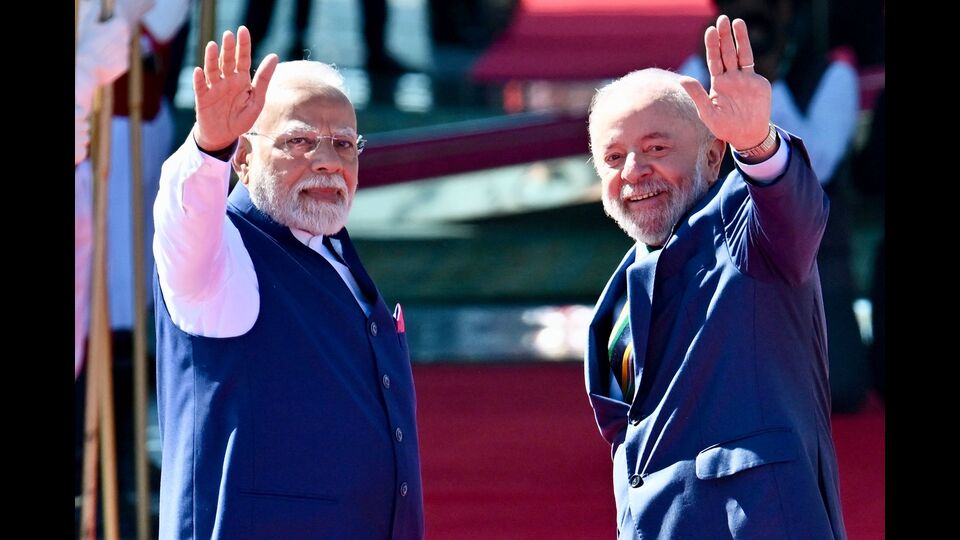
During their meeting, both leaders reaffirmed their commitment to a “zero tolerance” approach in the fight against terror and opposed both terrorism and those who support the menace. Modi travelled to the capital Brasilia for the bilateral meeting with Lula after attending the Brics Summit in Rio de Janeiro.
The two sides signed six agreements, including a pact on combating international terrorism and transnational organised crime and another on the exchange and mutual protection of classified information. They also signed memorandums of understanding (MoUs) on cooperation in renewable energy, sharing large-scale solutions for digital transformation, intellectual property, and agricultural research.
“In today’s discussions, we talked about strengthening cooperation in every field. We have set a target to take bilateral trade to $20 billion in the coming five years,” Modi said at a joint media interaction with Lula.
“Football is the passion of Brazil, cricket is the passion of the people of India. Whether the ball crosses the boundary or scores a goal, when both are in the same team, a partnership of $20 billion is not difficult. We will also work together to expand the India-Mercosur preferential trade agreement,” he said, speaking in Hindi.
Brazil is currently India’s largest trade partner in South America.Two-way trade was worth $12.2 billion in 2024-25, with Indian exports amounting to $6.77 billion. Major Indian exports included diesel, insecticides, chemicals, pharmaceuticals and engineering products. Brazilian exports included crude oil, soya oil, gold, raw sugar, cotton, wood, and iron ore.
Modi also pointed to growing cooperation in energy and said the environment and clean energy are key priorities of both countries. “The growing cooperation in the field of defence is a symbol of our deep mutual trust. We will continue our efforts to connect our defence industries,” he said.
Cooperation in artificial intelligence and supercomputers is growing and both sides are working on the adoption of India’s Unified Payment Interface (UPI) digital payments system in Brazil. “We will be happy to share India’s successful experience in areas like digital public infrastructure and space with Brazil,” Modi said.
In the context of counter-terrorism, Modi said both countries have similar thinking on the fight against the menace based on “zero tolerance and zero double standards”. He added, “We are clear that there is no place for double standards on terrorism. We strongly oppose terrorism and those who support terrorism.”
Shortly after India launched Operation Sindoor on May 7 in retaliation for the Pahalgam terror attack, Lula had extended support in the fight against terrorism during a phone call with Modi on May 8.
India and Brazil, Modi said, have always worked in close coordination at the global level. “As two large democratic countries, our cooperation is relevant not only for the Global South, but for the entire humanity. We believe that it is our moral obligation to raise the concerns and priorities of the Global South at global forums,” he said.
At a time when the world is grappling with tension and uncertainty, the India-Brazil partnership is an “important pillar of stability and balance” Modi said. “We are unanimous that all disputes should be resolved through dialogue and diplomacy,” he added.
Lula conferred the Grand Collar of the National Order of the Southern Cross, one of Brazil’s highest civilian honours, on Modi.



