
 E-Paper



India bridge in polarised world: S Jaishankar at UN
External affairs minister S Jaishankar met over 100 of his counterparts, from every continent, and engaged with both big powers and the countries of the global south, in five days on the sidelines of the UNGA.


At the end of the New York leg of his 11-day visit to the United States, hours after addressing the United Nations General Assembly, external affairs minister S Jaishankar said the world had become more polarised but India mattered more in this polarised landscape.
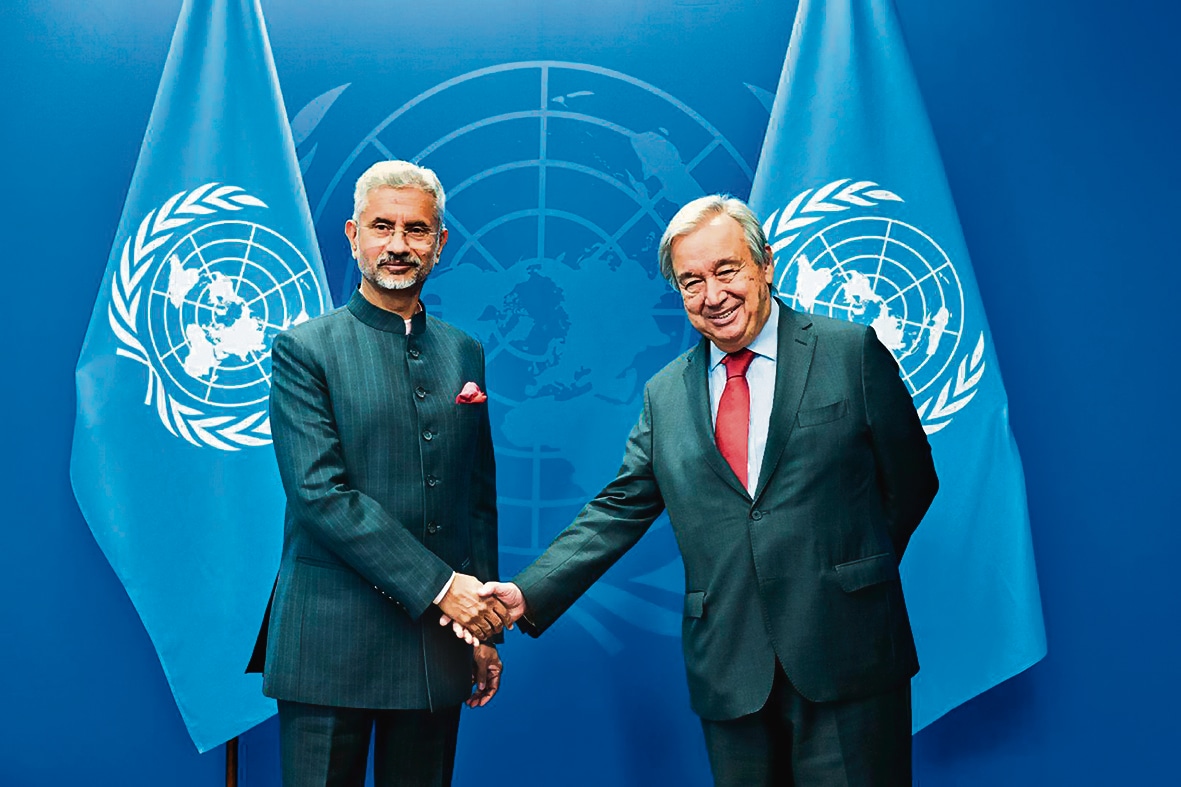
“There is no question that UNGA reflects the state of the world which is particularly polarised at this moment. What the state of the world actually reveals is that India matters more. We are a bridge, a voice, a viewpoint and a channel, at a time when normal diplomacy isn’t working that well,” the minister said.
Also Read| Voice of global south, emphasis on SC reform in Jaishankar’s New York outing
Jaishankar met over 100 of his counterparts, from every continent, and engaged with both big powers and the countries of the global south, in five days on the sidelines of the UNGA.
To substantiate his point, the minister added that for a country such as India, which had “so many relationships, such an ability to communicate, to find touch points with different countries”, he had concluded after his meetings that India mattered more in this polarised world.
For this, he gave credit to Prime Minister Narendra Modi’s leadership, his image and what he had done on the global stage. “Different people spoke to me about his role in COP26, in what he had done recently in some of the regional gatherings. That has contributed. The landscape and leadership has created a sense of India mattering more.”
The reference to regional gatherings hinted at Samarkand. French President Emmanuel Macron quoted Modi’s comment to Vladimir Putin on this not being the era of wars. The US has welcomed it publicly. And three European foreign ministers — of Austria, Finland, Estonia — told HT, in their conversations with Jaishankar, they had appreciated the comment.
The polarisation stems from the Russia-Ukraine war and India engaged with both sides in New York.
On his meeting with Russian foreign minister Sergey Lavrov, shortly before both addressed UNGA on Saturday, Jaishankar said that this was his fourth meeting with the Russian foreign minister just this year.
Also Read| ‘On Ukraine, India on the side of peace’: Jaishankar at UN
They talked about Ukraine in some detail. “He briefed me on various developments from the Russian perspective. I shared with him what I have picked up from some of the others,” said Jaishankar. And the two discussed the upcoming G20. “Russia is at the centre of the debate as far as G20 is concerned.”
For his part, Ukrainian PM Denys Shmyhal’s big concern in the conversation with Jaishankar was the conflict. “He gave me his perception, his assessment of what was happening in Ukraine. In terms of India, I think we had a discussion on what was our position. My sense is he clearly appreciated the fact that we were against the continuation of the conflict and for return to diplomacy and dialogue. He had his own views on why this was not happening. The humanitarian assistance situation came up.”
The two also discussed some specific aspects of the ground situation, including what had been the progress on grains, concern over fertilisers and a nuclear power plant issue. “All this was part of his overall description.” This was the highest level of in-person engagement between India and Ukraine since the war began.
India’s own position on the war remains that it is on the side of peace.
When HT asked Jaishankar whether India had thoughts on the empirical pathways to achieve this normative goal and if it came up during his discussions, the minister said: “We shouldn’t take normative goals as a given. If you don’t have goals, how do you get the empirical pathway? This conflict isn’t in the interests of any party. The PM’s position has been remarkably consistent. What we have said publicly is what we have said conversationally. In terms of the more specific issues, with different countries, with different personalities, there were discussions on specific issues which contribute to the overall normative goal.”
Jaishankar said that different actors had different ways of defining what peace meant and different priorities. “Various issues came up in that respect. This was not an airy fairy conceptual discussion. With different countries, specific issues came up.”
The minister also said that the global south increasingly saw India as their voice, India’s data-driven development trajectory had become a subject of keen interest in the debates around sustainable development goals, and India’s delivery in times of need had added to its credibility.
Jaishankar said that there was greater momentum on UN reform. “This time, something has shifted.... it had relevance to reform of UN; it showed India mattered more; and it underlined global south relevance.”


